Act 10 Reading Group
Start: Thursday, July 31, 2025•07:00 PM
End: Thursday, July 31, 2025•08:45 PM
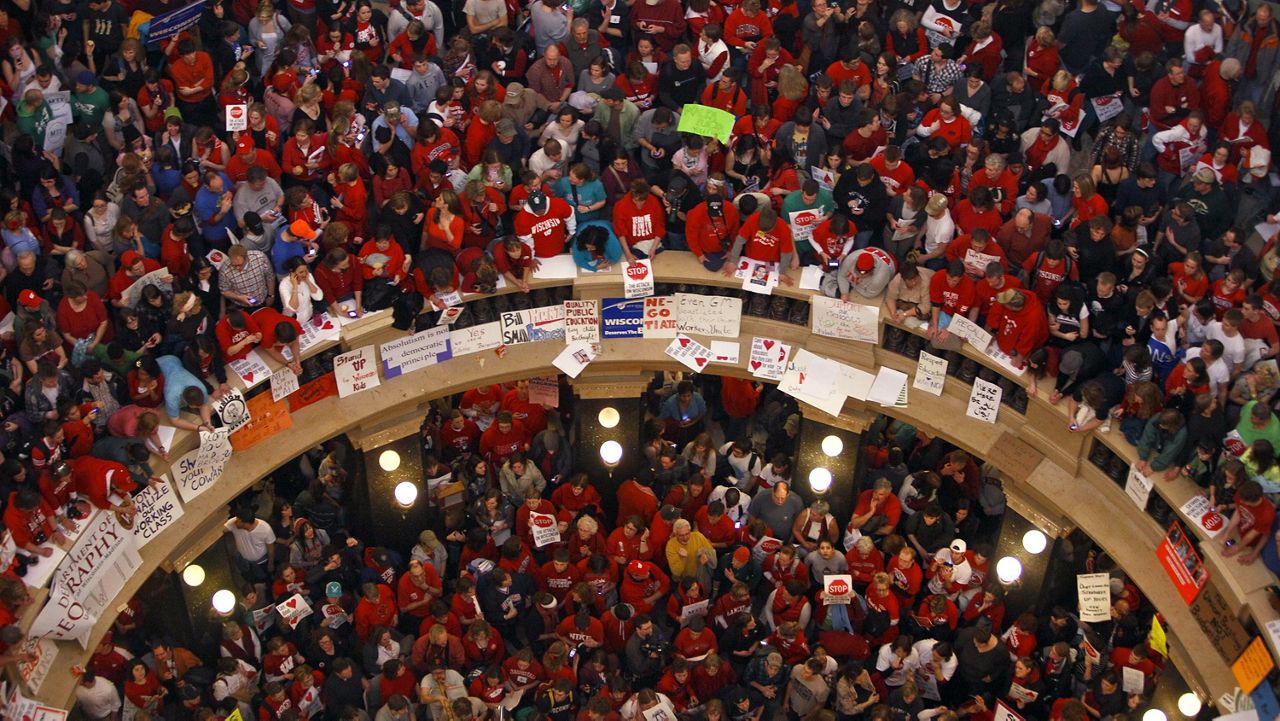
The Madison Area DSA Labor Working Group invites all DSA members to our reading group about the politics and strategies behind the Act 10 Uprising.
--Recommended Reading includes this digital article and linked pdf --
https://mronline.org/2021/03/31/commemorating-the-wisconsin-uprising/
Chapter 2: Capitalist Crisis and the Wisconsin Uprising
Come to learn and discuss key theories and decisions that were made collectively by different factions of the protest coalition
*We will be collecting donations for striking UAW Local 95 healthcare workers in Janesville at this event. They are now more than three weeks into their strike and fighting tooth and nail for the contract they deserve, but they are running low on supplies to sustain themselves and their families while they strike! Please consider bringing donations of non- perishable food, baby items, and other essentials. Items will be delivered to the picket line early next week.
___
Selection of passages with analysis questions:
First two paragraphs from Frank's piece from Monthly Review 3/31/2021.
The struggle of 2011 looked a lot like those of 1981: a great demonstration, obvious widespread public support for the workers, but absent a strategy beyond political mobilization and a refusal by union leadership to creatively mobilize at the work site. One cannot say that victory would have been achieved had there been workplace actions – but it was perfectly clear that without the workplace mobilization, the Republicans had no desire to change their minds.
In the most basic sense, public sector workers found themselves back in the 1960ies- some had collective bargaining rights, but with a very narrow scope, all the locals were under extreme financial pressure, and none had the ability to initiate direct action in the workplace.
Selection from Andrew S's article, "Capitalist Crisis and the Wisconsin Uprising:"
-So why was the movement defeated? I think this is more than anything an issue of historic capacity. After decades of neoliberal attacks and business union demobilization, there was a serious lack of working class organization, historic memory and collective experience. Most people who showed up in February and March had never been to a protest in their lives, and fewer had been part of a strike. If there had been another strike of any kind, it would have been miraculous, but I think a general strike was solely a point of agitation[vi]. In the immediate moment, there were not standing networks of rank and file unionists who could agitate to make it more likely that their unions did what was needed and help navigate a militant course for the movement. Nor were there channels for community members and unorganized workers to meet and develop their own plans.
-There has been a basic consensus across the spectrum of ruling parties that the road ahead is going to be austerity for the vast majority of people in order to manage the continuing crisis of capitalism. The experience of the last three years suggests that there is no win-win solution for workers and capital as capital rolls back decades of rights and protections to open new avenues for profit.
-Wisconsin then is one part of a global struggle. In the past two years we have seen major mobilizations in Greece, France, the United Kingdom, Tunisia, Egypt, Algeria, Yemen, Wisconsin and into Spain, with more sure to follow. Despite setbacks and defeats, each struggle informs the next in kind, and statements of solidarity are sent from place to place in an understanding of common struggle. If we learn something from these places, its that a radically democratic, “from below” orientation is not just a good idea or something that we would like to see, but critically necessary for the success in the battles to come. There is no simple move or strategy to take us out of this situation, but clearly we will have to prepare ourselves for patient, committed organizing and movement building.
Prompting Questions:
What went right and what went wrong during the Act 10 protests?
What do you think has changed about the conditions and strategies of the labor movement since 2011?
What do the Act 10 protests and their legacy teach us about how power is built and sustained?
Sernatinger’s conclusion asserts that the lessons from other major worker-led movements is that “a radically democratic, ‘from below’ orientation is…critically necessary for the success in the battles to come.” What does this look like in practice?
In what ways was this “from below” orientation present and/or disregarded during the Wisconsin Uprising?
Emspak concludes his article with a call for Wisconsin working people "to figure out ways to show the employer how valuable we are." What tactics can workers use to “act like a union” even without collecting bargaining rights or union affiliation? How do the events of the Wisconsin Uprising inform those tactics?
Sponsored by
