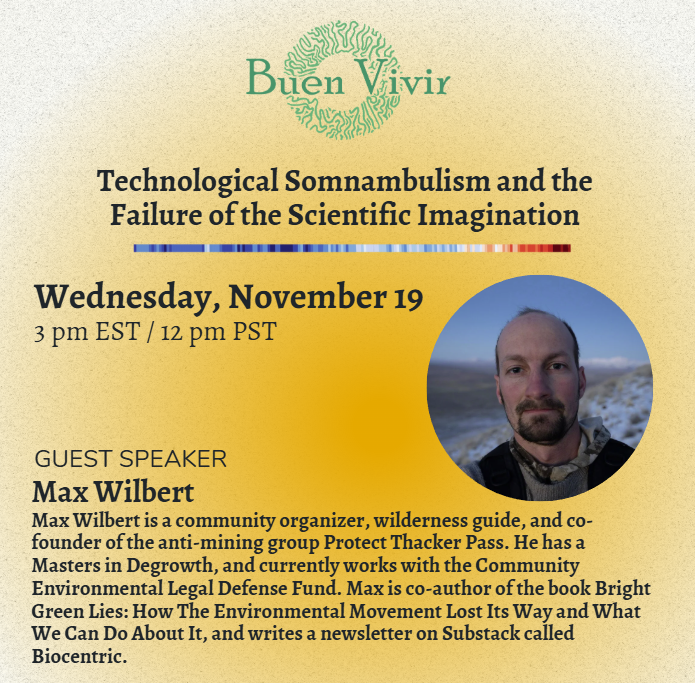
Technological Somnambulism and the Failure of the Scientific Imagination - Max Wilbert - Buen Vivir Nov 2025
Start: 2025-11-19 12:00:00 UTC Pacific Standard Time (US & Canada) (GMT-08:00)
End: 2025-11-19 13:00:00 UTC Pacific Standard Time (US & Canada) (GMT-08:00)
Event Type:
Virtual
A virtual link will be communicated before the event.
The Buen Vivir campaign includes a monthly series of talks on global social and climate justice. “Buen Vivir” is the most common translation for the indigenous Quechua concept of Sumak Kawsay, life lived in harmony with nature and community. While it is sometimes translated into English as A Good Life, Buen Vivir relates to a deeper understanding of how humankind, and the impacts of our lives, affect the planet and each other.
The monthly talk series will feature expert speakers in facilitated discussion addressing Buen Vivir issues affecting the world’s working populations. Speakers will alternate from global south and global north regions bringing together the voices of the most affected and those who benefit, connecting the dots of our impact. By illuminating and linking the effects of continuing unjust extractivism on the lives, livelihoods and resource-rich physical lands of global south peoples, and discussing the many opportunities to address the impacts, we hope to position the social justice issue clearly at the center of the climate justice conversation in Turtle Island and beyond.
