RSVP today! Standing Trees Annual Gathering, Saturday Sept 26, 2026
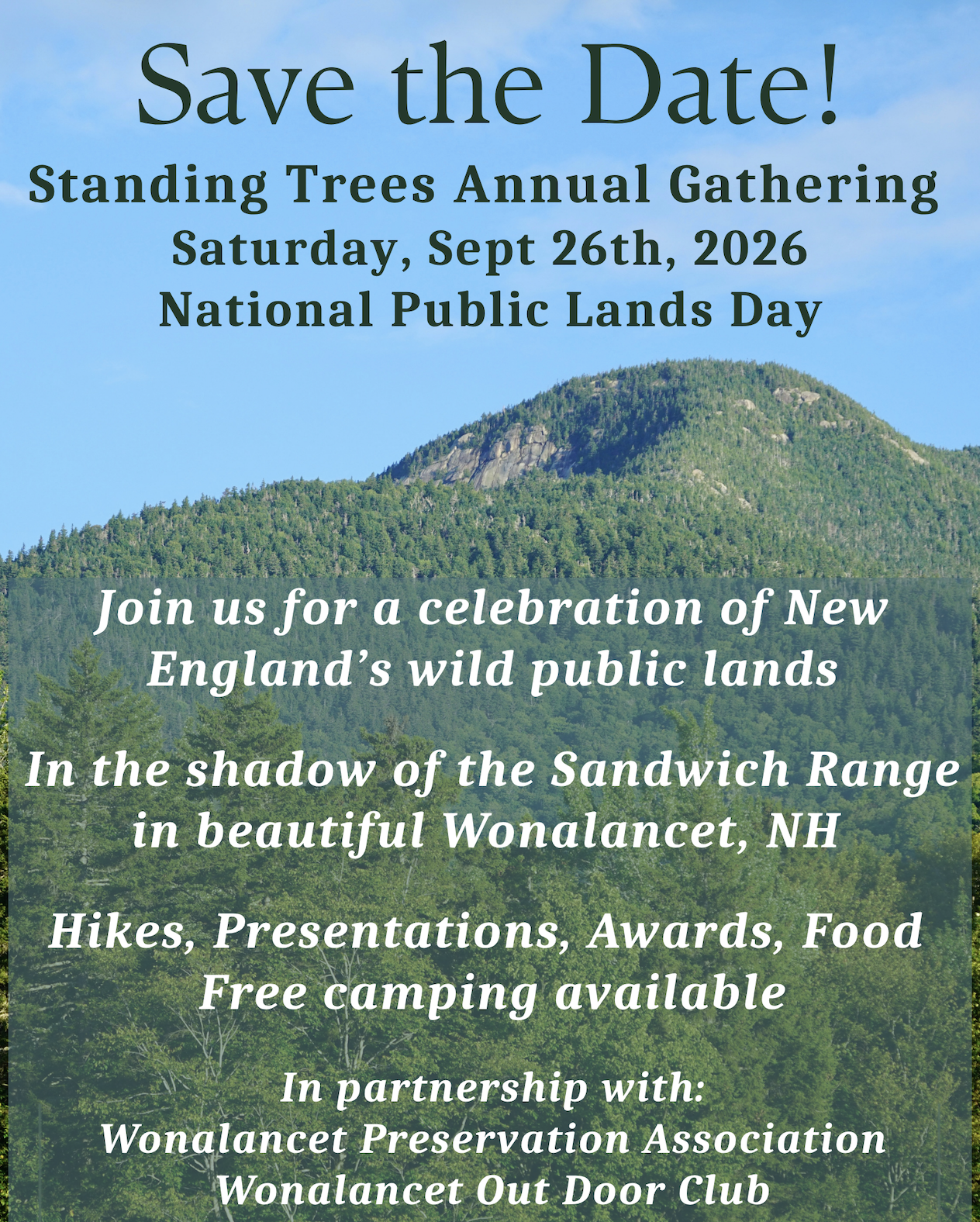
Save the Date!
Standing Trees Annual Gathering
Saturday, September 26th, 2026
National Public Lands Day
***Please note: This event is free of charge, and you can attend for as much or as little as your schedule allows, but an RSVP is required to help us with planning.***
Each fall, the Standing Trees community gathers to celebrate our volunteers, supporters, partners, and the hard work that goes into keeping our public lands wild!
On National Public Lands Day, Saturday Sept 26th, we'll gather in the shadow of the lofty Sandwich Range in beautiful Wonalancet, New Hampshire, for a day of hiking, trail work, presentations, awards, food, and...most importantly...great company among friends of wild places. None of Standing Trees' work would be possible without our partners, and this year we are excited to feature the Wonalancet Preservation Association and Wonalancet Out Door Club, which are working with Standing Trees to protect the wild Sandwich Range.
The event lineup is below (subject to change). Please join in for whichever activities fit your schedule and interests!
All events, activities, and food (at the evening picnic) are free of charge.
- Morning trail project, 8:15am:
- Join the Wonalancet Out Door Club for a chance to give back to the trails that we rely on to access the White Mountain National Forest! Trailworkers will gather at 8:15 a.m. in Wonalancet; exact meeting location will be emailed once you register.
- Contact trails@wodc.org for details and to register.
- Grab your hiking boots, some layers, and a trail lunch for an easy hike into an old-growth forest that is threatened by logging and burning in the Sandwich Vegetation Management Project. We'll hike no more than 1.5 miles with a small amount of elevation gain, but we may venture off trail, so please be prepared for uneven terrain and some light bushwhacking. Meet at the White Mountain National Forest Liberty Trailhead parking lot at 11am.
- Presentations and Awards at the Wonalancet Chapel, 2pm to 4pm:
- Welcome from Mark Nelson, Standing Trees Board Chair
- "State of New England's Public Lands," Zack Porter, Standing Trees Executive Director
- "Wilderness and Indigenous Land Zones," a presentation by Nohham Cachat-Schilling (Kanienke’ha:ka-Nashaue), traditional medicine person, Co-Principal Investigator and Project Coordinator for The Mahikaniituk Project, Chair of Massachusetts Ethical Archaeology Society, and Researcher for Oso:ah Foundation. (See below for full bio and presentation abstract.)
- Presentation of Standing Trees' "Walking Stick" Award
- Evening picnic in "The Grove," next to the Chapel, 4pm-5:30pm
- Catered by Standing Trees
Free Camping at Sacred Nectar Sanctuary
We are very fortunate to have free camping spots available on Friday and Saturday nights from Sacred Nectar Sanctuary in Sandwich, NH. The campground is just 10 minutes away from the Wonalancet Chapel (site of the program on Saturday afternoon) and 20 minutes from the Mt Chocorua Liberty Trailhead where the lunchtime hike will take place on Saturday.
Here is the information you need for camping:
- There is no need to make a reservation.
- Please try to arrive during daylight hours to make it easier to get settled.
- The campground owner, Nick Thorndike, requests that you text him when you are on your way to the campground with your estimated time of arrival so that he will know to meet you (please give him a minimum of 30 min heads-up). Nick's phone number is 603.707.7220.
- The address for the campground is 222 Whiteface Intervale Rd, North Sandwich, NH.
- Note: Nick is planning to attend the annual gathering, so he won't be available to meet you during the middle of the day on Saturday.
Questions? Contact us at info@standingtrees.org.
About the presentation, "Wilderness and Indigenous Land Zones:"
Abstract:
The concept and conservation approach of wilderness has been criticized as being Eurocentric and incompatible with Indigenous land use and flawed because it ignores Native people’s longstanding presence on the North American landscape. Drawing on ethnohistorical and archaeological evidence, this paper argues that many Indigenous societies recognized parts of the landscape as analogous to wilderness and inhabited only a small proportion of their homeland. For instance, the Nimiipuu in the Rocky Mountains and Algonquian nations of the Northeast left much of the uplands and mountains uninhabited or lightly used, often for ceremonial, spiritual, or seasonal hunting and gathering purposes. Terms such as titoqa-nót wétes (“people-less land”) and tauohkomuk (“wildland”) align with the modern Wilderness Act’s description of lands “untrammeled by man” and “where man is a visitor who does not remain.” These Indigenous classifications, grounded in cultural and pragmatic restraint and spiritual significance, suggest that large, forested areas of upland North America grew and self-organized with minimal human impact before European colonization. Thus, rather than a colonial imposition, the wilderness designation in North America in many respects carries forward Indigenous land traditions.
Bio:
Nohham Cachat-Schilling (Kanienke’ha:ka-Nashaue) is a traditional medicine person, Co-Principal Investigator and Project Coordinator for The Mahikaniituk Project, Chair of Massachusetts Ethical Archaeology Society, and Researcher for Oso:ah Foundation. Nohham is an author in Our Hidden Landscapes (Dr. Lucianne Lavin and Elaine Thomas, Editors, Univ. of Arizona Press), Indigenous Cultural and Environmental Heritage (Dr. Paulette Steeves and Dr. Ranjan Datta, Editors, Univ. of Nebraska Press, out in 2027) and Decolonizing Archaeology (Dr. Lucianne Lavin, Editor, Univ. of Arizona Press, out in 2027). They operate a Traditions Permafarm carbon-neutral on unceded, undeeded ancestral land on Kwenitekw in Massachusetts with their husband, Jim
