ResistCVE Fracked Gas Plant
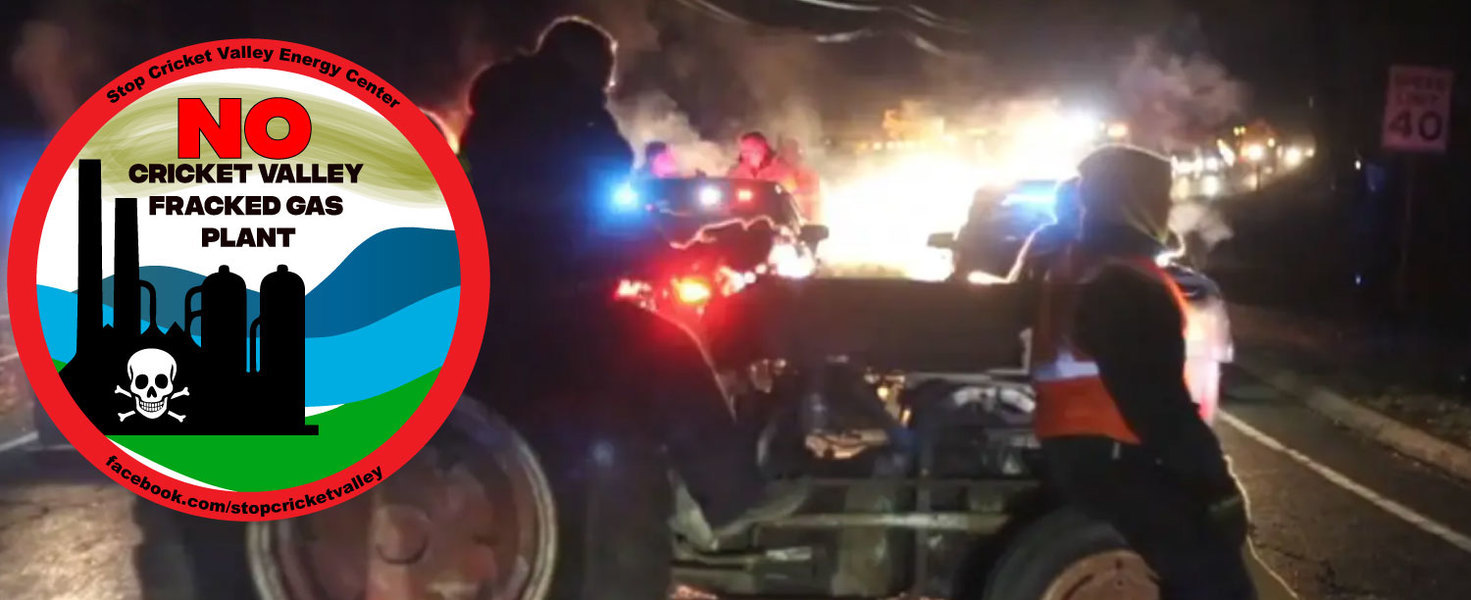
Cricket Valley Energy Center (CVE) is a newly constructed fracked gas power plant that will damage community health, environment, and the agricultural economy in rural Dutchess County. CVE was approved over a decade ago, before the science on fracking and its devastating effects were clear. Set to produce 1100 megawatts of energy, CVE is poised to be one of the largest power plants in the northeast, yet the electricity it will produce isn’t actually needed. Residents have put forth thousands of petition signatures, calls, letters to New York's Governor Andrew Cuomo, begging him to stop construction of the plant until a proper study is done to evaluate the impact CVE will have on the quality of air, water, flora, fauna, community health, local farm economy, etc. Governor Cuomo has ignored each and every effort.
CVE is a project being financed by a hedge fund based in Switzerland called Advanced Power AG. In January, 2017, eight years after the plant was first proposed, Advanced Power announced that it had successfully completed its efforts to collect $1.584 billion from investors and banks to finance the construction of CVE. Advanced Power AG includes JERA Co., Inc. (half-owned by Chubu Electric Power Company and half by TEPCO Fuel & Power, which maintained the Fukushima nuclear reactors that melted down in 2011). Additional investors include BlackRock Financial Management Inc.; Development Bank of Japan, Inc.; NongHyup Financial Group (under the direction of the National Agricultural Cooperative Federation of Korea); and TIAA Investments. CVE’s construction contract was awarded to Bechtel, the US’s largest construction company, with subsidiaries that were key to the controversial privatization of water in Bolivia.
CVE is tucked away in a rural agricultural community, just across the border from Connecticut residents who had no say in the matter but will suffer the consequences. The plant was permitted without any input from neighboring residents in CT, including the Schaghticoke people. The Schaghticoke reservation, along with three different schools enrolling over 1300 children, are located less than 2 miles from the plant. The plant is being constructed adjacent to the Great Swamp, NY’s largest freshwater wetland, which is home to a variety of ecosystems and wildlife, including Bald eagles and the critically endangered Bog Turtle.
New York State has shown that it’s still serious about the environment with the passage of the Climate Leadership and Community Protection Act in June of 2019. This legislation is one of the most ambitious in the world, but opening up a new fracked-gas electricity plant is a giant step in the wrong direction—especially now that a cheaper, completely nonpolluting, non-greenhouse-gas-emitting path has emerged. Eliminating fossil-fuels is the only path that can save us from irreversible climate catastrophe.
“The Cricket Valley Power Plant will be emitting toxins such as arsenic, acid gases, chromium, NOx, mercury, nickel, and toxic CO2 spanning a 50 km or 31 mile radius, (which) encompasses 24 towns in New York and Connecticut; this also includes the Schaghticoke Indian Reservation established in 1736 bordering Dover, New York, and Kent, Connecticut,” said Sachem HawkStorm, Schaghticoke First Nations hereditary leader. “This is a violation of our free, prior and informed consent according to the United Nations Declaration on the rights of indigenous peoples, which was ratified by the United States government. Clean air, water and land are inalienable human and natural rights. These rights cannot be superseded by a corporation for capital gain.”
New York State banned hydraulic fracturing for natural gas, or fracking, in 2014 because of health risks associated with drilling, but Governor Andrew Cuomo has continued to approve gas infrastructure like the Cricket Valley plant which poses many of the same risks. Local residents are particularly concerned that its location in the Harlem Valley, a narrow north-south corridor, will engulf the region with pollution.
“Our farms need clean air and water just like our schoolchildren down the road from the gas plant,” said Ben Schwartz, who is an area farmer. “The much cleaner solar-power plant, approved for construction across the road from Cricket Valley, plans to sell its electricity to Dover residents, unlike the gas plant.”
In addition to the local air pollution, the farmers are concerned about climate impacts. Methane, the main component of the Cricket Valley’s planned fuel supply, is 86 to 100 times more potent a heat-trapping gas than carbon dioxide during its first 20 years in the atmosphere. Independent researcher are finding alarming methane leakage rates from gas infrastructure, debunking the industry myth that gas is better for the climate than coal.
“We need a Green New Deal with renewable-energy jobs which protect our families’ health and homes and repair our environment from the cheap fossil-fuel era,” said Phil Erner, another area farmer, who also used to teach university physics. “While this era is ending whether we admit it or not, to continue business-as-usual in the meantime is causing much needless suffering.”
“A new, 650-megawatt power plant on my side of the Hudson River just had its air-permit renewal denied by New York’s Department of Environmental Conservation, who cited expected climate impacts,” said Creek Iversen, a third farmer. “Cricket Valley, at 1100 megawatts, should be next.”