Don’t Waste Horse Creek Valley
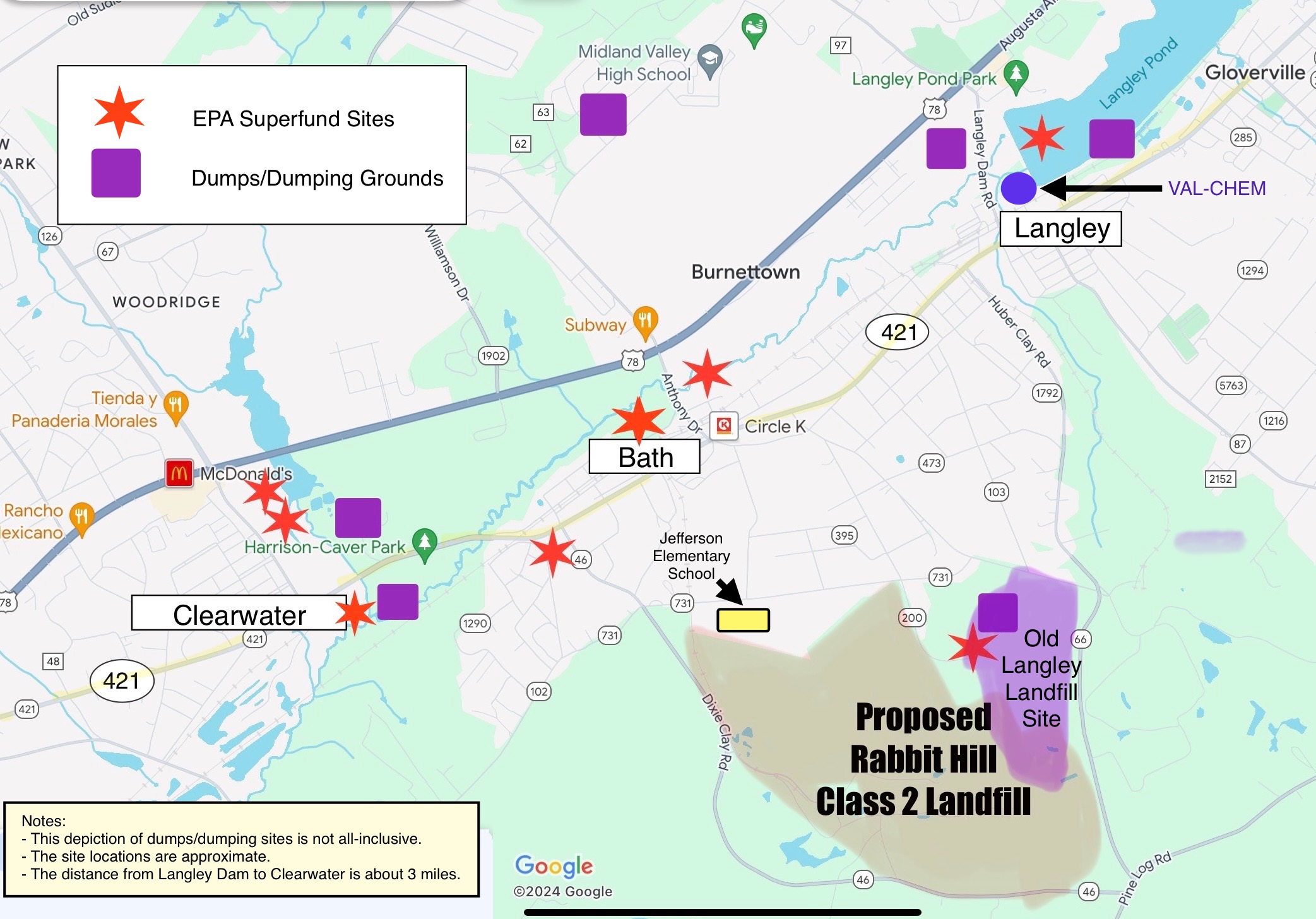
Yet another landfill operation has been proposed for Horse Creek Valley. The Rabbit Hill C&D Landfill would be located in the Langley, Bath, Clearwater community — a 3-mile stretch of SC Highway 421 whose history includes 9 EPA superfund sites, numerous unregulated dumping sites, and decades of landfill operations.
We understand that landfills are a necessity of modern life. This fight is not against landfills. The fight is against yet another landfill being sited in Horse Creek Valley and, specifically, in this section of the Valley.
Langley, Bath, Clearwater is home to a close-knit, working class community with a poverty rate of some 30% due to decades of mostly negative growth. The area’s elementary schools count 100% of their students as low income. One of these schools, the historic Jefferson Elementary school, is located just a stone’s throw from the proposed C&D landfill property line. The Langley-Bath-Clearwater community has already borne the lion’s share of the environmental damages, safety risks, health effects, diminished property values and negative growth from carrying Aiken County’s waste over the past 70 years. Enough is enough.
_____________________
FOR MORE READING:
Background
As has been well documented in recent local articles (1)(2), Horse Creek Valley has been recipient to the bulk of Aiken County and City garbage and industrial waste in both landfills and unregulated dumps for the past 70 years and longer, with much environmental damage inflicted during the 1960s-1980s at a time when environmental regulations were being simultaneously born and ignored.
The highest concentration of this activity occurred within a 3-mile stretch of Highway 421 in Langley-Bath-Clearwater, which can count:
- nine EPA Superfund sites,
- a once-biologically-dead river and pond
- numerous polluting industries
- and numerous areas of unregulated dumping, some of which occurred on clay company property.
While our lands and waters have undergone measurable healing from past damages, the health effects to those living near these industries and hazardous waste may continue for generations.
On “Cancer Villages”
We know about the health effects of these histories because, while the US public health and environmental scientists have not undertaken studies of the textile villages in Horse Creek Valley, they have conducted dozens of studies of China’s textile villages over the past 20 years. These studies gave rise to the term, “cancer villages.”(3) In the absence of such studies in Horse Creek Valley, the stories from local residents who have watched one mother, father, grandparent, uncle, and neighbor after another die early deaths from cancers and respiratory diseases have been relegated to anecdotal accounts with no statistical value.
On Environmental Justice
Both the EPA and SC-DHEC recognize, however, that cancers and other health issues such as asthma cardiovascular disease, neurological disease and developmental disabilities are the costs of living near Superfund sites, hazardous waste dumps and polluting industries. The EPA and SC-DHEC also recognize that these sites have been traditionally placed around poor, working-class, and minority neighborhoods. This recognition is what gave birth to the term, “environmental justice” — a factor that both of these agencies are obligated to apply in decision making for permitting. (4)(5)(6). If the term “environmental injustice” doesn’t apply in Langley-Bath-Clearwater area — with 9 superfund sites,(7) numerous old dumps and landfills, a poverty rate of some 30%, and with 100% of schoolchildren counted as low income — where does the term apply?
The Risks
While regulations enacted over the past 50 years have reduced the environmental and public health impacts from landfills, these regulations have by no means eradicated these effects.(8) Impacts that may be expected by nearby residents and students at Jefferson Elementary School in near proximity to this proposed Rabbit Hill Class 2 landfill include:
- Water and Soil Pollution: In addition to the legacy waste from the former unregulated and under-regulated landfills on clay company lands, the construction and demolition debris in the proposed C&D landfill could potentially contain arsenic, cobalt, barium, cadmium, mercury, asbestos, lead, and even radioactive materials from industry which can potentially leach into the soil, water and air.
- Particulate Matter (PM) Emissions: The emissions from the burning of fuel in heavy machinery and the dust created by the crushing and movement of construction and demolition materials and debris would contribute greatly to the PM levels in the area, potentially carrying some of the above listed toxic substances. These fine particles can penetrate deep into the respiratory systems, posing health risks to nearby residents and school children.
- Noise Pollution: In addition to the toxic emissions from the heavy machinery and dump trucks to the site, there is the potential for noise pollution and loss of quality of life to nearby residents.
- Landfill Fires: According to FEMA, there are over 8,000 landfill fires each year. These fires can occur in any type of landfill, including C&D landfills. These fires range from minor to major, with some fires burning for weeks or even months. Even minor fires can produce toxic smoke and gases that can present significant health risks to nearby residents and others downwind from the smoke.
_________________________
- The Aiken Chronicles: Horse Creek Valley: Aiken County’s Waste Receptacle
- The Aiken Chronicles: Horse Creek Valley and the Rabbit Hill Landfill
- Clemson University: Dozens of studies exist on so-called “cancer villages” near textile industries in China. Here is one: A story map created by Michael White at Clemson University
- EPA website: Federal Actions To Address Environmental Justice in Minority Populations and Low-Income Populations, Executive Order from 1994: Agency Responsibilities.
- EPA website: environmental justice permitting. The EPA’s definition of environmental justice: “The just treatment and meaningful involvement of all people, regardless of income, race, color, national origin, tribal affiliation, or disability, in agency decision-making and other federal activities that affect human health and the environment so that people: is committed to carrying out its permitting processes in a nondiscriminatory manner.”
- The SC Department of Health and Environmental Control is likewise committed to environmental justice in its mission and permitting processes:
- University of Texas news: “Communities Living Near Polluted Superfund Sites Have Lower Life Expectancy.”
- Thermo-Fisher: Three Reasons Landfills Can be Viewed as Piles of Threats: Asbestos, Lead, and Radiation
Sponsored by