Healthy Start Saves Lives: A Call to House LHHS members
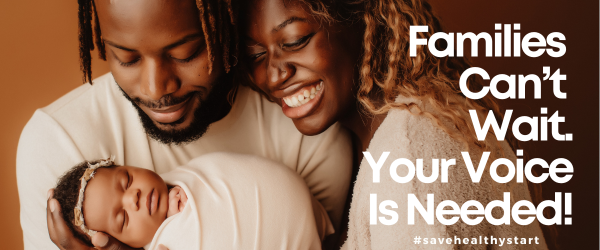
Congress is deciding whether to continue funding Healthy Start, a vital program that has supported pregnant moms, dads, and families in communities with high infant mortality rates for over 30 years. Healthy Start works to ensure safe pregnancies, healthy babies, and thriving families, and provides:
- Education and support for healthy pregnancies and babies (to both moms and dads)
- Postpartum care up to 18 months
- Resources for safe sleep, mental health, and domestic violence
- Community-led projects improving food access, transportation, housing and more
Without funding, families will lose access to these life-saving services.
Will you take 2 minutes to email members of the Labor, Health and Human Services, Education, and Related Agencies (LHHS) Appropriations Subcommittees and ask them to support both FY27 funding and reauthorization of Healthy Start? Your voice can help protect families and save lives.
Ready to help? Click the "Start Writing" button to your right.
Operated by the Health Resources and Services Administration’s (HRSA) Maternal and Child Health Bureau, Healthy Start supports 115 programs nationwide and serves tens of thousands of families in communities facing the highest risk of maternal and infant mortality. Healthy Start is a discretionary program within the U.S. Department of Health and Human Services (HHS) and receives its annual funding through the Labor, Health and Human Services, Education, and Related Agencies (LHHS) Appropriations Subcommittees in the House and Senate. The entire program costs $145.25 million per year - a very small fraction of the federal budget and a modest investment compared to many other federal initiatives. For purposes of comparison, one year of Healthy Start programming in 115 communities' costs less than half of one day of war in Iran. Eliminating Healthy Start will not meaningfully reduce federal spending, but it will place lives at risk.
The United States has the highest infant mortality rate among high-income countries. Healthy Start serves 115 high-risk communities nationwide. All sites are located in areas with infant mortality rates at least 1.5 times higher than the national average. The program traditionally attracts bipartisan support and aligns closely with a pro-family agenda, emphasizing prevention, early intervention, and locally tailored solutions.
Healthy Start projects work to prevent infant deaths by:
- Increasing access to prenatal and postpartum care
- Screening and support for domestic violence and postpartum depression
- Distributing safe sleep and infant health resources
- Offering fatherhood support and parenting education
- Addressing systemic drivers of poor birth outcomes through community improvement projects
What's at Stake
The President's proposal to eliminate Healthy Start would dismantle a program that has supported more than 85,000 families annually in historically underserved areas, reduced health disparities through evidence-based interventions and culturally tailored care, and leveraged community partnerships to improve perinatal outcomes.
Healthy Start's integrated, whole-family model is not duplicative but complementary to other maternal-child health programs. It bridges clinical care, community services, and equity-centered strategies in ways that other block grants or Medicaid funding mechanisms do not.
Uniquely, Healthy Start reduces federal spending by preventing costly preterm births and infant deaths through early, targeted interventions in high-risk communities, lowering the need for expensive neonatal care, special education, and long-term disability support, which together cost the U.S. $12 billion annually.
What's Next
Collectively, we must urge Congress to continue to provide at least $145 million in funding for the Healthy Start Initiative in the Fiscal Year (FY) 2027 budget.