Oppose Senate Bill 543 / Assembly Bill 547
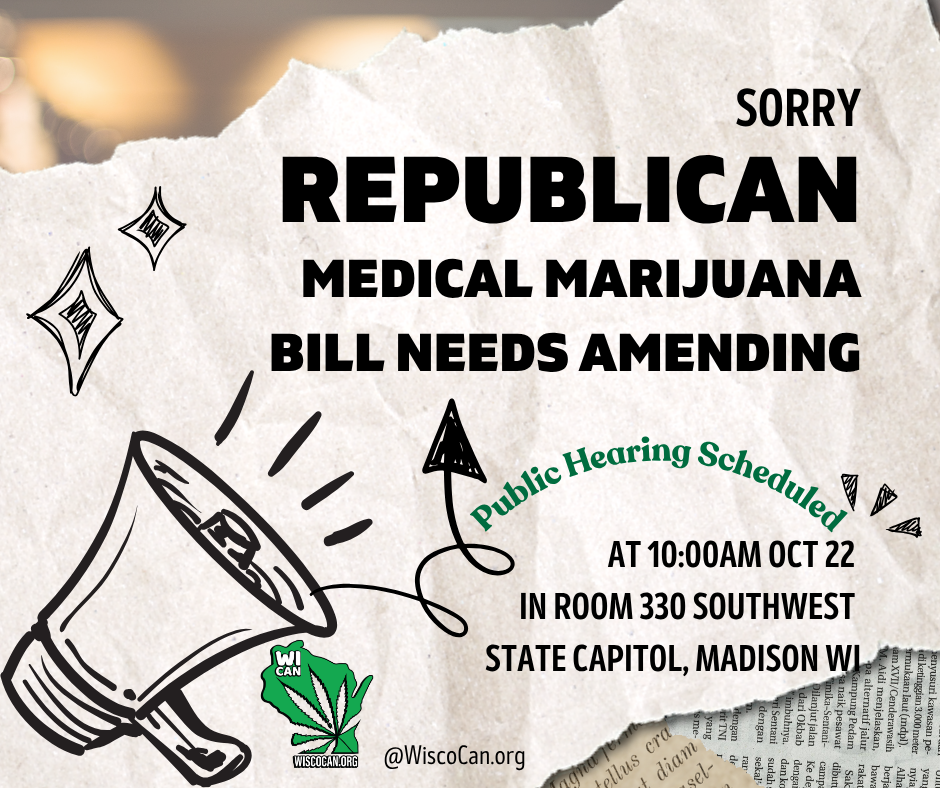
Senate President – Sen. Mary Felzkowski (R-Tomahawk) and Senate President Pro Tempore – Sen. Pat Testin (R-Stevens Point) are the authors of the 2025 Republican Medical Cannabis Legislation. The bill was fast tracked to a public hearing, not giving much time for co-sponsors to be added. We all know Republicans have been drafting their bills behind closed doors in a partisan basis and this legislation is just the same repeat and rinse or previous efforts. As freshman Democratic Senator Sarah Keyeski recently pointed out, the Republican Senate has only scheduled seven (7) session days and the Wisconsin Senate is currently on track to be the LEAST productive Wisconsin Senate in recent history – under Senator LeMahieu’s leadership, which Felzkowski and Testin are part of. These facts and the number of Republicans already opposing this legislation are known and the bill, without the help from Democrats, is all but doomed to die. But, we still should remain vigilant and show up for the public hearing to testify. The hearing, which was scheduled the same day the bill was introduced, is set for October 22 at 10:00 a.m. in Room 330 Southwest of the State Capitol.
Strengths, Weaknesses & Political Dynamics
Strengths / Potential Benefits
- Moves Wisconsin into a regulated medical cannabis regime, filling a long-standing policy gap.
- The prohibition of smoking but allowance of vaporized forms may make the bill more palatable to more conservative lawmakers.
- Strong regulatory guardrails (security, tracking, licensing) signal a seriousness about control and oversight, which can ease opposition.
- Protection clauses for patients (housing, custody) make it more just and equitable.
- Exempting medical cannabis from sales tax is a positive for accessibility.
Weaknesses / Concerns / Limitations
- Prohibiting smoking might be seen as an arbitrary restriction by advocates who favor full spectrum access.
- The limit on supply (30-day initial, 90-day later) might feel restrictive especially for chronic conditions.
- Employer drug-use policies remain intact, which means patients could still face job risk — a common point of contention.
- The high license fees (grower/processor $10,000, labs $5,000) could be barrier for smaller operators or equity applicants.
- Advertising ban is logical for public safety, but may make market visibility and patient outreach harder.
- The inclusion in PDMP may raise concerns about privacy among patients who prefer cannabis not be tracked.
Political & Strategic Considerations
- Because the bill is sponsored by Republicans (including Sen. Felkowksi and Testin, both in Republican Senate leadership) and filed in that chamber, it signals that reform is gaining traction within GOP ranks, but the Assembly authors of the bill, Patrick Snyder, Dan Knodl, Paul Melotik and surprise surprise, Dean Kaufert makes an appearance to the medical marijuana debate, are sure an oddball collection to push this legislation through their chamber. Kaufert was a long time prohibitionist with family in the policing business that made a rare re-entry back into state level politics in 2024. Kaufert told me times where changing on the issue and I was truly surprised to see his name.
- That said, its passage will depend heavily on the Senate Health Committee, which is chaired by Rachael Cabral-Guevara, a long time, but more quiet supporter of reform measures. The Senate Health Committee is co-chaired by the Author of the bill, Patrick Testing and has a third Republican member, Senator Jesse James, who has co-authored similar legislation in the past. This all but assures the Senate Committee could pass this bill out of their committee for a floor vote even if Democrats Smith and Drake strongly object.
- Then crossover in the Assembly; opposition in bill language and other issues could complicate the Assembly Committee process. The Assembly Committee is chaired by Clint Moses, who co-authored the bill last session with Robin Vos never gave his own bill a public hearing and it will be interesting to see if Moses swallows what Felzkowski submitted and holds a hearing or if he will listen to Vos and use the opportunity to undercut efforts. The Assembly Committee is fifteen (15) people, ten (10) Republicans and five (5) Democrats. Robert Brooks is a co-chair and has supported this type of legislation in the past. Rep. Barbara Dittrich will probably oppose the legislation, she co-sponsored the bill to ban hemp products, along with Rick Gundrum. Joel Kitchens has been quiet of lately, but supports medical marijuana. Kitchens will probably vote yes, but should be approachable on possible amendments as he was one of the first Republicans to break ranks years ago and did stuff with the Democrats. Rep. Adam Neylon has been singled out as a elected official who uses cannabis, but has not done anything about it expect try to hide it, we should approach him also, but with some caution as he is probably still in the cannacloset to his colleagues. Rep. Snyder is also on this committee and he is the lead in the Assembly, but in the past he said once he would vote NO to his own bill, as least that is what I remember about him. Rob Summerfield (who is also in Assembly Leadership) has co-sponsored GOP medical bills in the past and we highly expect him to support this one also. Nancy Vendermeer is in leadership and we know very little about her stance on cannabis reform. The final Republican member of the committee is Chuck Wichgers, who supports banning hemp products and is not a know cannabis reformer by any means. Democrats on the committee: Representative Subeck, Representative Stubbs, Representative Vining, Representative Johnson and Representative Mayadev.
- The cautious compromises (no smoking, strict licensing, business constraints) may make it more likely to pass in a split or conservative legislature, but will fail to attract support from the Democrats.
- It is likely to become a focal point for advocacy groups to push for expansions (e.g. home grow, broader conditions, lower fees) during amendment processes and to focus on these issues during the public hearing, which was scheduled the same day the bill was introduced, is set for October 22 at 10:00 a.m. in Room 330 Southwest of the State Capitol.
- As of 12:05pm on Oct 16th, the Assembly has not scheduled a public hearing.
