Save Forests to Avoid a Drinking Water Crisis
Northeastern Watersheds with 100% Ability to Produce Clean Water
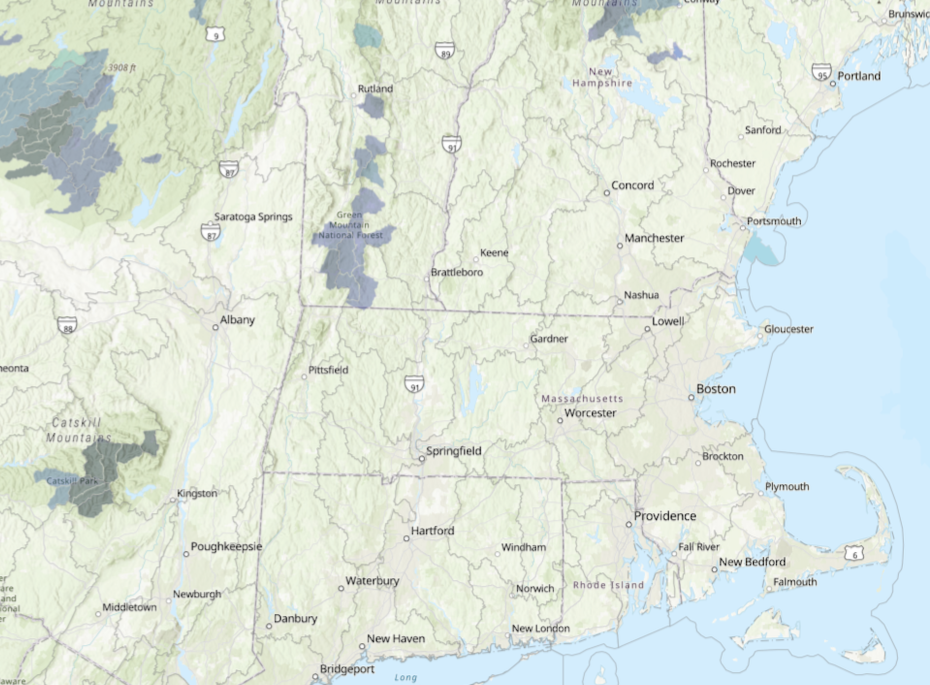 Massachusetts has no watersheds able to produce clean water at 100% capacity (dark gray on map). Statewide, our watershed forests are degraded with only 73% or lower Ability to Produce Clean Water (APCW). In contrast, forests that are preserved as wildlands in the Adirondacks and Catskills (NY) and in national forests (VT, NH) create most of the Northeast’s 100% APCW watersheds (see map).
State policy degrades our clean-water capacity. Peer-reviewed studies show that “Relative to roadless watersheds with intact natural vegetation [i.e., forever-wild forests], intensively managed watersheds also produce less available water… The monthly reliability of water is also diminished.” But Massachusetts logs the forest watersheds that produce our drinking water—even though our drinking water supply is vulnerable. The Quabbin Reservoir, which supplies drinking water to Boston and much of Metro West, dropped 12.3% capacity (June–December 2025), leaving us within 1% of drought stage. This rapid drop highlights our need for the extra 27% APCW that MA would gain by ending the “active management” logging that degrades our forest watersheds of our most important drinking water areas. In a water crisis, we might have to reconsider 20th-century plans to divert and filter the Connecticut River—a costly and legal nightmare.
Tell state legislators that we must legally designate our most important watershed forests as wildland reserves in order to maximize our state’s drinking water capacity and avoid a water crisis.
Adding bills H.952, H.953, and H.1048, or equivalent language, to the Environmental Bond Bill (S.2542) will accomplish this at no cost to taxpayers.
Please send a letter now to state legislators on crucial Committees.

.png)