Urge Bill Cassidy to Support S.521 Social Security Fairness Act
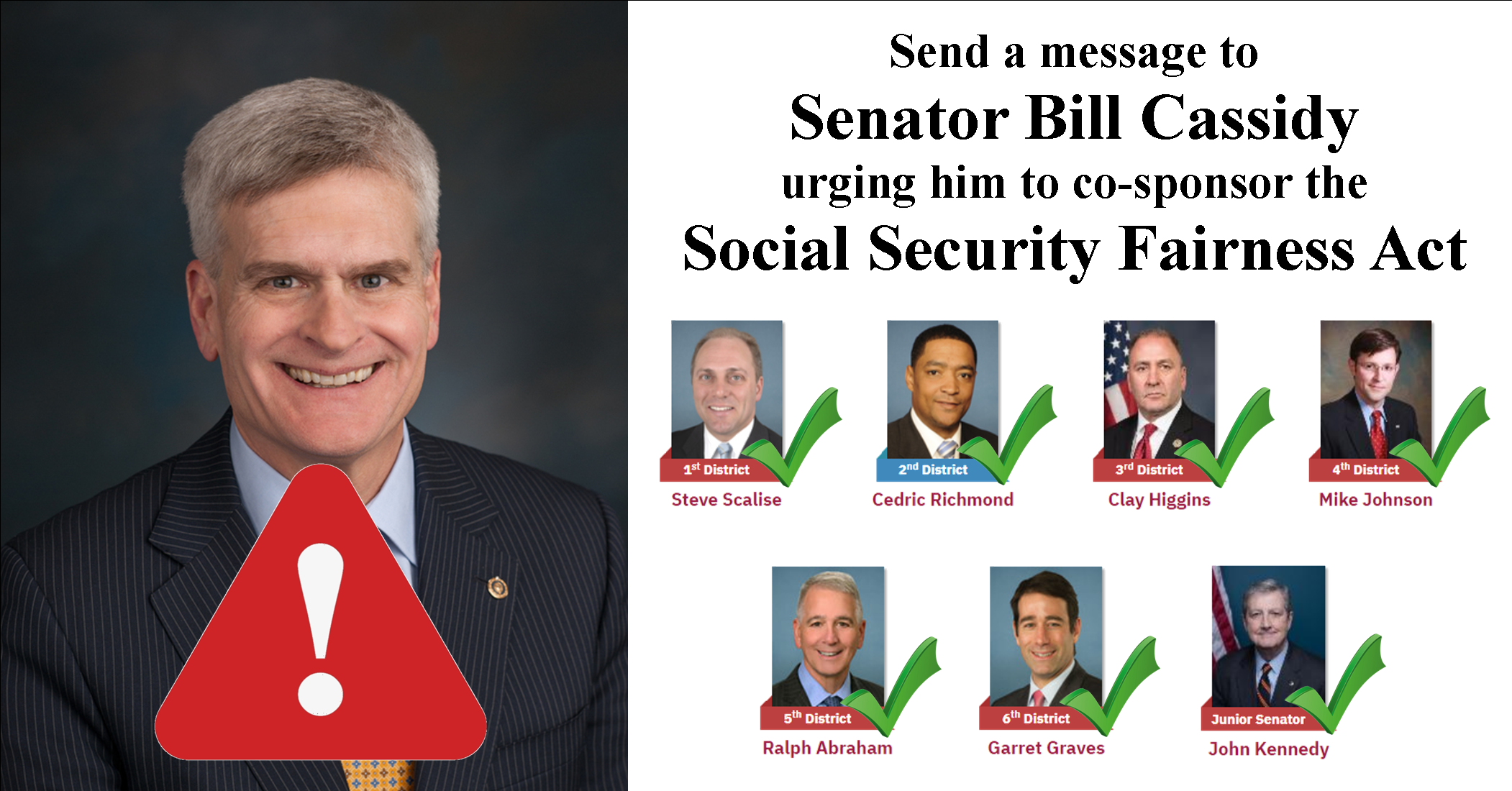
Jarred James Breaux of the Iberia Association of Educators is urging educators from around the state to send a message to their Congressmen to support Sen. Sherrod Brown's bipartisan Social Security Fairness Act (S.521). This Act would eliminate the Windfall Elimination Provision (WEP) and the Government Pension Offset (GPO), two titles of the Social Security Act that unfairly reduce or eliminate Social Security benefits for millions of Americans who have devoted much of their careers to public service, specifically educators in the state of Louisiana.
Educators, Fireman, and Police officers in the state of Louisiana do not contribute to Social Security through their government employment (with the exception of a select few districts); however, many of these civil servants have worked second jobs or have had career changes where they did pay into Social Security. Teachers receive 50% less of the money they or their spouse paid into Social Security than their private employer counterparts. This law affects teachers in only 15 states —Alaska, California, Colorado, Connecticut, Georgia, Illinois, Kentucky, Louisiana, Maine, Massachusetts, Missouri, Nevada, Ohio, Rhode Island, and Texas.
Furthermore, civil servants who are widows are especially affected by these laws. While WEP does not affect survivor benefits, if the spouse of a civil servant dies first, his or her primary insurance amount (PIA) will be recomputed using the regular computation formula, and his or her potential widow's benefit would be derived from a starting point of 100% of his or her spouse’s PIA, plus any delayed retirement credits that apply. An amount equal to two-thirds of the gross amount of the spouse's non-covered pension is withheld from their Social Security spousal or widow's benefits, which can reduce the amount payable to zero.
Here is an example from the Social Security website to illustrate how these provisions would be applied: Say Jane is eligible for a monthly teacher's pension of $1200 based on earnings that were exempt from Social Security taxes. Jane is also eligible for Social Security retirement benefits based on her other earnings which were subject to Social Security taxes and her primary insurance amount (PIA), which is equal to her full retirement age (FRA) rate, is $800, However, if Jane is drawing both her Social Security retirement benefits and her teacher's pension, the WEP provision would cause her benefit rate to be calculated using a less generous formula. In Jane's case, WEP would likely reduce her PIA from $800 to roughly $400. So, if Jane is drawing her teacher's pension and files for her Social Security retirement benefits at FRA she'd receive a monthly rate of $400.
Continuing our example, say that Jane's husband started drawing his benefits at his FRA and dies after Jane reaches her FRA. Jane's husband's PIA was $2000, so Jane's widow's benefit rate would be calculated by subtracting her PIA from her husband's PIA, which in this example would be $1600 (i.e. $2000 - $400). However, due to the GPO provision, 2/3rds of the amount of Jane's teacher's pension (i.e. $800 or 2/3rds of $1200) would be subtracted from her widow's rate, reducing her net widow's benefit rate to $800. That benefit would then be added to Jane's retirement benefit to give her a combined monthly benefit rate of $1200.
Note however that if Jane's PIA wasn't affected by WEP and she was receiving $800 on her own record, she would still receive a combined rate of $1200. Her widow's rate would then be $400 (I.e. $2000 - her PIA of $800 - 2/3rds of her $1200 teacher's pension), which would then be added to her own $800 benefit rate. Thus, once Jane becomes entitled to higher widow's benefits the WEP reduction no longer has any net bearing on her total benefit rate.
“This bill ensures that a teacher who spends his or her summers working a second job or a police officer who changes careers after years of service will not face a possible 40 percent reduction in their Social Security benefits,” said Representative Davis. “By repealing these outdated provisions that unfairly penalize public servants in Illinois, we can provide some certainty to retirees while helping to recruit future teachers, firefighters, and police officers.”
“These outdated provisions deprive educators and other public employees of the benefits they have earned and the secure retirement they deserve," said Illinois Education Association President Kathi Griffin. "I thank Representative Davis for his leadership on this issue and for his support of educators throughout Illinois and across the nation.
Please do not deprive someone who served our country in the line of duty from receiving their full benefits.
Letter Campaign by

Sponsored by