Tell DHS: Stop the ICE Warehouse in Washington County
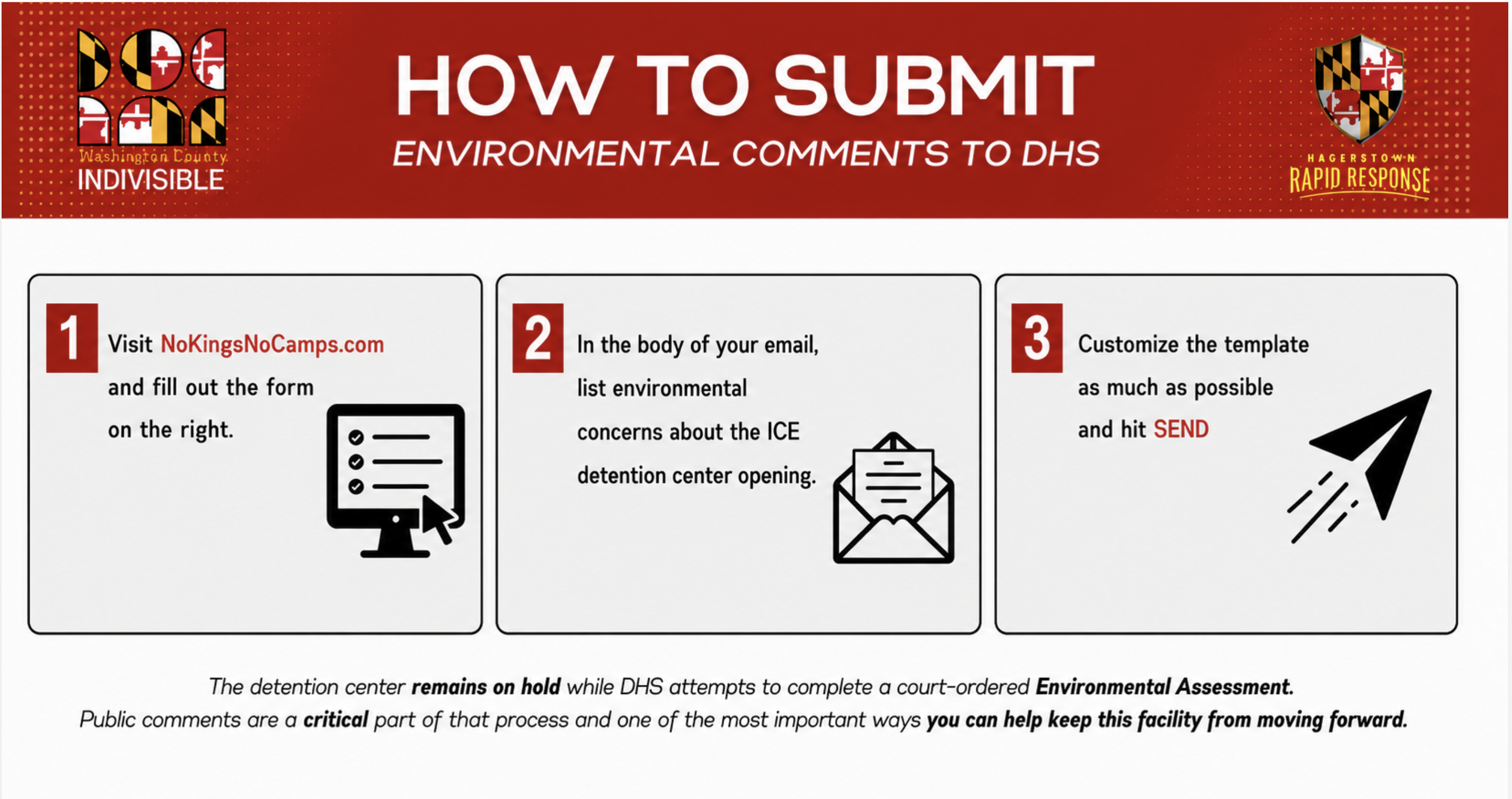
Use the form to submit a public comment and urge the Department of Homeland Security to abandon this project before it is too late. Submitting a comment opposing the opening of the ICE detention center in Washington County, Maryland will take two minutes or less.
You do not need to address every issue in your submission. A wide range of thoughtful comments highlighting different issues helps demonstrate the many ways this project could affect Washington County, and surrounding communities.
Residents in Maryland, Washington, D.C., Virginia, West Virginia, Delaware, and Pennsylvania will be most directly impacted if the ICE detention center is opened, but anyone concerned with the environmental, infrastructure, and health impacts can and should submit a public comment. Below are examples of concerns you may wish to include.
- You believe the project should not move forward until U.S. Department of Homeland Security (DHS) releases all of the studies they relied on to come to the conclusion that the facility won't have a negative impact on the environment and the public is given an additional 30-day comment period to review them. DHS asked the public to comment on the project without access to the environmental studies, engineering reports, and infrastructure analyses that DHS relied upon to conclude impacts would not be significant. DHS needs to provide these to the public.
- You are concerned about converting an 825,000-square-foot industrial warehouse into one of the largest ICE detention facilities in the region and the impact this would have on local businesses and tourism.
- You are concerned about the loss of tax revenue Washington County has and will continue to experience since warehouse was acquired by DHS, which does not pay local property taxes. Washington County is projected to lose $2 million in tax revenue in the first year of the sale (compared to if it had been sold to a private owner), in addition to the loss of over $700,000 property tax revenue per year after.
- You want DHS to provide detailed information regarding sewer capacity, wastewater treatment impacts, and downstream effects. For the past four years, the warehouse has been allocated 800 gallons of water a day and if converted into a 1,500-person ICE detention center, it would require 187,000+ gallons of wastewater each day. The current sewer does not have capacity to handle this.
- You are concerned that DHS began recruiting staff for the proposed ICE detention center in March, well before conducting meaningful environmental or infrastructure assessments, reinforcing concerns that the agency intended to fast-track the project while treating the required review process as a formality rather than a genuine evaluation of the facility's impacts on Washington County.
- You are concerned that the facility sits within the watershed of the Potomac River, which flows directly into the Chesapeake Bay, and want to understand any potential impacts on regional waterways and ecosystems. The Conococheague Creek is one of the largest tributaries of the Upper Potomac River and flows from Pennsylvania into Maryland before meeting the Potomac near Williamsport. The creek has drawn significant attention from the Potomac Riverkeeper Network because of persistent bacteria contamination and broader water quality concerns such as toxic algae. Would the increased runoff into the Conococheague Creek from increased traffic and activity at the facility amplify the algae growth?
- You are concerned about increased traffic from employees, contractors, deliveries, detainee transportation, and law enforcement vehicles.
- You want to know how local emergency services, hospitals, EMS systems, and first responders could be affected by the project. A detention facility of this size could place significant demands on local hospitals, EMS services, fire departments, 911 systems, and emergency responders. DHS should fully analyze these impacts before moving forward. A facility housing up to 1,500 people will generate medical emergencies, requiring ambulance transport, emergency room capacity, and ongoing care. Yet local resources are already stretched thin. The nearest EMS unit relies on just eight volunteer paramedics, and Meritus Medical Center is struggling to keep up with demand.
- You are concerned that the proposed ICE detention facility could affect public health by increasing the risk of communicable disease outbreaks spreading into the community through staff and contractors. Up to 182,500 detainees could pass through the proposed Washington County, MD ICE detention center each year, and public health studies indicate that immigration detention centers experience an elevated burden of preventable illnesses like influenza, mumps, and hepatitis A due to crowding and low vaccine uptake. Additionally, Immigration and Customs Enforcement (ICE) does not require its detention center employees to be vaccinated against standard communicable diseases and when these employees leave the facility, they can spread these preventable diseases throughout the local community.
- You are concerned about the lack of medical care that the detainees will receive in the facility. According to DHS itself, in a report from September of 2024, in the majority of detention facilities “we found instances of non-compliance with medical care standards, like dental and chronic care, and medical staffing.”
- You are concerned that the public has been systematically excluded from the decision-making process surrounding the proposed ICE detention center. In addition to DHS holding a sham public comment period, the Washington County Commissioners have refused to allow public comment on the project and have gone so far as to have members of the public removed from meetings for attempting to discuss it and threatened to charge them with trespassing.
- You want greater transparency regarding expected water usage and whether the project could affect future development or existing users.
- You believe the project raises environmental justice concerns and deserves additional scrutiny.
- You want to know what alternatives were considered and why this site was selected.
- You are concerned that DHS plans to install a 750,000 gallon water tank and you are concerned about where the water for this would come from. If it is trucked in by giant tanker trucks, it would require about 100 tanker trucks to fill the tank and would need to be refilled every four days. This would cause increased runoff, pollution, and damage to local roads.
- You are concerned that DHS plans to tap into the well currently on the property to fill the 750,000 gallon water tank because this would affect both the water level of wells in the town but also the water pressure in southern Pennsylvania.
- You believe the project deserves a full and transparent environmental review before construction proceeds.
- You believe federal agencies should not rely on secrecy, non-disclosure agreements, or incomplete disclosures when undertaking projects with major community impacts. In April, we uncovered that in December, 2025, the Washington County Commissioners signed non-disclosure agreements about a secret land deal and weeks later, and DHS officially purchased the warehouse and 54 acres in Williamsport, Maryland.
- You believe residents of Washington County, Maryland and neighboring states deserve meaningful participation in decisions that could affect their infrastructure, environment, and federal funding they receive tied to the removal of pollution from the Chesapeake Bay.
- You believe the scale of the project warrants greater transparency and public engagement than has occurred to date.
- You live downstream or outside Maryland and you can explain how wastewater discharges, watershed impacts, or regional environmental consequences could affect your community.
- You can also explain your personal concerns, such as raising children nearby, owning property in the area, using local waterways, operating a business, or relying on local infrastructure and emergency services.
- You are concerned that opening the ICE detention center would reduce the local home values. A recent study showed that when new correctional facilities open, they can reduce neighboring home values by 20% or more.
- You are concerned that the Washington County Commissioners are working in coordination with DHS to advance the proposed ICE detention facility and this may explain why Greg Murray and his company, GDMS, were hired and granted broad authority to provide consulting and support services related to public utility capacity, sewer infrastructure, and other matters that could facilitate the project's development.
We are Extending Our Campaign Until DHS Conducts a Public Comment Period in Good Faith
Our original campaign was scheduled to end at 11:59 on June 30, because that is when the Department of Homeland Security (DHS) announced that the 30 day public comment period as part of the environmental review process would end. But we will no longer be doing that. That's because DHS did not conduct this required public comment period in good faith. DHS claims to have relied upon environmental and infrastructure reports and assessments that led them to the conclusion that they are "not aware of any potential for significant environmental impacts" from opening this ICE detention warehouse. Yet, DHS has refused to release any of said environmental or infrastructure reports or assessments.
According to DHS's own documents, those materials include:
• Wastewater & Domestic Water Infrastructure Assessment
• Third-party Phase I Environmental Site Assessment
• Site utilities report
• Floodplain information
• Documentation regarding wetlands, water features, cultural resources, and threatened and endangered species
The Department of Homeland Security asked the public to comment on the environmental and infrastructure impacts of this project while withholding the very studies and analyses it relied upon to conclude that those impacts either do not exist or are not significant.
A public comment process can only function as intended if the public has access to the information necessary to provide informed feedback. Without access to the environmental studies, engineering reports, and infrastructure analyses underlying DHS's conclusions, it is difficult to view this process as a genuine good-faith opportunity for public participation.
If DHS is confident that these reports support its conclusions, it should release them so the public can evaluate the evidence for themselves. Until that happens, we will not be ending our public comment campaign. We encourage everyone concerned about the impacts of converting an 825,000-square-foot industrial warehouse into a massive ICE detention facility that is projected to generate approximately 200,000 gallons of wastewater per day in a community with an already strained sewage system to continue making their voices heard on behalf of Washington County, Maryland, and the neighboring communities and states that could also be affected.
If you're unsure what to say when you submit a comment, here's one very specific thing you can ask for:
Request that DHS publicly release the reports and assessments it claims to have relied upon when concluding that it is "not aware of any potential for significant environmental impacts" from this project.
Background
The Department of Homeland Security (DHS) is attempting to convert an 825,000-square-foot industrial warehouse in Washington County, Maryland into a massive ICE detention facility despite overwhelming environmental, infrastructure, and human rights concerns.
DHS is now accepting public comments until July 1 as part of the environmental review process.
This public comment period exists because the State of Maryland took DHS to court. In February 2026, Maryland Attorney General Anthony Brown sued DHS after the agency attempted to move forward with the project without conducting the environmental review required by federal law. The lawsuit showed that DHS unlawfully fast-tracked the project while failing to adequately evaluate impacts on local waterways, wastewater systems, traffic, emergency services, public health, air quality, and surrounding communities.
Maryland has already won significant victories in court. A federal judge largely halted the project and forced DHS to begin the environmental review process it had previously attempted to avoid. As a result, DHS must now create a public record and consider public input before moving forward.
Every public comment submitted becomes part of that official record. Those comments can help demonstrate widespread opposition to the project, identify environmental and infrastructure concerns DHS must address, and strengthen the record that will be scrutinized throughout the ongoing legal battle.
The Environmental Impacts if the Facility Opens
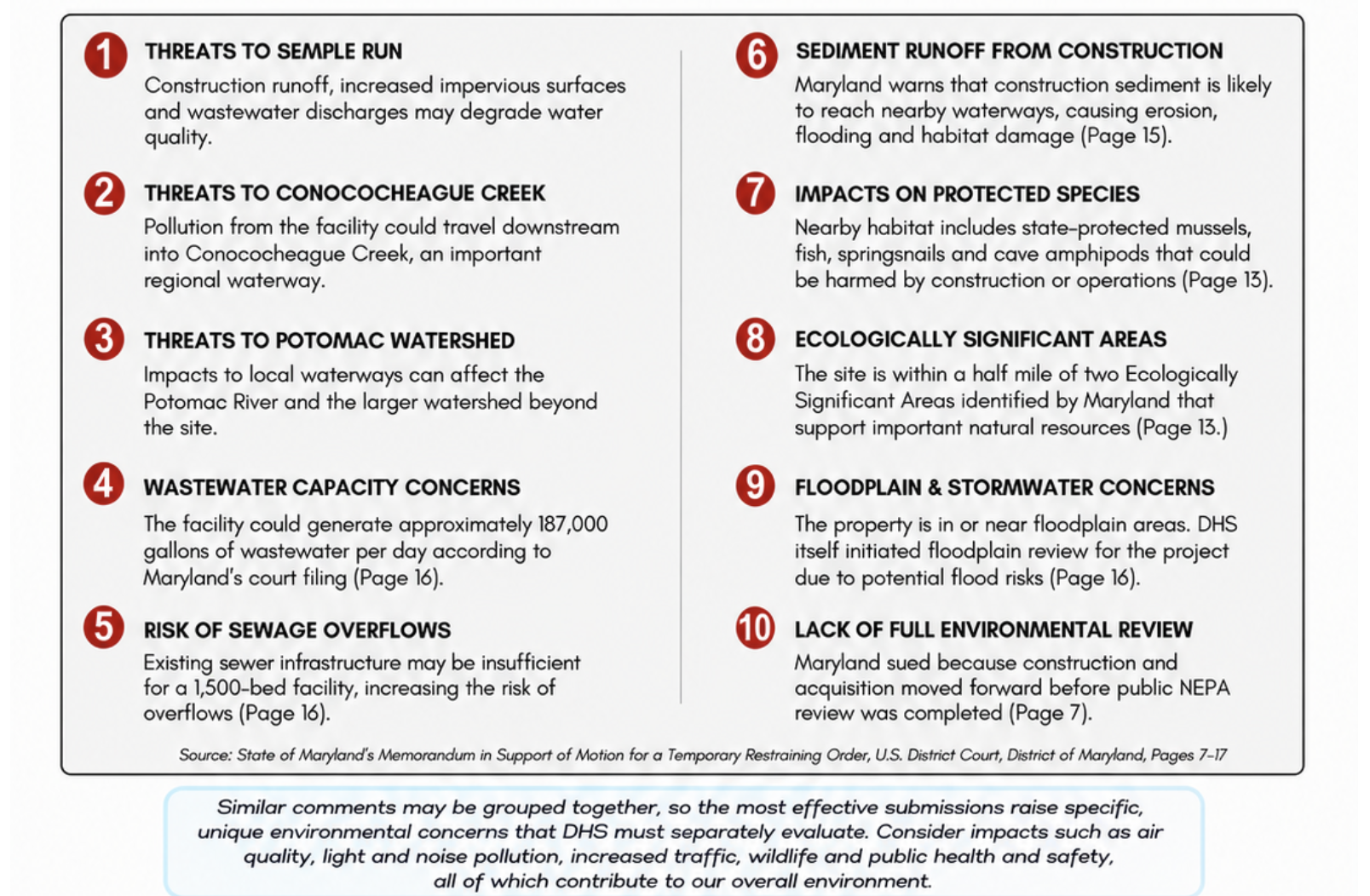
One of the most serious environmental concerns associated with the proposed ICE detention warehouse is wastewater. The Maryland Department of the Environment estimates the facility would generate more than 187,000 gallons of wastewater per day. That wastewater has to go somewhere.
Washington County's sewer infrastructure is already at capacity, and increasing the current property's daily sewage output by over 234 times would overwhelming collection lines, pump stations, and treatment capacity. When sewer systems exceed their capacity, the result is sanitary sewer overflows, where untreated or partially treated sewage backs up into streets, properties, and waterways.
If sewage spills occur, they would not remain confined to the detention facility site. The area drains into local streams that ultimately connect to the Conococheague Creek, then flow down the Potomac River, and then the Chesapeake Bay, meaning contamination would move far beyond Washington County. Raw sewage releases would introduce bacteria, viruses, excess nutrients, and other pollutants into waterways, harming aquatic ecosystems, degrading water quality, and creating public health risks for downstream communities.
The environmental and health impacts associated with this proposed facility would affect communities throughout the Potomac watershed, including parts of Maryland, Washington, D.C., Virginia, West Virginia, and Delaware. This would also affect southern Pennsylvania. Our recent blog post explains many of the ways this will affect these five states and the District of Columbia.
Before DHS adds an additional 187,000 gallons of wastewater per day to the system, the public deserves clear answers about whether the existing infrastructure can safely handle that volume, what upgrades would be required, who would pay for them, and what protections are in place to prevent sewage overflows into nearby streams and rivers.
This is one of the most important opportunities the public has had to influence the future of this project. The comments submitted now will become part of the administrative record DHS must consider before deciding whether to proceed.
We have a chance to make it clear that this detention facility is not welcome in Washington County and should never be allowed to open.
News:
- June 30: Hagerstown Rapid Response and Washington County Indivisible Join ACLU-MD, NAACP Washington County, and Elected Officials to Submit Public Comment Opposing Proposed ICE Detention Center
- July 1: Maryland Attorney General Demands Environmental Studies, New Public Comment Period, and Suggests DHS Sell Washington County ICE Warehouse
- July 1: Sierra Club of Maryland Submits Public Comment Opposing the ICE Detention Center, "As three Maryland environmental agencies have warned, the impacts of this project would be significant and adverse to Williamsport, Hagerstown, and neighboring areas, and likely catastrophic with regard to its impacts on sewerage infrastructure and surrounding waterways. Given the insurmountable evidence regarding the significant impacts of this site, we urge DHS to immediately cancel its plans for a warehouse immigration detention and processing facility in Williamsport."
For continuous updates about this campaign, please also subscribe to our substack: https://substack.com/@hagerstownrapidresponse