Allow for diverse homes across Berkeley!
Berkeley City Council and Mayor Adena Ishii
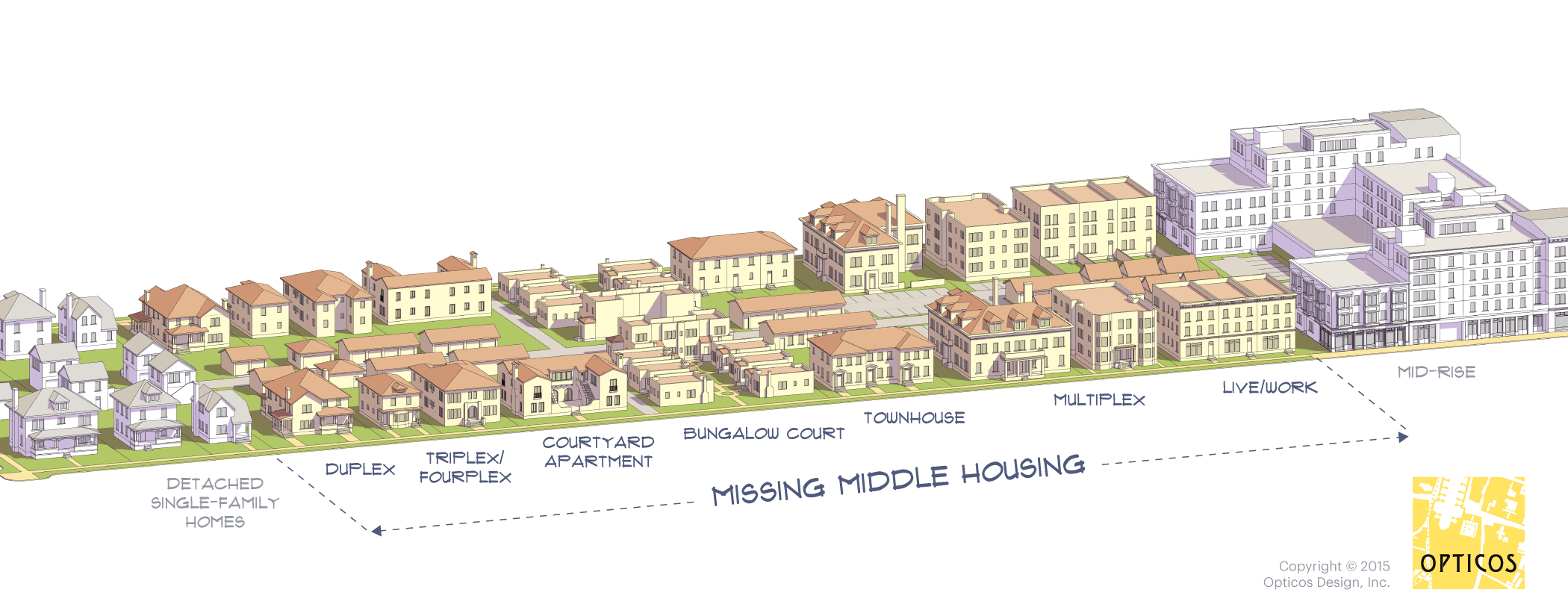
June could be the month that we end single-family zoning where it began! Berkeley's Elmwood neighborhood was one of the first places in the country to institute single-family zoning, and it was done for overtly racist reasons. (You can read more about it here.)
Fast forward to the 1970s, Berkeley all but stopped building housing. For three decades, Berkeley permitted fewer than 100 new dwelling units per year, even seeing net dwelling unit decreases in the 1980s. The effect was unsurprising: Housing prices grew sharply, and diversity plummeted. The city lost more than half of its Black population: In 1970, Berkeley had about 27,000 Black residents, representing about 25% of its population, but in 2020, that number had fallen to about 9,500, or about 7.6% of its population.
Berkeley must contend with its history of racialized, restrictive zoning and the massive displacement that comes from artificial scarcity.
Thankfully, we have the opportunity to address some of the wrongs of our past in the proposed Middle Housing Ordinance. Imagine naturally-affordable condos and townhouses springing up across Berkeley, as well as small-scale apartment buildings near parks, coffee shops, and Berkeley's famous grocery stores. Imagine having the same standards across the exclusive neighborhoods in North Berkeley and the historically-redlined South Berkeley. That's the opportunity that Berkeley's Middle Housing Ordinance, coming before council on June 26th, represents! However, to truly meet the moment, the Missing Middle Ordinance must:
- Treat historically red-lined versus historically exclusive neighborhoods equally (understanding that exceptions must be made for high-fire-risk areas). The current proposal has tighter density limits in North Berkeley than South Berkeley, but to end Berkeley's legacy of racist zoning, we need to treat these neighborhoods the same!
- Be flexible enough to actually increase housing production and the number of projects that pencil. It would be a shame if our Middle Housing Ordinance were so restrictive that it resulted in very few homes getting built and becoming a de facto continuation of single-family zoning.
We need people to speak up for an equitable, ambitious Middle Housing Ordinance in Berkeley!
Sponsored by
.png)
Additional Sponsors


To:
Berkeley City Council and Mayor Adena Ishii
From:
[Your Name]
Honorable Mayor and City Council,
I support the Middle Housing Ordinance and urge you to pass it, ending single-family zoning in the city where it began.
I further urge you to improve upon it by passing a stronger and more equitable version of the Middle Housing Ordinance that treats all low-fire-risk neighborhoods equally and removes density caps throughout our city. Berkeley has a unique responsibility to address its history as the birthplace of single-family zoning—a policy originally implemented with explicitly discriminatory intent in the Elmwood neighborhood. The consequences of decades of restrictive zoning are evident in our housing crisis and dramatic demographic shifts, including the loss of more than half our Black population since 1970.
The Middle Housing Ordinance presents a historic opportunity to begin undoing this legacy of exclusion. However, the proposed density limits risk making the Middle Housing Ordinance ineffective. The density limits are also unnecessary, as the rest of the ordinance already constrains the building envelope.
For the Middle Housing Ordinance to be truly effective and meet this moment in history, it must:
1. Remove unnecessary density restrictions, or dramatically increase them to at least 90 dwelling units per acre (but more would be better!), in order to avoid overly burdensome requirements that would make middle housing development financially infeasible.
2. Apply uniformly across low-fire-risk neighborhoods without creating different standards for historically redlined versus historically exclusive areas. Equity demands consistency.
Berkeley has the chance to lead by example and demonstrate how cities can address their exclusionary pasts through meaningful zoning reform. Unfortunately, we also have the chance to squander this opportunity and pass an ordinance that results in little substantive change. I strongly encourage you to pass a Middle Housing Ordinance that is bold enough to make a real difference in our housing shortage and inclusive enough to begin healing the divisions of our past.