Common Council: Vote No on Camping Bans
Mayor Lewis and Ithaca Common Council
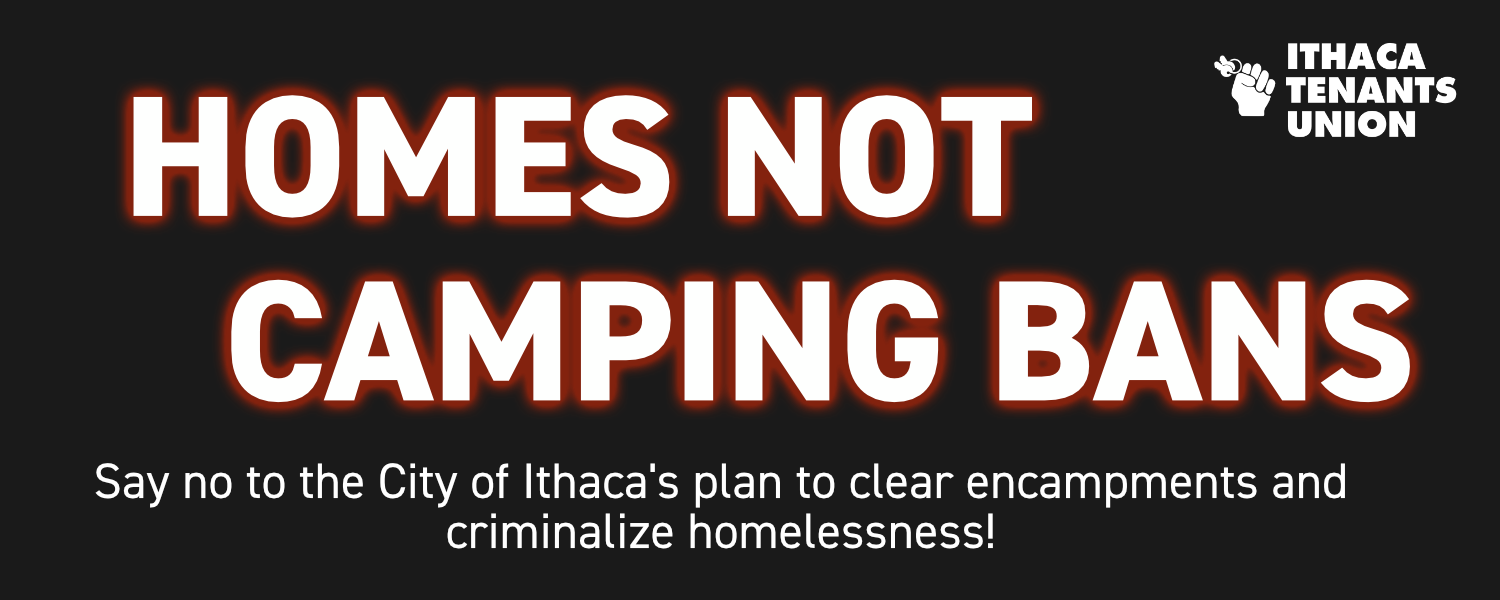
A new policy is coming before Common Council to ban camping by homeless Ithacans. This policy contradicts evidence-based and compassionate responses to homelessness, has been largely driven by business owners and anti-homeless fearmongers, and has been shrouded in dishonest misrepresentations and secrecy. The Ithaca Tenants Union and the undersigned call on Common Council to throw out this policy, and work on the real solution to homelessness: housing people without homes. We need homes, not camping bans.
City leadership, including Alderperson Cynthia Brock, are calling it a “land use” policy, but it specifically targets locations where people pushed out of housing in Ithaca are living, and bans camping there, under threat of police enforcement. Despite claims that the City won’t criminalize homelessness, non-criminal citations included in this policy are always enforced by warrants, arrests, and increasing criminal penalties. Treating homeless people as a “land use issue” is disrespectful and dehumanizing, and an attempt to distract from the fact that they’re not addressing the root causes of the issue: Ithaca is in a worsening housing crisis and our housing system is built to serve profit, not people. Now that they've released their policy for public input. We're sending them a clear no.
The policy fails to address housing, safety, or health, but instead further displaces and corralls unhoused people into a small flood-prone area under threat of police violence. If passed, this policy will erode existing relationships and communication with outreach workers, and disrupt existing progress towards housing. People experiencing homelessness could be forced to abandon their belongings and move to spaces where they are unsafe and unable to meet their basic needs with dignity. Displacement uproots the lives that unhoused individuals are able to build for themselves to survive. Rather than improving safety for everyone in and around the encampment spaces, this policy will expose homeless Ithacans to unsafe and unfamiliar environments, with more police response for camping than this community has ever seen.
Community members often focus their fears on crime committed by homeless people, but homelessness increases vulnerability to violence among people who are homeless, not among people who are housed. A study by the National Healthcare for the Homeless Council found that 49% of homeless people reported experiencing violence, in part in the form of hate crimes.
To address homelessness and encampments, we need policies that compassionately and effectively respond to homelessness, and the evidence points to housing first. An example of how Housing First can be applied in Ithaca and Tompkins County can be found in the Home Together Tompkins plan, introduced by the Tompkins County Continuum of Care. By expanding housing and shelter options, increasing community engagement, and expanding staff capacity across the human services, and offering services that meet peoples’ support needs.
To all Ithaca Alderpersons, especially those on the Planning and Economic Development Committee, we call on you to vote “no” on this policy and — instead of passing a punitive homelessness policy disguised as a land use policy — to recognize homes as the real solution to homelessness.
Sponsored by

To:
Mayor Lewis and Ithaca Common Council
From:
[Your Name]
A new policy is coming before Common Council to ban camping by homeless Ithacans. This policy contradicts evidence-based and compassionate responses to homelessness, has been largely driven by business owners and anti-homeless fearmongers, and has been shrouded in dishonest misrepresentations and secrecy. The Ithaca Tenants Union and the undersigned call on Common Council to throw out this policy, and work on the real solution to homelessness: housing people without homes. We need homes, not camping bans.
City leadership, including Alderperson Cynthia Brock, are calling it a “land use” policy, but it specifically targets locations where people pushed out of housing in Ithaca are living, and bans camping there, under threat of police enforcement. Despite claims that the City won’t criminalize homelessness, non-criminal citations included in this policy are always enforced by warrants, arrests, and increasing criminal penalties. Treating homeless people as a “land use issue” is disrespectful and dehumanizing, and an attempt to distract from the fact that they’re not addressing the root causes of the issue: Ithaca is in a worsening housing crisis and our housing system is built to serve profit, not people. Now that they've released their policy for public input. We're sending them a clear no.
The policy fails to address housing, safety, or health, but instead further displaces and corralls unhoused people into a small flood-prone area under threat of police violence. If passed, this policy will erode existing relationships and communication with outreach workers, and disrupt existing progress towards housing. People experiencing homelessness could be forced to abandon their belongings and move to spaces where they are unsafe and unable to meet their basic needs with dignity. Displacement uproots the lives that unhoused individuals are able to build for themselves to survive. Rather than improving safety for everyone in and around the encampment spaces, this policy will expose homeless Ithacans to unsafe and unfamiliar environments, with more police response for camping than this community has ever seen.
Community members often focus their fears on crime committed by homeless people, but homelessness increases vulnerability to violence among people who are homeless, not among people who are housed. A study by the National Healthcare for the Homeless Council found that 49% of homeless people reported experiencing violence, in part in the form of hate crimes.
To address homelessness and encampments, we need policies that compassionately and effectively respond to homelessness, and the evidence points to housing first. An example of how Housing First can be applied in Ithaca and Tompkins County can be found in the Home Together Tompkins plan, introduced by the Tompkins County Continuum of Care. By expanding housing and shelter options, increasing community engagement, and expanding staff capacity across the human services, and offering services that meet peoples’ support needs.
To all Ithaca Alderpersons, especially those on the Planning and Economic Development Committee, we call on you to vote “no” on this policy and — instead of passing a punitive homelessness policy disguised as a land use policy — to recognize homes as the real solution to homelessness.