Decriminalize Marijuana: Pass the Winston Salem Fair Justice and Public Safety Ordinance!
Winston Salem City Council
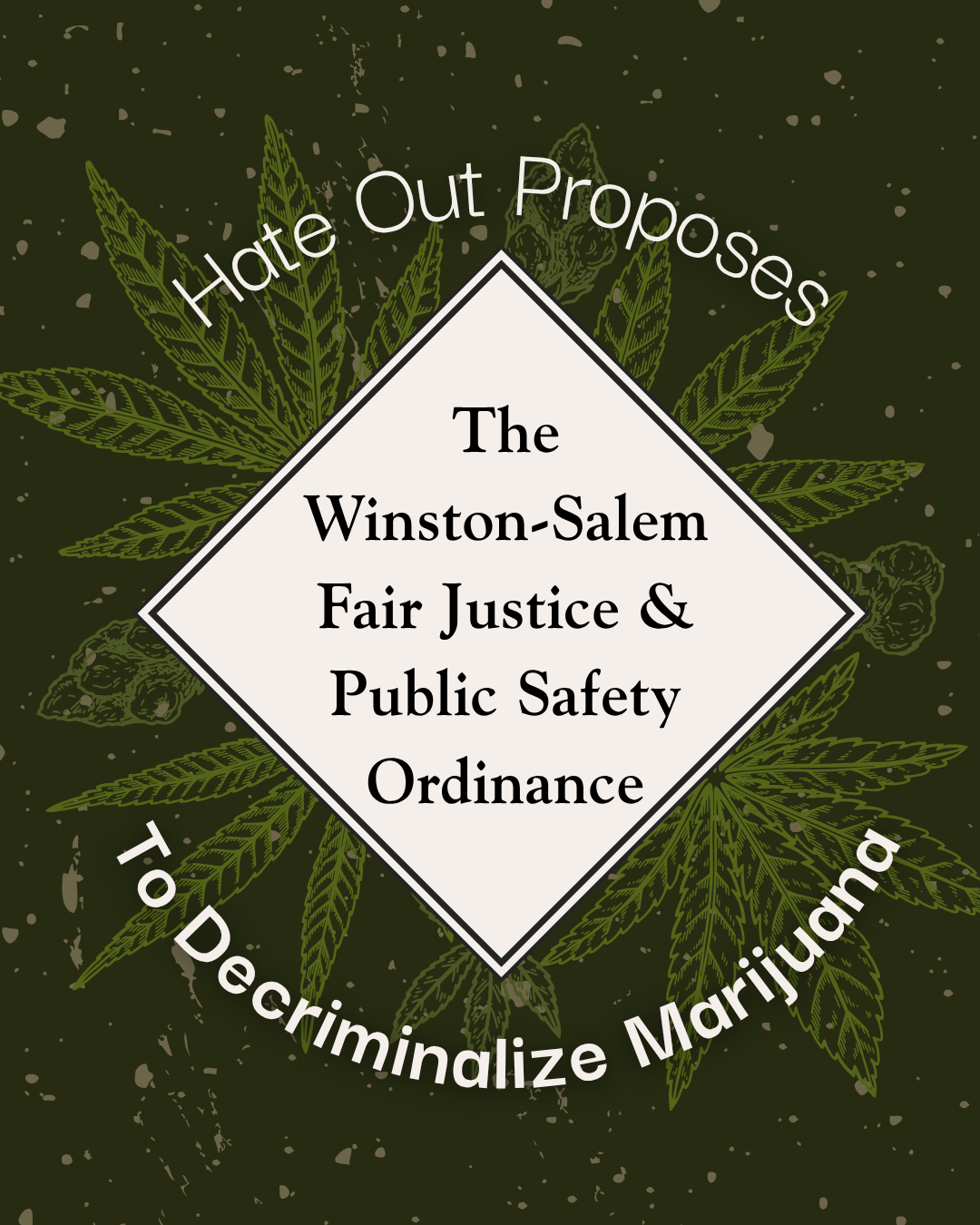
This year, Hate Out is working with local supporters, business owners, and advocates to formally decriminalize marijuana in Winston-Salem through two specific municipal policies: a Mandatory Cite and Release Protocol and a Lowest Law Enforcement Priority (LLEP) Ordinance.
As the state considers regulation or prohibition of marijuana, YOU can make sure our neighbors aren't arrested for misdemeanor possession by telling City Council to decriminalize Winston!
Petition by
Sponsored by
To:
Winston Salem City Council
From:
[Your Name]
PROPOSAL: The Winston-Salem Fair Justice & Public Safety Ordinance
To: Winston-Salem City Council and the Forsyth County District Attorney’s Office
From: Hate Out of Winston (HOOW) and Undersigned Residents/Business Owners
Subject: Implementation of Cite & Release, Lowest Law Enforcement Priority (LLEP), and Decarceration Protocols
I. Summary
Winston-Salem currently utilizes arrests and incarceration to manage social behaviors and minor substance use, a strategy that disproportionately harms Black and brown residents while failing to produce genuine safety. This proposal outlines a transition away from punitive policing through Cite and Release and Lowest Law Enforcement Priority (LLEP) protocols. These are foundational steps toward an abolitionist horizon: shrinking the footprint of the legal system, ending state-sanctioned violence for non-violent acts, and reinvesting resources back into the community.
II. Proposed Policy 1: Mandatory Cite and Release (C&R)
- The Protocol: Per NC General Statute § 15A-302, whereby "an officer may issue a citation to any person who he has probable cause to believe has committed a misdemeanor," law enforcement officers shall be prohibited from custodial arrests for misdemeanor marijuana possession (up to 1.5 oz).
- Decarceration as Safety: Physical arrests and incarceration can separate and destabilize families. By mandating citations, we prevent the trauma of booking, strip searches, and the "locked door" of a jail cell.
- Ending the Paper Trail: Criminal records prevent community members from securing employment, housing and more. This policy prevents the creation of records that bar residents from the basic human rights of housing and employment.
- Reducing Police Encounters: Every minute an officer spends processing an arrest is a minute of potential escalation. Minimizing these points of contact reduces the risk of police-involved violence while saving the City’s time and money.
III. Proposed Policy 2: Lowest Law Enforcement Priority (LLEP)
- The Protocol: The Winston-Salem Police Department and the DA’s Office shall designate the investigation, citation, arrest, seizure, and prosecution of adult marijuana possession as the absolute lowest priority, effectively creating a "non-enforcement" zone for simple possession.
- Divestment from Prohibition: Prohibition has historically been used as a tool of racial social control. LLEP is a step toward "disarming" the police of a pretext often used to initiate invasive searches and surveillance in marginalized neighborhoods.
- Redirecting the Gaze: By de-prioritizing marijuana, we challenge the logic that "more policing equals more safety." We demand a shift in focus away from low-level "crimes" and toward the root causes of community instability, which may be addressed with the public dollars diverted from marijuana possession cases.
IV. Abolitionist Reinvestment & Community Care
Standard "reform" often keeps resources within the police department. This proposal demands community-led reinvestment:
- Budgetary Realignment: Savings from reduced jail intake and decreased police processing hours should be transferred to the Behavioral Evaluation and Response (BEAR) team.
- Reparative Equity: We reject a "corporate-only" cannabis model. We demand local policies that support the "underground" economy—those who survived the War on Drugs—ensuring they are not pushed out by white-owned “green rush” dispensaries as marijuana is decriminalized and potentially legalized.
- Youth Decarceration: We demand the decarceration of Forsyth County jail inmates serving sentences for the possession of marijuana, especially 16- and 17-year-olds.
*Note: In Forsyth County, Black residents are arrested at 4.6 times the rate of white residents despite nearly identical usage rates.*
V. Additional Proposals to Reinvest Saved Resources
- Mayor's Youth Employment Program: Reclaimed administrative hours can expand youth employment infrastructure. Keeping at-risk students earning a paycheck rather than a record is the most cost-effective intervention available. Durham’s YouthWorks program, which connects hundreds of young adults with top employers for career development and direct compensation, offers a replicable template for reinvesting the policing dividend.
- Interlocal Agreements (NCGS § 160A-461): This statute allows Winston-Salem to contract with Forsyth County to fund shared goals. While other districts have used this for Community Learning Centers and student broadband access, we can use it to pool the resources saved from reduced law enforcement and prosecution costs toward universal Wi-Fi for every student in the district.
VI. Conclusion: Beyond the Cage
The data is clear: the current system uses marijuana as a gateway to incarceration and economic exile. We are not merely asking for "smarter" policing; we are asking for a city that values the lives of its residents over the expansion of its jail. By adopting these policies, Winston-Salem begins the work of dismantling the "scent as a sentence" pipeline and moving toward a model of safety rooted in care, not cages.