Defend Marijuana Legalization: Say NO to SB1725 (Excessive Smoking)
Arizona House of Representatives
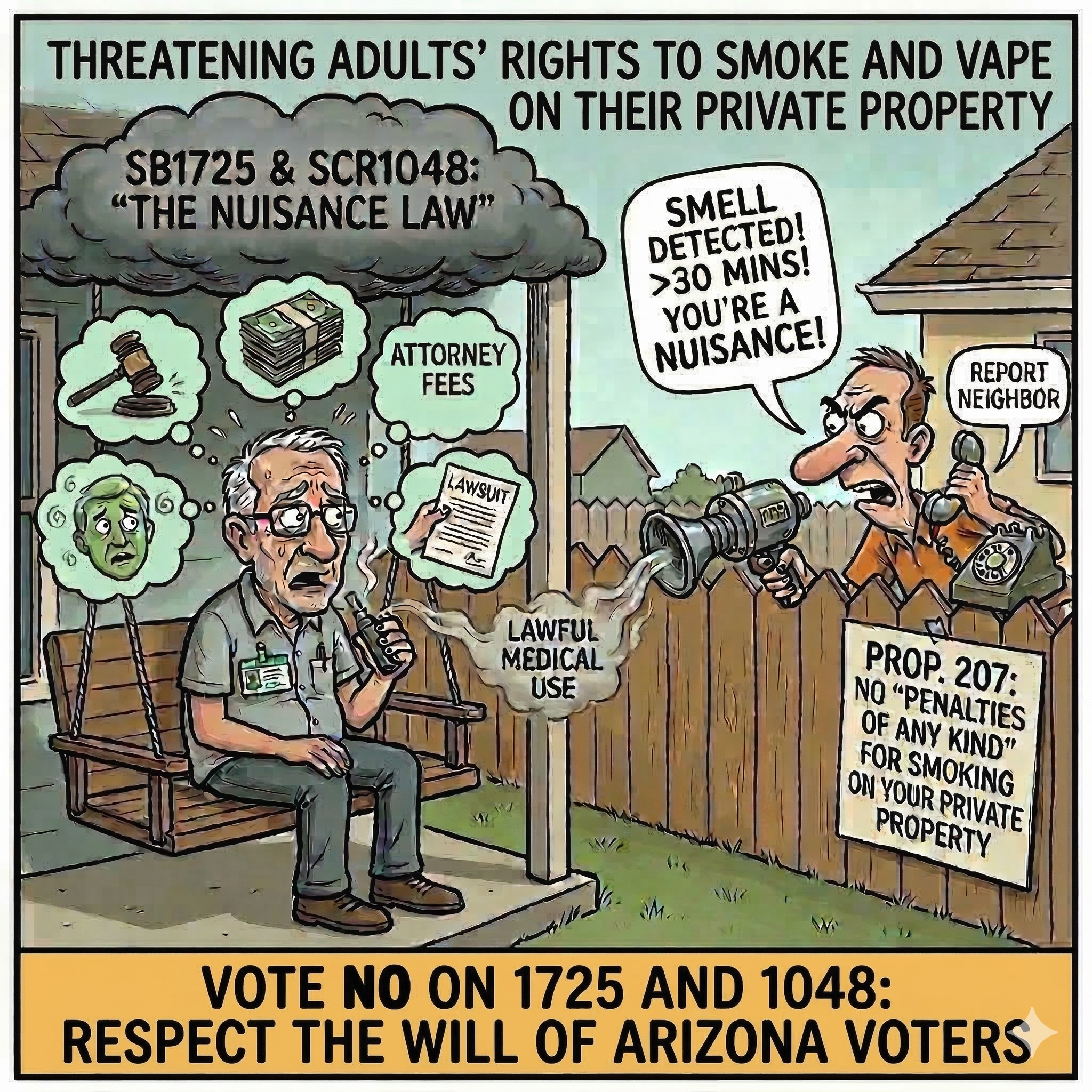
Arizona voters made it clear: marijuana is legal. But now, anti-marijuana politicians are trying to criminalize your legal consumption right in your own backyard. State Senator J.D. Mesnard has introduced SB1725, a bill that designates "excessive" marijuana smoke or odor as a public and private nuisance. The absurd part? This bill stems from Mesnard simply not wanting to explain the smell of marijuana to his kids. Instead of having a basic parenting conversation, he wants to weaponize the legal system against adults who are quietly consuming a legal product on their own land.
Don’t let the word "excessive" fool you. Under SB1725, your marijuana smoke or vapor is considered a legal nuisance if it can simply be smelled by a reasonable person on another property for just 30 consecutive minutes, or on three separate days within a 30-day period. This incredibly broad definition makes it virtually impossible to smoke or vape marijuana outside your house, even if you are entirely on your own private property. To make matters worse, the bill explicitly states that your lawful possession and use of marijuana does not prevent a finding of a nuisance. Neighbors could sue you for compensatory damages, and you could face nuisance abatement orders and fines.
We cannot allow out-of-touch politicians to bypass the will of the voters and turn legal marijuana consumers into targets over a smell. Personal freedom means the right to consume a legal product on your own private property without fear of petty neighbor disputes turning into court injunctions and legal fees. Add your name to the petition below so we can deliver it to Representatives and demand the Arizona Legislature reject SB1725!
Sponsored by
.png)
To:
Arizona House of Representatives
From:
[Your Name]
Dear Representatives,
We respectfully urge you to vote NO on SB 1725.
When Arizona voters adopted Proposition 207 by a decisive 60-40 margin—drawing broad support from our urban centers to conservative strongholds like Mohave County—they spoke clearly. Except for smoking in public places and open spaces, an adult’s consumption of marijuana “cannot serve as sole basis … for imposing penalties of any kind under the laws of this state or any locality.”
Support for Proposition 207 was broad. Not limited to Arizona’s more liberal counties, support for legalization exceeded 60% even in conservative strongholds like Mohave County. SB 1725 attempts to bypass this voter-enacted protection, and in doing so, creates several severe problems for our state:
1. Direct Violation of the Voter Protection Act (VPA)
In State v. Maestas, the Arizona Supreme Court determined that when a voter initiative creates a protected right and outlines specific exceptions, the Legislature amends the initiative when it adds new penalties outside those exceptions. SB 1725 does just this by turning currently-lawful private use into the basis for nuisance liability, injunctions, and even class 2 misdemeanor charges. Furthermore, for medical patients, the bill dismisses valid AMMA status as merely a “mitigating factor” rather than a defense. Under the VPA, altering our marijuana initiatives requires three-quarters supermajority support (23 votes in the Senate, 45 votes in the House). Because SB 1725 does not have a Voter Protection Act clause and failed to receive 75% support in the Arizona Senate, passing this bill would guarantee an immediate, expensive, and taxpayer-funded court challenge that the state would lose.
2. Lack of Evidence for Outdoor Intoxication Claims
The primary justification for this bill—the fear that neighbors or their children will "get high" from outdoor, secondhand marijuana smoke drifting across property lines—finds no support in scientific evidence. To the contrary, research shows no meaningful risk that intoxication may result from exposure to outdoor marijuana smoke. For example, in a NIOSH/open-air concert study, although officers had measurable airborne exposure to marijuana smoke, tests could not detect any THC or THC metabolites in the officers’ blood, and urine findings also fell below routine drug-testing thresholds. See Douglas M. Wiegand et al., Occupational Exposure to Secondhand Cannabis Smoke Among Law Enforcement Officers Providing Security at Outdoor Concert Events, 64 Ann. Work Expo. Health 705 (2020), available at https://pmc.ncbi.nlm.nih.gov/articles/PMC8593821/pdf/nihms-1752453.pdf. Similarly, another study found that nonsmokers exposed for an hour to heavy secondhand cannabis smoke showed detectable THC and mild subjective effects only under extreme unventilated conditions in a sealed chamber, whereas the ventilated conditions produced no sedative drug effects, performance impairment, or positive urine screens. See Evan S. Herrmann et al., Non-Smoker Exposure to Secondhand Cannabis Smoke II: Effect of Room Ventilation on the Physiological, Subjective, and Behavior/Cognitive Effects, 151 Drug & Alcohol Depend. 194 (2015), available at https://pubmed.ncbi.nlm.nih.gov/25957157/. Claims that outdoor marijuana smoke can cause intoxication are in direct conflict with all available research on the subject.
3. A Slippery Slope to Government Overreach
In a free society, mere annoyance should not justify government intervention or the criminalization of lawful conduct on private property. Once the government starts punishing a lawful household odor simply because a neighbor finds it offensive, there is no neutral stopping point. Cigar smoke and the smell of wood-burning fire pits can also cross property lines and bother neighbors. Some people find them very unpleasant. Vegans find barbecue smoke genuinely offensive. But we do not ordinarily turn those private disputes into new crimes.
4. Practical Enforcement Problems
Senator Mesnard himself has said he does not even know which neighbor is responsible in his own situation. That is the practical problem here: odor drifts, smoke dissipates, multiple households may be possible sources, and the evidence is inherently subjective. The result will be guesswork, selective enforcement, and neighbor-against-neighbor litigation.
The worst-case consequences are far too severe for a bill aimed at such a minor and uncertain problem. A single complaint could escalate into a civil lawsuit, an injunction, attorney’s fees, repeated petty-offense allegations for alleged noncompliance, and a misdemeanor prosecution followed by weeks in jail. That is a disproportionate response to an intermittent quality-of-life complaint, especially when the bill rests on an unsupported fear of outdoor intoxication and a constitutional theory that will not survive judicial review.
In conclusion, SB 1725 uses criminal law to address mere discomfort rather than real harm. It violates the clear will of Arizona voters, infringes on private property rights, and invites frivolous litigation that will waste taxpayer dollars.
For these reasons, I respectfully ask that you uphold the Voter Protection Act and vote NO on SB 1725.