Don’t let the Tennessee Valley Authority lock us into a fossil fuel future
Ashley Farless, Tennessee Valley Authority NEPA Specialist
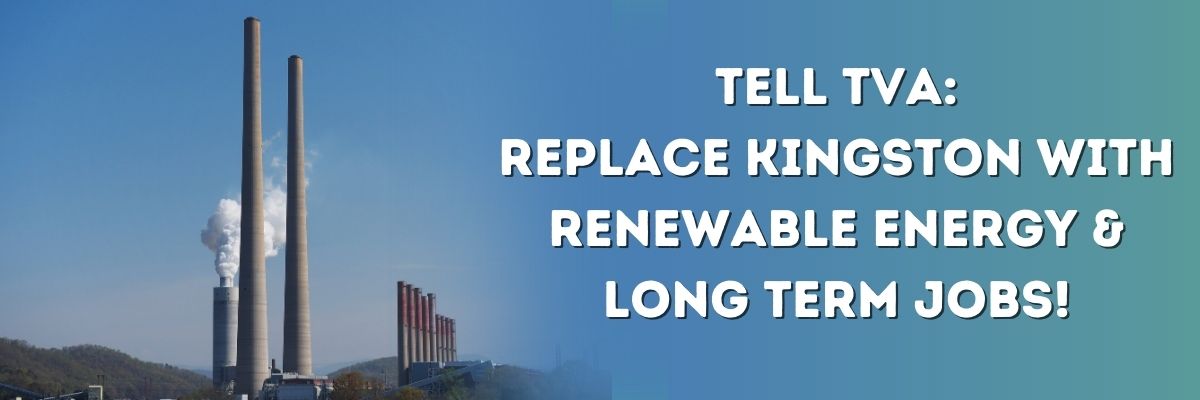
Tennessee residents received major news when the Tennessee Valley Authority announced plans to close down the coal-fired Kingston Fossil Plant in coming years. But TVA is pushing to replace it with a methane gas plant onsite, plus a massive, 122-mile gas pipeline across eight counties.
The Ridgeline pipeline, which would be owned by the multinational company Enbridge, Inc., could threaten clean water for drinking, fishing and farming. Enbridge says the pipeline and its construction area would cross 567 waterbodies. Drilling fluid spills or explosives used during construction can also put rural wells at risk.
After decades of burning coal at Kingston and its massive coal ash spill in 2008, TVA wants to continue to dump pollution into the air surrounding Kingston for another 30 years. Meanwhile, renewable energy alternatives would create more jobs, save money and provide reliable power for replacing the Kingston plant. Tell TVA to support clean air and water with renewable energy!
For more on TVA’s plans and how to comment, check out this guide made by the Sierra Club, or reach out to gabi@appvoices.org for support.
*This petition will be submitted to TVA by Appalachian Voices
Sponsored by

To:
Ashley Farless, Tennessee Valley Authority NEPA Specialist
From:
[Your Name]
The Tennessee Valley Authority should not select Alternative A to replace the Kingston Fossil Plant because of the significant negative impacts it will have on the people, land, water and air in East Tennessee and the global climate. TVA can create jobs, protect public health and the environment, and provide reliable power by replacing the coal at Kingston with safer alternatives. TVA should study and select a Clean Energy Portfolio that includes renewable energy and storage, energy efficiency and demand response to replace the coal capacity at the Kingston plant.
TVA staff’s preferred choice for replacing the Kingston plant, Alternative A, involves the construction of a combined cycle gas facility, 16 combustion turbine gas units and a 122-mile gas pipeline. This construction would require the clearing of more than 700 acres of forest and would impact hundreds of additional acres of vegetated areas. This loss or permanent conversion of habitat would place threatened species like the spotfin chub and the tricolored, little brown, gray and long-eared bats at risk. Several other aquatic species, birds, reptiles and plants are potentially threatened by this massive project.
The pipeline would also cross cherished recreational areas like the Cumberland Trail, Lone Mountain State Forest and tributaries of the Obed Wild and Scenic River. In addition, the pipeline would cut through areas with deep Indigenous history. The pipeline company has already reported 122 Indigenous sites in their project area. It is not necessary for TVA to jeopardize these important cultural and natural sites when it could select a different alternative for replacing the Kingston plant.
The gas plant that TVA wants to build for this project would require 300 million cubic feet of methane per day, releasing emissions such as sulfur dioxide, methane, carbon monoxide and other harmful toxins and greenhouse gasses. TVA’s analysis of the damages that these pollutants would have on the economy are significant — using current standards for calculating the social cost of greenhouse gas, that damage is valued at $7 billion dollars for the total life cycle of the gas plant. By comparison, TVA’s solar and storage Alternative B would have a significantly smaller social cost at $1 billion for the total life cycle of the equipment.
Meanwhile, TVA’s solar and storage option would not produce any air emissions at all. Ironically, TVA also notes in the DEIS that the impacts of climate change would have a negative impact on the efficiency of the gas turbines.
This gas project will have disproportionate impacts on communities who have already been exposed to coal plant pollution for generations. TVA found that all of the low-income census block groups in Roane County near the plant site scored higher than the majority of Tennessee for their proximity to superfund sites, exposure to respiratory hazards and cancer risk caused by air toxins. Yet, TVA’s environmental justice analysis still fails to meaningfully consider the impact that nearly 70 years of coal plant pollution has had on these communities.
For instance, TVA makes hardly any mention of the 2008 Kingston coal ash spill in its analysis. This spill was the largest industrial disaster in U.S. history, when more than a billion gallons of coal ash dumped into the Clinch and Emory rivers and the surrounding community. In the aftermath, TVA tore down 100 affected homes and turned their neighborhood into a park. During the five-year clean up of the spill, workers were denied protective equipment and now are suffering from serious illnesses due to their exposure. It’s hard to imagine that a federal utility could plan to pollute these same neighborhoods for another 30 years without taking this significant history into account.
TVA has a responsibility to support environmental justice for current and future generations in East Tennessee by choosing an emissions-free alternative to replace the Kingston coal plant.
TVA states in the DEIS that it did not consider alternatives such as distributed solar and energy efficiency because it would take too long to scale those technologies. As the largest federal utility in the country, TVA benefits from:
• partnerships with 153 local public power companies who provide service to ratepayers
• partnerships with building trade unions and engineering unions who implement energy planning and projects
• significant funding made available via the Inflation Reduction Act and bipartisan infrastructure law; and
• the opportunity to partner with federal agencies and national labs on energy transition planning.
TVA has the resources at hand to plan and execute a fast and reliable energy transition that is more decentralized and directs benefits to disadvantaged communities. I urge TVA to take advantage of these ample resources and implement an emissions-free alternative for replacing the Kingston plant.
Thank you for considering my comment.