Save Lives on Inner Lake Shore Drive
Chicago Department of Transportation
The Chicago Department of Transportation (CDOT) must act NOW to design safe streets on Inner Lake Shore Drive and stop hundreds of preventable crashes, injuries, and deaths a year.
In the last six months of 2025, the Addison and Inner Lake Shore Drive intersection made headlines after car crashes injured three pedestrians. One of the victims died and another spent weeks in the hospital recovering from critical injuries, including broken ribs, severely damaged legs, a fractured pelvis, and a traumatic brain injury.
Zooming out, the Lakeview portion of the Inner Lake Shore Drive corridor (from Sheridan to Belmont) saw 171 total crashes, with 41 injuries, in the past year. These are just the reported crashes. Unfortunately, residents faced countless more close calls and minor injuries that they didn’t formally report.
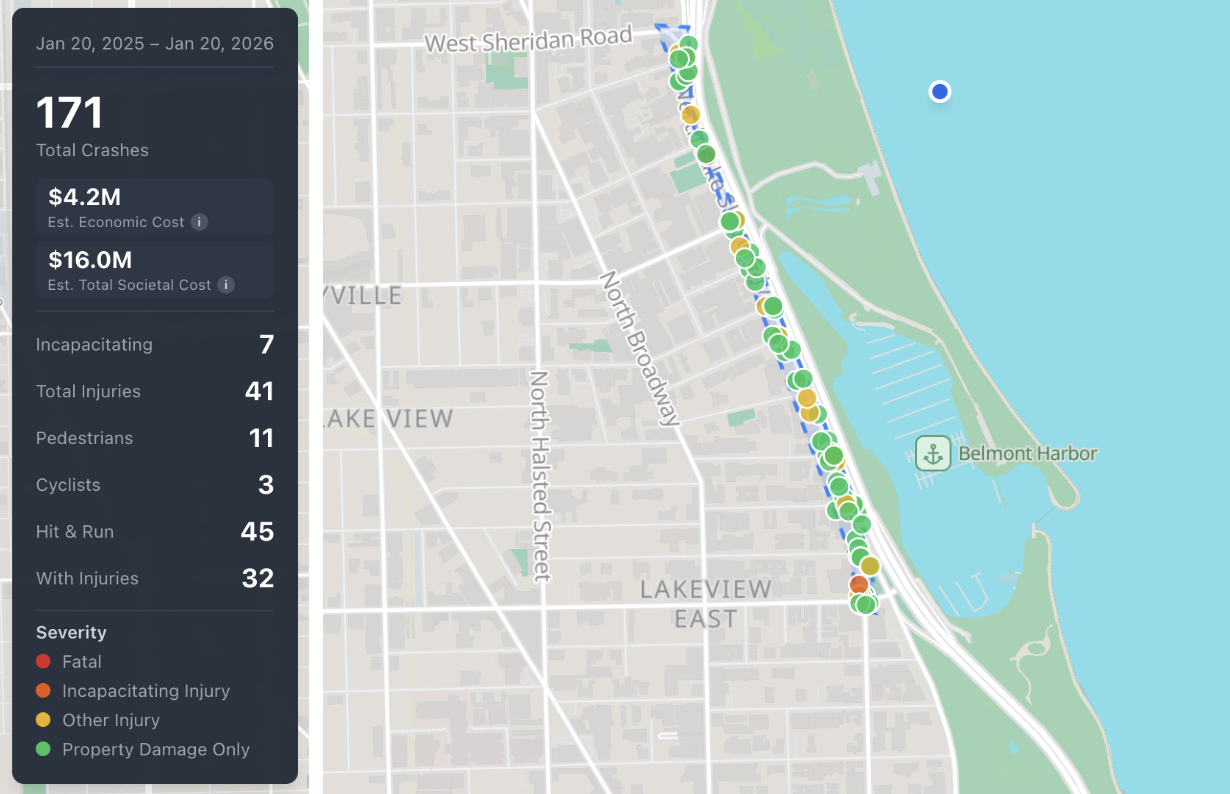
Beyond the human cost of physical injuries and mental trauma, these crashes have an enormous economic impact. The past year of crashes on this corridor cost victims an estimated $4.2 million in medical expenses, legal costs, and property damage. This doesn’t include an additional $16 million in estimated damages to quality of life.
Every day, residents in our community risk their lives walking, biking, taking transit, or driving on or across Inner Lake Shore Drive. It’s an important road for pedestrians and cyclists to cross to access the lakefront, for transit riders to catch one of the many high-ridership bus routes, and for drivers to travel across the city. No one using Inner Lake Shore Drive should fear for their lives on their daily commute or stroll to the park.
CDOT has a moral responsibility to prevent future injuries and deaths on this road and across our community. In a recent social media post, CDOT acknowledged a well-known and well-researched fact that car crashes are not accidents. In CDOT’s own words, “No traffic-related death or serious injury is acceptable when the tools exist to prevent the conditions that lead to these tragedies.”
In November, the 46th Ward requested CDOT to review their portion of Inner Lake Shore Drive from Sheridan to Stratford, which includes the Addison intersection. The 44th Ward plans to do the same for their portion of Inner Lake Shore Drive from Stratford to Belmont.
The next step now is for CDOT to conduct a traffic study to determine what options are available to improve pedestrian safety. However, traffic studies can take a while. We need to let CDOT know that this is a high priority corridor that they need to move quickly on before more preventable injuries and deaths occur.
Although the traffic study is in progress, CDOT sent some initial findings to the 46th Ward office in early January telling them that they most likely will consider adding more road signs and striping. This is not enough.
Driver behavior is largely influenced by road design. If we want them to drive cautiously, we need to design a road with traffic calming measures like curb bumpouts that provide higher visibility for pedestrians and narrow lanes to slow down drivers. This can all be done at a low cost with a high return.
CDOT must act NOW to build safe streets, and they must implement meaningful infrastructure changes that prioritize safety for all road users.
Sponsored by

To:
Chicago Department of Transportation
From:
[Your Name]
CDOT must act NOW to design safe streets on Inner Lake Shore Drive and stop hundreds of preventable crashes, injuries, and deaths a year.
In the last six months of 2025, the Addison and Inner Lake Shore Drive intersection made headlines after car crashes injured three pedestrians. One of the victims died and another spent weeks in the hospital recovering from critical injuries, including broken ribs, severely damaged legs, a fractured pelvis, and a traumatic brain injury.
Zooming out, the Lakeview portion of Inner Lake Shore Drive corridor (from Sheridan to Belmont) saw 171 total crashes, with 41 injuries, in the past year. These are just the reported crashes. Unfortunately, residents faced countless more close calls and minor injuries that they didn’t formally report.
Beyond the human cost of physical injuries and mental trauma, these crashes have an enormous economic impact. The last year of crashes on this corridor cost victims an estimated $4.2 million in medical expenses, legal costs, and property damage. This doesn’t include an additional $16 million in estimated damages to quality of life.
Every day, residents in our community risk their lives walking, biking, taking transit, or driving on or across Inner Lake Shore Drive. It’s an important road for pedestrians and cyclists to cross to access the lakefront, for transit riders to catch one of the many high-ridership bus routes, and for drivers to travel across the city. No one using Inner Lake Shore Drive should fear for their lives on their daily commute or stroll to the park.
CDOT has a moral responsibility to prevent future injuries and deaths on this road and across our community. In a recent social media post, CDOT acknowledged a well-known and well-researched fact that car crashes are not accidents. In CDOT’s own words, “No traffic-related death or serious injury is acceptable when the tools exist to prevent the conditions that lead to these tragedies.”
We demand that CDOT accelerate the traffic study requested by the 46th Ward office and expand the study to review the entire Inner Lake Shore Drive corridor in Lakeview (from Sheridan to Belmont) before more preventable crashes, injuries, and deaths occur.
We also demand that CDOT implement meaningful infrastructure changes like curb bumpouts. Driver behavior is largely influenced by road design. If we want them to drive cautiously, we need to design a road with traffic calming measures like curb bumpouts that provide higher visibility for pedestrians and narrow lanes to slow down drivers. This can all be done at a low cost with a high return.
CDOT must act NOW to build safe streets, and they must implement meaningful infrastructure changes that prioritize safety for all road users.