Acknowledge the inconsistencies and racist rhetoric within Raymond's article
Emilie Raymond
Sign the open letter and add your voice! Full text and what will be sent attached below:
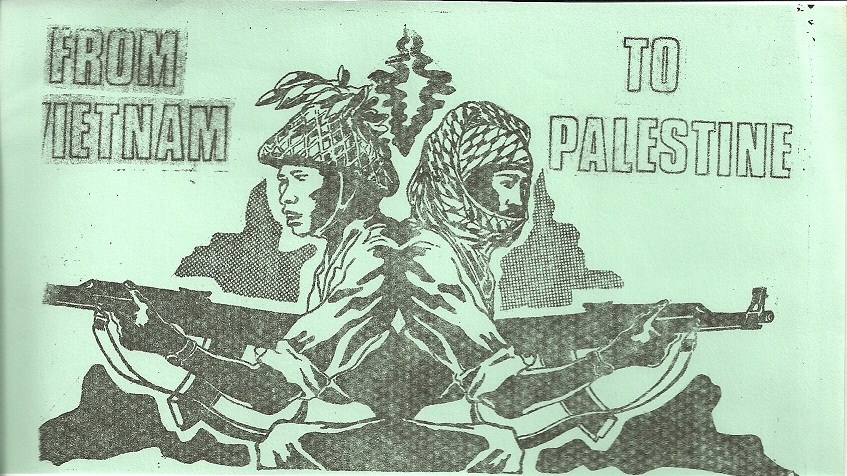
What Red Scare Tactics and Islamophobia Can Teach Us About Vietnamese-Palestinian Liberation
CW: genocide, war, western imperialism, murder, xenophobia
Không có gì quý hơn độc lập, tự do.
(Nothing is more precious than independence and freedom.)
Raymond consistently paints Vietnamese people (người Việt) as easily intimidated, malleable, and gullible Asians to shore up her representations of Palestinians as ignorant and naive. Her usage of terms such as “North Vietnam,” “North Vietnamese,” “Hanoi,” and “the communists” as interchangeable, fails to acknowledge crucial distinctions between the Communist Party of Vietnam (CPV), the People’s Army of Vietnam (PAVN), or the National Liberation Front of South Vietnam (NLF) often called Việt Cộng (which is a derogatory term). Moreover, many of Raymond’s claims lack a permalink citation or are flat-out incorrect, such as when she references a picture of anti-war protestors carrying the flag of “their captors” which in actuality is the flag of the NLF, not the PAVN, which held most POWs in Hanoi. Her scholarship and analysis provided within the article are flimsy and oftentimes built upon xenophobic claims maintained for decades to justify harm and violence to Asian bodies.

These inaccurate and at times xenophobic representations maintained for decades to justify harm and violence to Asian bodies, underpin her portrayal of Palestinians as analogous to Vietnamese people, and as currently living under the oppressive “hostage-taking regime” of Hamas, when in reality, Palestinians in Gaza are currently imprisoned in the largest open-air prison maintained by Israel. Nowhere in her account does she mention the First Nakba and the 75+ years of occupation, nor does she mention the French colonization of Việt Nam and the victory of the Vietnamese people leading to their independence. Raymond doesn’t even take the time or effort to acknowledge the Geneva Accords (which the United States did not sign) which split Việt Nam in two to begin with. Moreover, there is no mention of the PAVN or NLF POWs and the torture they experienced in Phú Quốc Prison or Chí Hòa Prison, both built by the French and managed by the South Vietnamese government (backed by the US) during the War of American Aggression. It has been widely accepted that if elections in 1956 had occurred, the majority of người Việt would have unified under Hồ Chí Minh. Of course, due to Ngô Đình Diệm’s refusal to hold elections and the continued division of the country, we may never know how much bloodshed could have been avoided. Michael Hunt in Ideology and U.S. Foreign Policy offers insight into American foreign policy and attitudes towards Việt Nam as he writes:
Finally, Raymond fails to acknowledge how the refugee crisis was a result of the complete destabilization and devastation of an entire country and nearly all its inhabitants. I believe Nhi T. Lieu explains it best. Writing in her book The American Dream in Vietnamese she explains:
Nearly 3 million người Việt across nations, affiliations, status, etc., died in the conflict. When reading a piece like this we cannot help but feel an intense wave of anger, hurt, sadness, and shock. We feel as if Vietnamese voices that aren’t anti-communist, voices that don’t lick the boots of those who killed and massacred our people, voices that simply love and take pride in our country, are always disregarded, ignored, and ridiculed.
In two years (2025), the Socialist Republic of Vietnam will celebrate its 50th year of existence. 50 years since reunification, 50 years from when the bombings stopped, 50 years of resilience and struggle, 50 years of prosperity, 50 years of transformation. I ask, is the plight of the Vietnamese person in Vietnam comparable to Việt kiều (Overseas Vietnamese) still in the imperial core? Are scholars and historians speaking from a place of care and empathy, or rather exceptionalism and a white savior complex? I'm tired of the narratives of Vietnamese nationals as naive and incompetent. I'm tired of narratives that Asians in communist nations are easily brainwashed and susceptible to propaganda. I put the mirror up to America, where our country houses the largest prison population in the world. Where we are funding wars and genocides (PLURAL). Less than three years ago we were marching and uprising in the streets because this country continues to hunt, dehumanize, and murder Black people. What could you possibly tell a Vietnamese person about their history then?
More white Western/American historians need to engage critically and with the understanding of Third World/Global South struggles and history unless they want to maintain this notion of white saviorism and Western hegemony in their scholarship, which at the end of the day is perpetuating racism and white supremacy. I implore Dr. Raymond and others to invest time into these resources and make a more informed conclusion that doesn’t rely on xenophobic tactics and rhetoric to get a point across. A better analogy is made between the histories, experiences, and liberation struggles in Palestine and Vietnam by looking towards the effects that imperialism and colonialism have in destroying land and deploying counter-revolutionary strategies, while simultaneously engaging in exaggerated and xenophobic language to defend said people’s oppression. Moreover, another comparison can be made between the global anti-colonial struggles for liberation beginning in the late 1940s and the ongoing movement for Palestine we are seeing today. I have no more to say other than I will never support or see the validity in a state that went across the globe to kill and destroy Asians in the name of stopping some dominoes from falling over. I will never support a state that continues to fund genocide so that it can make a profit and establish control within the Middle East. The reality of người Việt, Palestinians, and those of us in the diaspora are linked and by promoting solidarity and collective action, we can make a difference. From the river to the sea, Palestine will be free.
Resources to engage with:
Vietnam Resources from Vietnamese People and Leftist Perspectives
Teaching Resources on Palestine
Solidarity between Vietnam and Palestine
A Short History Of Vietnam And Palestine
Vietnam War POWs: Their Unsettled Legacy at Fifty Years
The Vietnam War's 200,000 forgotten victims: North Vietnamese prisoners of war
Policing the borders of anti-Asian violence
The U.S. Military’s Long History of Anti-Asian Dehumanization
SEAFN Free Palestine & Resources
Jamie Vuong’s addition to the letter:
My parents and many other Vietnamese who lived through the war already had to deal with American-funded attacks. My parents and other Vietnamese refugees were fed with lies about the American Dream without acknowledging or knowing that it was indeed the US traumatizing their life back in Vietnam. I cannot believe that I too am fed these lies growing up in the Vietnamese-American community. Seeing the romanticization of the now-defeated South Vietnamese government, funded by the US government, scares me and continues to do so right now, not realizing that I am seeing a regime that supports killing of innocent lives. Additionally, seeing first-generation Vietnamese Americans in military outfits standing around a statue supporting an American-backed regime in Houston’s Little Saigon in Bellaire shocks me a lot. I always think to myself why so many Vietnamese-American refugees would even support a regime that doesn’t exist because of the liberation and reunion of Vietnam. My experiences of being a Vietnamese American, having to deal with all these things reminds me of what many Jewish-Americans were taught about Israel. Romanticized views of how Israel is the state for Jews, not knowing that displacement and killing of many Palestinians for imperialist purposes.
Knowing that pro-Israeli Jews support the killing of Gazan children through chemical warfare from the Israeli government shocks me the most. In many ways, it reminds me of the My Lai Massacre, where many women and children died at the hands of American soldiers because they were accused of being part of the North Vietnamese army as spies. I cannot grasp that both the American and Israeli armies would kill the innocent as they suspect them to be the bad guys when both the North Vietnamese and Hamas, respectively, are liberators. But why children? Why children when they grew up in terror? Why children when they don’t even know what is going on and have to live on their own? My heart goes out to all of the victims who died in the hands of an imperialist regime.
Petition by

To:
Emilie Raymond
From:
[Your Name]
What Red Scare Tactics and Islamophobia Can Teach Us About Vietnamese-Palestinian Liberation
CW: genocide, war, western imperialism, murder, xenophobia
Không có gì quý hơn độc lập, tự do.
(Nothing is more precious than independence and freedom.)
As students from Virginia Commonwealth University, we are writing to express the shock and sadness that we felt when reading Emilie Raymond’s Time Magazine article, “What Hostage-Taking During the Vietnam War Can Teach the World About Hamas,” In the piece meant to support Israel’s attacks on Hamas, and presumably to draw attention to her own research on POWs during the Vietnam War, Raymond maintains a bad faith argument to support a flimsy analogy devoid of critical historical context or any acknowledgment of the United States and Israel’s colonial and imperialist interventions in Việt Nam and Palestine. For a US-based historian to be so blind to historical context in not just one, but two nations, is appalling and enables the reproduction of simplistic, and frankly racist, tropes, as well as Islamophobic and Red-Scare paranoia.
Raymond consistently paints Vietnamese people (người Việt) as easily intimidated, malleable, and gullible Asians to shore up her representations of Palestinians as ignorant and naive. Her usage of terms such as “North Vietnam,” “North Vietnamese,” “Hanoi,” and “the communists” as interchangeable, fails to acknowledge crucial distinctions between the Communist Party of Vietnam (CPV), the People’s Army of Vietnam (PAVN), or the National Liberation Front of South Vietnam (NLF) often called Việt Cộng (which is a derogatory term). Moreover, many of Raymond’s claims lack a permalink citation or are flat-out incorrect, such as when she references a picture of anti-war protestors carrying the flag of “their captors” which in actuality is the flag of the NLF, not the PAVN, which held most POWs in Hanoi. Her scholarship and analysis provided within the article are flimsy and oftentimes built upon xenophobic claims maintained for decades to justify harm and violence to Asian bodies.
These inaccurate and at times xenophobic representations maintained for decades to justify harm and violence to Asian bodies, underpin her portrayal of Palestinians as analogous to Vietnamese people, and as currently living under the oppressive “hostage-taking regime” of Hamas, when in reality, Palestinians in Gaza are currently imprisoned in the largest open-air prison maintained by Israel. Nowhere in her account does she mention the First Nakba and the 75+ years of occupation, nor does she mention the French colonization of Việt Nam and the victory of the Vietnamese people leading to their independence. Raymond doesn’t even take the time or effort to acknowledge the Geneva Accords (which the United States did not sign) which split Việt Nam in two to begin with. Moreover, there is no mention of the PAVN or NLF POWs and the torture they experienced in Phú Quốc Prison or Chí Hòa Prison, both built by the French and managed by the South Vietnamese government (backed by the US) during the War of American Aggression. It has been widely accepted that if elections in 1956 had occurred, the majority of người Việt would have unified under Hồ Chí Minh. Of course, due to Ngô Đình Diệm’s refusal to hold elections and the continued division of the country, we may never know how much bloodshed could have been avoided. Michael Hunt in Ideology and U.S. Foreign Policy offers insight into American foreign policy and attitudes towards Việt Nam as he writes:
We dehumanized the Vietnamese by the everyday language applied to them. We called them “g—” or “s—”... Reflecting our diminished sense of their humanity, we made massive and indiscriminate use of firepower and herbicides, killing non-combatants as well as combatants and poisoning the land. At the same time, we promoted a pattern of national development informed by the American experience, taught the Vietnamese how to fight and govern, and when necessary both fought and governed for them. The resulting devastation, dislocation, and subordination was the price the Vietnamese paid for our self-assigned crusade to stop communism, save a people we regarded as backward, and revitalize an outmoded culture (176– 77).
Finally, Raymond fails to acknowledge how the refugee crisis was a result of the complete destabilization and devastation of an entire country and nearly all its inhabitants. I believe Nhi T. Lieu explains it best. Writing in her book The American Dream in Vietnamese she explains:
The United States acted in self-interest, allowing their military machine to ravage the Vietnamese landscape, poisoning it with defoliants such as Agent Orange and indiscriminately destroying human life in the process. Such devastation contributed to making life in Vietnam unbearable. The refugees who ultimately fled Vietnam did not leave merely because Saigon fell into the hands of the communist rulers. The effects of the war made it very difficult to sustain life in such a toxic devastated environment (12).
Nearly 3 million người Việt across nations, affiliations, status, etc., died in the conflict. When reading a piece like this we cannot help but feel an intense wave of anger, hurt, sadness, and shock. We feel as if Vietnamese voices that aren’t anti-communist, voices that don’t lick the boots of those who killed and massacred our people, voices that simply love and take pride in our country, are always disregarded, ignored, and ridiculed.
In two years (2025), the Socialist Republic of Vietnam will celebrate its 50th year of existence. 50 years since reunification, 50 years from when the bombings stopped, 50 years of resilience and struggle, 50 years of prosperity, 50 years of transformation. I ask, is the plight of the Vietnamese person in Vietnam comparable to Việt kiều (Overseas Vietnamese) still in the imperial core? Are scholars and historians speaking from a place of care and empathy, or rather exceptionalism and a white savior complex? I'm tired of the narratives of Vietnamese nationals as naive and incompetent. I'm tired of narratives that Asians in communist nations are easily brainwashed and susceptible to propaganda. I put the mirror up to America, where our country houses the largest prison population in the world. Where we are funding wars and genocides (PLURAL). Less than three years ago we were marching and uprising in the streets because this country continues to hunt, dehumanize, and murder Black people. What could you possibly tell a Vietnamese person about their history then?
More white Western/American historians need to engage critically and with the understanding of Third World/Global South struggles and history unless they want to maintain this notion of white saviorism and Western hegemony in their scholarship, which at the end of the day is perpetuating racism and white supremacy. I implore Dr. Raymond and others to invest time into these resources and make a more informed conclusion that doesn’t rely on xenophobic tactics and rhetoric to get a point across. A better analogy is made between the histories, experiences, and liberation struggles in Palestine and Vietnam by looking towards the effects that imperialism and colonialism have in destroying land and deploying counter-revolutionary strategies, while simultaneously engaging in exaggerated and xenophobic language to defend said people’s oppression. Moreover, another comparison can be made between the global anti-colonial struggles for liberation beginning in the late 1940s and the ongoing movement for Palestine we are seeing today. I have no more to say other than I will never support or see the validity in a state that went across the globe to kill and destroy Asians in the name of stopping some dominoes from falling over. I will never support a state that continues to fund genocide so that it can make a profit and establish control within the Middle East. The reality of người Việt, Palestinians, and those of us in the diaspora are linked and by promoting solidarity and collective action, we can make a difference. From the river to the sea, Palestine will be free.