Miami Has Acres Of Empty Parking Lots. Why Destroy Wetlands To Build More?
The Miami-Dade County Commission
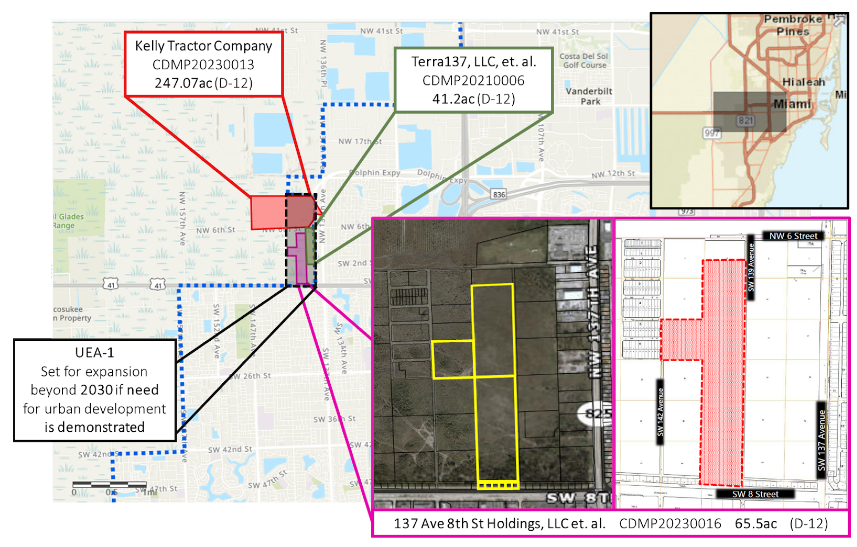
In March 2023, the County Commission voted to build a truck parking and service facility, the "Miami Transit Hub", on 40 acres of wetlands outside the Urban Development Boundary (UDB). Now, developers want to pave another 70 wetland acres for more truck parking. This time, Commissioners must say no to wetlands destruction. A better, more efficient and less environmentally damaging solution to the truck parking shortage is to implement the Florida Department of Transportation's (FDOT) recommendations to create parking capacity at existing county, municipal, and private facilities.
FDOT has identified a truck parking deficit in the county and Miami-Dade is working to increase the supply of parking spaces. FDOT's 2022 study identified multiple methods to supply additional truck parking spaces without destroying sensitive environmental lands or adding to urban sprawl. Much of the local, short-haul parking demand can be met using existing parking lots, vacant land, and public facilities inside the UDB to host parking sites. Stadiums and county facilities like Homestead Raceway, Hard Rock Stadium, and the FLA Live Arena (Broward) have extensive parking areas with low utilization rates. Big box retailers and warehouses and other stakeholders that rely on the trucking industry need to pitch in by allowing access to their lots during off-peak hours.
Proven technology can also play a role. 15 years after Airbnb launched, an obvious solution- matching available, authorized parking spaces with truckers for short stays- does not exist. A public-private partnership to build a reservation platform would create a compliance solution for drivers, income for parking "hosts", and revenue to bolster MDC's finances. It's smart policy that leverages public assets, and private know-how to solve a community problem through greater efficiency.
Or, we can fill rare wetlands with concrete while simultaneously spending billions of taxpayer dollars to revive Biscayne Bay and restore Everglades ecosystems imperiled by land use decisions like these.
We have better solutions. Tell Commissioners it's time to demand innovative, efficiency-based solutions to land use challenges, and avoid repeating the same environmentally-destructive development patterns. Sign the petition today to demand modern solutions, not perpetuate an antiquated development model.
Sponsored by

To:
The Miami-Dade County Commission
From:
[Your Name]
Chairman Gilbert and Members of the Miami-Dade County Commission,
We urge you to vote no on CDMP20230016 "Miami Transit Hub II", an application to pave 70 acres of North Trail Basin wetlands to construct a truck parking facility. Biscayne Bay is fighting for its life. Smart solutions that maximize the economic potential of urbanized areas while minimizing sprawl and pollution in the Biscayne Bay watershed are vital to the Bay's recovery. We acknowledge the need for truck parking, but with thousands of underutilized acres across Miami-Dade County, we can find solutions that without paying an unacceptable ecological price.
FDOT's 2022 study recommended several options to increase the supply of truck parking without the need for more concrete and steel. Using legislative and administrative measures, opening spaces in county, municipal, and commercial properties could help to address the truck parking shortfall. These locations can provide safe, convenient, affordable parking options for truckers while generating additional revenue streams for site owners. Online reservation systems are established technology that could support this system. Smart economics, and smart growth policies, demand using existing capacity more efficiently before consuming precious unique ecosystems.
It's relatively cheap and easy to connect truckers to existing parking locations. It is expensive and incredibly difficult to restore wetlands and South Florida's hydrology. Let's try using the easy button, and explore smart regulatory and technology-based solutions. Reject the Miami Transit Hub II application. Choose smart solutions over sprawl for the survival of wetlands and a healthy Biscayne Bay.