No Data Centers in Monterey Park! / Opongan los centros de data en Monterey Park! / 蒙特利公園市絕不容許資料中心的存在!
Monterey Park City Council
The Issue
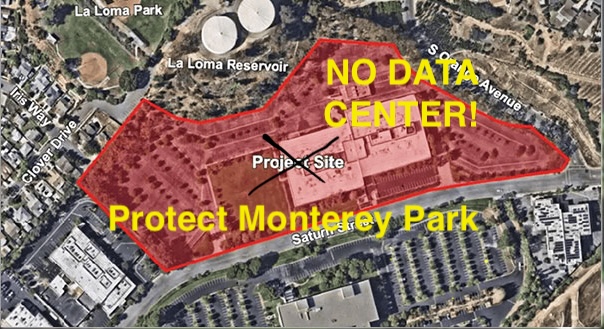
In January of 2024, a private Australian developer, HMC StratCorp (the Applicant), with their subsidiary DigiCo REIT, proposed building a hyperscale data center. This is a facility housing computer servers to be used to train AI, among other uses, at 1977 Saturn Avenue in Monterey Park. This would be an approximately 250,000 square foot industrial facility that would be operating 24 hours a day, 7 days a week, 365 days a year in the middle of Monterey Park, tripling the city's energy consumption. A project of this scale would undoubtedly create negative environmental and health-related consequences, raise utility costs, and decrease property values.
[January 26, 2026 update] At the January 21, 2026 Council Meeting, hundreds of residents showed up at City Hall to protest against the data center and raised health, environmental, and quality-of-life concerns. Had the community not spoken up, this project would have quietly moved forward after appearing on a December City Council agenda. After more than five hours of public comment, City Council approved a 45-day moratorium on data centers (expires on March 7) and is now open to also exploring a potential permanent ban on data centers in Monterey Park during the 45 day moratorium.
We have made significant progress, but we aren’t done yet: we need to make sure the permanent ban goes through.
Given this, we are updating the demands as follows:
🚫 [Added after January 21, 2026 City Council Meeting] We do not want any data centers in Monterey Park, ever.
📣 We demand that the City Council approve a permanent ban on data centers in Monterey Park.🚫 HMC Wants to Push The Project Through Without a Full Environmental Review [We have achieved this demand! HMC is voluntarily conducting an EIR if the project moves forward. However, the public needs to be involved and provide oversight on any potential EIR.]
📣 We do not want a data center in Monterey Park. There is no level of mitigation that would make this project okay. We demand that the City Council vote for a full environmental review to measure the full impact of the proposed project, which would effectively shut this project down.
🚫 City Council Did Not Effectively Engage the Public About This Project and Most Residents Are Just Finding Out About It
📣 City Council has an opportunity to demonstrate its commitment to Monterey Park residents and regain their trust. City Council's continued accommodation of HMC demonstrates a disregard for Monterey Park and its residents. Approving HMC’s proposal would be a betrayal of trust, especially considering the widespread opposition and the absence of meaningful public benefits for our community. Council members who vote "yes" on approving HMC’s proposal will face the consequences at the ballot box.
Background
[January 21, 2026 update] HMC has voluntarily agreed to conduct an EIR if the project moves forward. However, HMC is not trusted to conduct their own EIR in secrecy. Community feedback has urged the city to require public oversight and transparency on the EIR process if it happens.
On October 31, 2024, HMC submitted an Initial Study (IS) and Mitigated Negative Declaration (MND) for this data center. In response to some feedback received on December 2, 2024 from organizations like Advocates for the Environment and others, HMC submitted revised technical details with design enhancements on October 27, 2025. The IS/MND is a streamlined environmental review process that allows projects to move forward quickly, but only if all impacts are deemed "less than significant." For a facility of this scale, that conclusion deserves scrutiny.
The applicant's consultants (Kimley-Horn) prepared the IS/MND. They chose the assumptions, set the study boundaries, and selected the comparisons. Not surprisingly, they concluded their client's project poses no significant impacts. But "less than significant" is a legal threshold, not a measure of whether there are actual impacts or whether real people will be affected.
Thresholds are imperfect measures of experienced reality.
-
They are often arbitrary: Noise limits (54–56 dB) are set for regulatory convenience, not based on health research about sleep disruption or stress.
-
They may be outdated: Air quality thresholds don't always reflect current science on cumulative health effects.
-
Impacts below thresholds still cause harm: A continuous 50 dB hum 24/7 may comply with the law but still degrade quality of life.
-
"Mitigated" ≠ "Eliminated": Sound barriers reduce noise; they don't make it disappear. Biofiltration treats stormwater; it doesn't purify it.
You have the right to define what matters to your community – even if they're deemed legally "insignificant." The phrase "less than significant" is a regulatory conclusion, not a statement that nothing bad will happen. It means that by some measures impacts will fall below a regulatory threshold set by an agency (e.g., The City of Monterey Park). That’s all it means. It does not mean the impact is harmless, negligible, or unnoticeable; that no one will be affected; or that the threshold itself is scientifically or morally defensible.
Applicants have strong incentives to produce MNDs and avoid Environmental Impact Reports (EIRs): they save time and money, face less public scrutiny, and avoid identifying alternatives or additional mitigation measures. But MNDs are also easier to challenge legally. If opponents can show a "fair argument" that significant impacts exist – even if the applicant's consultants disagree – a court can require a full EIR.
On this project, the MND is quite weak and it is easy to meet this standard. Here are a couple of selected issues:
- Noise from chillers narrowly within permitted levels: Operational noise from chillers will be 50–55 dBA at property lines. These fall within City limits, but will be constant and with margins as narrow as 1 decibel -- essentially no room for error. For context, this is what that could sound like. Their conclusion is “less than significant impact.”
-
Energy consumption: The facility would draw an estimated 434 GWh/year from the SoCal Edison grid (which is only one-third renewable). This triples Monterey Park's total energy consumption, yet the IS/MND dismisses it as merely 0.64% of SoCal Edison's total demand. Their conclusion is "less than significant."
-
Scope 2 greenhouse gas emissions: The project would generate approximately 77,000 metric tons of CO2 annually -- equivalent to roughly 17,000 cars on the road. The bulk of these emissions (75,181 metric tons) come from offsite grid power generation. The IS/MND excludes these Scope 2 emissions from its analysis, saying it shouldn't count, even though they are real and should be counted; they are simply experienced by communities near power plants rather than in Monterey Park. Their conclusion: "less than significant."
Throughout the IS/MND, Kimley-Horn appears to minimize each number in ways that obscure its significance -- seemingly to avoid triggering an EIR.
✨✨Your voice matters! ✨✨
Your signature here and your testimony can help establish the record needed to argue that significant impacts weren't adequately analyzed.
The applicant wanted a quick approval; with your engagement, you can make the case that this project deserves a closer look. Together, we can make our voices hard to ignore.
What you can do right now
-
Sign this petition and engage on this page
-
Attend public hearings (date TBD; postponed indefinitely as of December 2025).
-
Attend City Council meetings (every second Wednesday @ 6:30) and make public comment that you are opposed to this Data Center and object to the lack of engagement of the City with the community.
-
Submit written comments to the City of Monterey Park Planning Division citing specific concerns and requesting responses (see contact information below)
-
Schedule 1:1s with City Council Members and ask them your questions and share your concerns directly (see contact information below). When you reach out, they may not respond immediately -- so it's important to follow-up with them to remind them that this is important to you.
-
Request an EIR if you believe there's a "fair argument" that significant impacts haven't been adequately analyzed.
-
Talk with your neighbors and organize to amplify concerns about cumulative and localized impacts. Learn more about the details of the project here.
-
Team-up with community-based organizations by following their Instagram (SGV Progressive Action), joining a Facebook Group (Monterey Park Against Data Centers), joining a Signal group (MPK Data Center Opposition), or joining an email list to stay up-to-date (send an email to sgvprogressiveaction@gmail.com to join).
Opongan los centros de data en Monterey Park!
El Asunto
En Enero de 2024, la empresa privada Australiana HMC StratCorp (el solicitante), a través de su filial DigiCo REIT, propuso la construcción de un centro de datos a gran escala. Se trata de una instalación que albergaría servidores informáticos para el entrenamiento de inteligencia artificial, entre otros usos en la locación 1977 de Saturn Avenue, en Monterey Park. Sería una instalación industrial de aproximadamente 250,000 pies cuadrados que operará las 24 horas del día, 7 días de la semana, 365 días del año, en pleno centro de Monterey Park, triplicando el consumo energético de la ciudad. Un proyecto de esta magnitud sin duda generaría consecuencias negativas para el medio ambiente y la salud, aumentaría los gastos de los servicios públicos y bajará el valor de las propiedades entre la ciudad.
🚫 HMC quiere impulsar el proyecto sin una evaluación ambiental completa.
📣 No queremos un centro de datos en Monterey Park. Ninguna medida de mitigación haría este proyecto aceptable. Exigimos que el Concejo Municipal haga bien su trabajo a favor de la ciudad y haga una mejor evaluación ambiental completa. Tenemos que medir el impacto total del proyecto propuesto, lo que efectivamente lo detendría.
🚫 El Concejo Municipal no involucró adecuadamente al público en este proyecto, por eso la mayoría de los residentes apenas se están enterando ahora.
📣 El Concejo Municipal tiene la oportunidad de demostrar su compromiso con los residentes de Monterey Park y recuperar su confianza. La continua complacencia del Concejo Municipal con HMC demuestra una falta de respeto hacia Monterey Park y sus residentes. Aprobar la propuesta de HMC sería una traición a la confianza, especialmente considerando la amplia oposición y la ausencia de beneficios públicos significativos para nuestra comunidad. Los concejales que voten a favor de la propuesta de HMC enfrentarán las consecuencias en las urnas.
Los Antecedentes
El 31 de Octubre de 2024, HMC presentó un Estudio Inicial (EI) y una Declaración Negativa Mitigada (DNM) para este centro de datos. En respuesta a los comentarios recibidos el 2 de Diciembre de 2024 de organizaciones, como Advocates for the Environment y otros, HMC presentó detalles técnicos revisados con mejoras de diseño el 27 de Octubre de 2025. El EI/DNM es un proceso de evaluación ambiental simplificado que permite que los proyectos avancen rápidamente, pero solo si todos los impactos se consideran "menos que significativos". Para una instalación de esta magnitud, esta conclusión merece un análisis exhaustivo.Los consultores del solicitante (Kimley-Horn) prepararon el Estudio de Impacto Ambiental/Declaración de Mitigación. Ellos eligieron las hipótesis, definieron los límites del estudio y seleccionaron los parámetros de comparación. Como era de esperar, concluyeron que el proyecto de su cliente no presenta impactos significativos. Sin embargo, "menos que significativo" es un umbral legal, no una medida de si existen impactos reales o si personas reales se verán afectadas.
Los umbrales son medidas imperfectas de la realidad experimentada.
-
A menudo son arbitrarios: los límites de ruido (54-56 dB) se establecen por conveniencia normativa, no basándose en investigaciones sobre los efectos en la salud, como las alteraciones del sueño o el estrés.
-
Pueden estar desactualizados: los umbrales de calidad del aire no siempre reflejan los conocimientos científicos actuales sobre los efectos acumulativos en la salud.
-
Los impactos por debajo de los umbrales también causan daño: un zumbido continuo de 50 dB las 24 horas del día, los 7 días de la semana, puede cumplir con la ley, pero aun así deteriorar la calidad de vida.
-
"Mitigado" ≠ "Eliminado": las barreras acústicas reducen el ruido; no lo eliminan por completo. La biofiltración trata las aguas pluviales; no las purifica.
Los solicitantes tienen fuertes incentivos para presentar Declaraciones de Impacto Ambiental Negativo (MND) y evitar los Informes de Impacto Ambiental (EIR): ahorran tiempo y dinero, se exponen a un menor escrutinio público y evitan tener que identificar alternativas o medidas de mitigación adicionales. Sin embargo, las MND también son más fáciles de impugnar legalmente. Si los opositores pueden demostrar con “argumentos sólidos” que existen impactos significativos, incluso si los consultores del solicitante no están de acuerdo, un tribunal puede exigir un EIR completo.
En este proyecto, la MND es bastante deficiente y es fácil cumplir con este requisito. A continuación, se presentan algunos ejemplos:
-
El ruido de los sistemas de refrigeración se encuentra justo dentro de los niveles permitidos: El ruido operativo de los sistemas de refrigeración será de 50 a 55 dBA en los límites de la propiedad. Estos niveles están dentro de los límites establecidos por la ciudad, pero serán constantes y con márgenes tan estrechos como 1 decibelio, lo que prácticamente no deja margen de error. Para contextualizar, así es como podría sonar. Su conclusión es que el impacto es "menos que significativo".
-
Consumo de energía: La instalación consumiría aproximadamente 434 GWh/año de la red de SoCal Edison (que solo utiliza un tercio de energía renovable). Esto triplica el consumo total de energía de Monterey Park, sin embargo, el Estudio Inicial/Declaración de Mitigación Negativa (IS/MND) lo descarta como si representara solo el 0.64% de la demanda total de SoCal Edison. Su conclusión es que el impacto es "menos que significativo".
-
Emisiones de gases de efecto invernadero de Alcance 2: El proyecto generaría aproximadamente 77.000 toneladas métricas de CO2 al año, lo que equivale a las emisiones de unos 17.000 automóviles en circulación. La mayor parte de estas emisiones (75.181 toneladas métricas) provienen de la generación de energía eléctrica fuera del sitio. El IS/MND excluye estas emisiones de Alcance 2 de su análisis, argumentando que no deberían contabilizarse, a pesar de que son reales y deberían incluirse; simplemente afectan a las comunidades cercanas a las centrales eléctricas en lugar de a Monterey Park. Su conclusión: "menos que significativo".
A lo largo del Estudio de Impacto Ambiental Inicial/Declaración de Mitigación Negativa, Kimley-Horn parece minimizar cada cifra de maneras que ocultan su importancia – aparentemente para evitar tener que realizar un Estudio de Impacto Ambiental completo.
✨✨¡Tu voz importa! ✨✨
Su firma y su testimonio pueden ayudar a establecer la documentación necesaria para argumentar que los impactos significativos no se analizaron adecuadamente.
El solicitante buscaba una aprobación rápida; con su participación, podemos demostrar que este proyecto merece un análisis más exhaustivo. Juntos, podemos lograr que escuchen nuestras voces.
Qué puedes hacer ahora mismo:
-
Firma esta petición y participa en esta página.
-
Asiste a las audiencias públicas (fecha por determinar; pospuestas indefinidamente a partir de Diciembre de 2025).
-
Asiste a las reuniones del Concejo Municipal (cada segundo Miércoles a las 6:30 p.m.) y expresa públicamente su oposición a este centro de datos y tu descontento por la falta de participación de la ciudad con la comunidad.
-
Envía comentarios por escrito a la División de Planificación de la Ciudad de Monterey Park, citando tus inquietudes específicas y solicitando respuestas (consulta la información de contacto a continuación).
-
Programa reuniones individuales con los miembros del Concejo Municipal para hacerles preguntas y compartir tus inquietudes directamente (consulta la información de contacto a continuación). Es posible que no respondan de inmediato, por lo que es importante dar seguimiento para recordarles que este tema es importante para ti.
-
Solicita un Estudio de Impacto Ambiental (EIR) si crees que existe un argumento válido de que los impactos significativos no se han analizado adecuadamente.
-
Habla con tus vecinos y organízate para dar a conocer las preocupaciones sobre los impactos acumulativos y localizados. Obtén más información sobre los detalles del proyecto aqui.
蒙特利公園市絕不容許資料中心的存在!
問題
2024 年 1 月,一家澳大利亞私營開發商 HMC StratCorp(申請方)與其子公司 DigiCo REIT,提議在蒙特利公園市土星大道 1977 號建造一座超大規模資料中心。該設施將用於容納電腦伺服器,主要進行人工智慧訓練等用途。這將是一個占地 約 25 萬平方英尺的工業設施,位於蒙特利公園市中心,將全年無休、每天 24 小時不間斷運營,致使本市能耗增加兩倍。如此規模的專案無疑將帶來負面的環 境和健康影響,推高公用事業成本,並導致房產貶值。
[2026 年 1 月 26 日更新] 在 2026 年 1 月 21 日的市議會會議上,數百名居民來到市政廳抗議該資料中心,並對健康、環境及生活品質問題表示擔憂。若非社區發聲反對,該專案在去年 12 月登上市議會議程後可能已悄然推進。經過超過五個小時的公眾評論,市議會批准了一項為期 45 天的資料中心暫停令(將於 3 月 7日到期),並願意在這 45 天的暫停期內探討在蒙特利公園市永久禁止資料中心的可能。
我們已取得重大進展,但鬥爭尚未結束:我們必須確保永久禁令獲得通過。有鑒於此,我們將訴求更新如下:
🚫 [2026 年 1 月 21 日市議會會議後新增] 我們絕不容許蒙特利公園市出現任何資料中心,永遠不容許。
📣 我們要求市議會批准在蒙特利公園市永久禁止資料中心。
🚫 HMC 試圖在不進行全面環境審查的情況下強行推進專案 [此項訴求我們已達成! HMC 已自願同意,若專案繼續推進,將進行環境影響報告。然而,公眾必須參 與並對任何潛在的環境影響報告進行監督。]
📣 我們不希望在蒙特利公園市建立資料中心。任何緩解措施都無法使這個專案變得可接受。我們要求市議會投票支持進行全面環境審查,以評估擬議專案的全部影響,此舉將有效扼殺該專案。
🚫 市議會未能就該專案與公眾進行有效溝通,大多數居民剛剛得知此事
📣 市議會有機會展現其對蒙特利公園市居民的承諾,並重獲他們的信任。市議會持續迎合 HMC,顯示出其對蒙特利公園市及其居民的漠視。批准 HMC 的提案將是對信任的背叛,尤其是考慮到廣泛的反對聲音以及該專案未能為本社區帶來有意義的公共利益。投票贊成批准 HMC 提案的市議員,將在未來的選舉中承擔後果。
背景
[2026 年 1 月 26 日更新] HMC 已自願同意,若專案繼續推進,將進行環境影響報告。然而,我們無法信任 HMC 會秘密進行他們自己的環境影響報告。社區的回饋敦促市政府,如果進行環境影響報告,必須要求其過程公開透明並接受公眾監督。
2024 年 10 月 31 日,HMC 為該資料中心提交了一份《初步研究》和《減輕負面聲明》。在收到來自“環保宣導者”等組織於 2024 年 12 月 2 日提出的一些回饋後,HMC 於 2025 年 10 月 27 日提交了修訂後的技術細節和設計改進方案。 IS/MND 是一種簡化的環境審查程式,允許專案快速推進,但前提是所有影響均被判定為“低於顯著水準”。對於如此規模的設施,這一結論值得仔細審視。
申請方的諮詢公司(Kimley-Horn)準備了這份 IS/MND。他們選擇了假設條件,設定了研究範圍,並選定了比較對象。不出所料,他們得出了其客戶的專案不會造成顯著影響的結論。但“低於顯著水準”是一個法律門檻,並非衡量是否實際存在影響或是否真有民眾會受影響的標準。
這些閾值並不能完美衡量人們實際體驗到的現實。
-
它們常常是武斷的:噪音限值(54-56 分貝)的設定是為了監管便利,而非基於關於睡眠干擾或壓力的健康研究。
-
它們可能已經過時:空氣品質閾值並不總能反映當前關於累積健康效應的科學認知。
-
低於閾值的影響仍會造成損害:持續不斷的 50 分貝嗡嗡聲,即使符合法律規定,仍會降低生活品質。
-
“減輕” ≠ “消除”:隔音屏障只能降低噪音,並不能使其消失;生物過濾可以處理雨水,但並不能淨化它。
您有權定義對您社區重要的事項——即使這些事項在法律上被認定為“不顯著”。 “低於顯著水準”這個短語是一個監管結論,並非意味著不會有壞事發生。它僅 意味著根據某些衡量標準,影響將低於某個機構(例如蒙特利公園市政府)設定 的監管閾值。僅此而已。它並不意味著影響是無害的、可忽略的或不引人注意的; 並不意味著沒有人會受到影響;也並不意味著該閾值本身在科學或道德上是站得 住腳的。
申請方有強烈的動機去炮製MND 並規避環境影響報告:這可以節省時間和金錢,面臨更少的公眾監督,並避免確定替代方案或額外的緩解措施。但 MND 在法律上也更容易受到挑戰。如果反對者能夠提出“合理論據”證明存在顯著影響——即使申請方的諮詢公司不認同——法院可以要求進行全面的環境影響報告。
就本項目而言,這份 MND 相當薄弱,很容易達到這個質疑標準。以下是選取的幾個問題:
-
冷水機組噪音勉強達標:冷水機組運行時在地塊邊界處的噪音將為 50-55分貝 A 聲級。這雖然符合本市限值,但將是持續不斷的,且裕度窄至僅 1分貝——基本上沒有出錯空間。作為參考,這聽起來可能是這樣的。他們的結論是“影響低於顯著水準”。
-
能耗問題:該設施每年將從南加州愛迪生電網(僅三分之一為可再生能源)消耗約 4.34 億千瓦時的電力。這使蒙特利公園市的總能耗增加兩倍,但 IS/MND 卻輕描淡寫地稱其僅占南加州愛迪生總需求的 0.64%。他們的結論是“影響低於顯著水準”。
-
範圍二溫室氣體排放:該專案每年將產生約 7.7 萬公噸二氧化碳排放——大致相當於 1.7 萬輛汽車上路行駛的排放量。這些排放中的大部分(75,181公噸)來自場外電網發電。IS/MND 在其分析中排除了這些範圍二的排放,聲稱不應計入,儘管它們是真實存在且本應計入的;它們只是由發電廠附近的社區承受,而非蒙特利公園市。他們的結論是:“影響低於顯著水準”。
✨✨您的聲音至關重要! ✨✨
您在此的簽名和證詞,有助於建立必要的記錄,以論證顯著影響未得到充分分析。
申請方想要快速獲批;通過您的參與,您可以證明這個專案值得更仔細的審視。團結一心,我們可以讓我們的聲音難以被忽視。
您現在可以採取的行動
-
簽署這份請願書並在此頁面參與互動
-
參加公眾聽證會(日期待定;自 2025 年 12 月起已無限期推遲)
-
參加市議會會議(每月第二個星期三@下午 6:30)併發表公眾評論,表明您反對此資料中心,並反對市政府缺乏與社區的溝通。
-
向蒙特利公園市規劃部門提交書面意見,引用具體關切並請求答復(聯繫方式見下文)
-
與市議員預約一對一交流,直接向他們提問並分享您的擔憂(聯繫方式見下文)。 聯繫他們時,他們可能不會立即回復——因此重要的是要進行後續跟進,提醒他們此事對您至關重要。
-
與您的鄰居交談並組織起來,放大對累積性和本地化影響的擔憂。 點擊此處瞭解更多專案詳情。
蒙特利公园市绝不容许资料中心的存在!
问题
2024 年 1 月,一家澳大利亚私营开发商 HMC StratCorp(申请方)与其子公司 DigiCo REIT,提议在蒙特利公园市土星大道 1977 号建造一座超大规模资料中心。该设施将用于容纳计算机服务器,主要进行人工智能训练等用途。这将是一个占 地约 25 万平方英尺的工业设施,位于蒙特利公园市中心,将全年无休、每天 24 小时不间断运营,致使本市能耗增加两倍。如此规模的项目无疑将带来负面的环 境和健康影响,推高公用事业成本,并导致房产贬值。
[2026 年 1 月 26 日更新] 在 2026 年 1 月 21 日的市议会会议上,数百名居民来到市政厅抗议该资料中心,并对健康、环境及生活质量问题表示担忧。若非社区发声反对,该项目在去年 12 月登上市议会议程后可能已悄然推进。经过超过五个
小时的公众评论,市议会批准了一项为期 45 天的资料中心暂停令(将于 3 月 7日到期),并愿意在这 45 天的暂停期内探讨在蒙特利公园市永久禁止资料中心的可能。
我们已取得重大进展,但斗争尚未结束:我们必须确保永久禁令获得通过。
有鉴于此,我们将诉求更新如下:
🚫 [2025 年 1 月 21 日市议会会议后新增] 我们绝不容许蒙特利公园市出现任何资料中心,永远不容许。
📣 我们要求市议会批准在蒙特利公园市永久禁止资料中心。
🚫 HMC 试图在不进行全面环境审查的情况下强行推进项目 [此项诉求我们已达成! HMC 已自愿同意,若项目继续推进,将进行环境影响报告。然而,公众必须参 与并对任何潜在的环境影响报告进行监督。]
📣 我们不希望在蒙特利公园市建立资料中心。任何缓解措施都无法使这个项目变得可接受。我们要求市议会投票支持进行全面环境审查,以评估拟议项目的全部影响,此举将有效扼杀该项目。
🚫 市议会未能就该项目与公众进行有效沟通,大多数居民刚刚得知此事
📣 市议会有机会展现其对蒙特利公园市居民的承诺,并重获他们的信任。市议会持续迎合 HMC,显示出其对蒙特利公园市及其居民的漠视。批准 HMC 的提案将是对信任的背叛,尤其是考虑到广泛的反对声音以及该项目未能为本社区带来有意义的公共利益。投票赞成批准 HMC 提案的市议员,将在未来的选举中承担后果。
背景
[2026 年 1 月 26 日更新] HMC 已自愿同意,若项目继续推进,将进行环境影响报告。然而,我们无法信任 HMC 会秘密进行他们自己的环境影响报告。社区的反馈敦促市政府,如果进行环境影响报告,必须要求其过程公开透明并接受公众监督。
2024 年 10 月 31 日,HMC 为该资料中心提交了一份《初步研究》和《减轻负面声明》。在收到来自“环保倡导者”等组织于 2024 年 12 月 2 日提出的一些反馈后,HMC 于 2025 年 10 月 27 日提交了修订后的技术细节和设计改进方案。 IS/MND 是一种简化的环境审查程序,允许项目快速推进,但前提是所有影响均被判定为“低于显著水平”。对于如此规模的设施,这一结论值得仔细审视。
申请方的咨询公司(Kimley-Horn)准备了这份 IS/MND。他们选择了假设条件,设定了研究范围,并选定了比较对象。不出所料,他们得出了其客户的项目不会造成显著影响的结论。但“低于显著水平”是一个法律门槛,并非衡量是否实际存在影响或是否真有民众会受影响的标准。
这些阈值并不能完美衡量人们实际体验到的现实。
-
它们常常是武断的:噪音限值(54-56 分贝)的设定是为了监管便利,而非基于关于睡眠干扰或压力的健康研究。
-
它们可能已经过时:空气质量阈值并不总能反映当前关于累积健康效应的科学认知。
-
低于阈值的影响仍会造成损害:持续不断的 50 分贝嗡嗡声,即使符合法律规定,仍会降低生活质量。
-
“减轻” ≠ “消除”:隔音屏障只能降低噪音,并不能使其消失;生物过滤可以处理雨水,但并不能净化它。
您有权定义对您社区重要的事项——即使这些事项在法律上被认定为“不显著”。 “低于显著水平”这个短语是一个监管结论,并非意味着不会有坏事发生。它仅 意味着根据某些衡量标准,影响将低于某个机构(例如蒙特利公园市政府)设定 的监管阈值。仅此而已。它并不意味着影响是无害的、可忽略的或不引人注意的; 并不意味着没有人会受到影响;也并不意味着该阈值本身在科学或道德上是站得 住脚的。
申请方有强烈的动机去炮制MND 并规避环境影响报告:这可以节省时间和金钱,面临更少的公众监督,并避免确定替代方案或额外的缓解措施。但 MND 在法律上也更容易受到挑战。如果反对者能够提出“合理论据”证明存在显著影响——即使申请方的咨询公司不认同——法院可以要求进行全面的环境影响报告。
就本项目而言,这份 MND 相当薄弱,很容易达到这个质疑标准。以下是选取的几个问题:
-
冷水机组噪音勉强达标:冷水机组运行时在地块边界处的噪音将为 50-55分贝 A 声级。这虽然符合本市限值,但将是持续不断的,且裕度窄至仅 1分贝——基本上没有出错空间。作为参考,这听起来可能是这样的。他们的结论是“影响低于显著水平”。
-
能耗问题:该设施每年将从南加州爱迪生电网(仅三分之一为可再生能源)消耗约 4.34 亿千瓦时的电力。这使蒙特利公园市的总能耗增加两倍,但 IS/MND 却轻描淡写地称其仅占南加州爱迪生总需求的 0.64%。他们的结论是“影响低于显著水平”。
-
范围二温室气体排放:该项目每年将产生约 7.7 万公吨二氧化碳排放——大致相当于 1.7 万辆汽车上路行驶的排放量。这些排放中的大部分(75,181公吨)来自场外电网发电。IS/MND 在其分析中排除了这些范围二的排放,声称不应计入,尽管它们是真实存在且本应计入的;它们只是由发电厂附近的社区承受,而非蒙特利公园市。他们的结论是:“影响低于显著水平”。
✨✨您的声音至关重要! ✨✨
您在此的签名和证词,有助于建立必要的记录,以论证显著影响未得到充分分析。
申请方想要快速获批;通过您的参与,您可以证明这个项目值得更仔细的审视。团结一心,我们可以让我们的声音难以被忽视。
您现在可以采取的行动
-
签署这份请愿书并在此页面参与互动
-
参加公众听证会(日期待定;自 2025 年 12 月起已无限期推迟)
-
参加市议会会议(每月第二个星期三@下午 6:30)并发表公众评论,表明您反对此资料中心,并反对市政府缺乏与社区的沟通。
-
向蒙特利公园市规划部门提交书面意见,引用具体关切并请求答复(联系方式见下文)
-
与市议员预约一对一交流,直接向他们提问并分享您的担忧(联系方式见下文)。 联系他们时,他们可能不会立即回复——因此重要的是要进行后续跟进,提醒他们此事对您至关重要。
-
与您的邻居交谈并组织起来,放大对累积性和本地化影响的担忧。 点击此处了解更多项目详情。
-
与社区组织合作,关注他们的Instagram(SGV Progressive Action),加入Facebook 群组(Monterey Park Against Data Centers),加入Signal 群组(MPK Data Center Opposition),或加入邮件列表以获取最新信息(发送邮件至 sgvprogressiveaction@gmail.com 加入)。
Monterey Park Contacts
City Council
|
Name |
Title |
|
Phone |
|---|---|---|---|
|
Yang, Elizabeth |
Mayor and Council Member, District 2 |
eyang@montereypark.ca.gov |
626-307-1465 |
|
Lo, Henry |
Mayor Pro Tem and Council Member, District 4 |
hlo@montereypark.ca.gov |
626-307-1465 |
|
Sanchez, Jose |
Council Member, District 3 |
josanchez@montereypark.ca.gov |
626-307-1465 |
|
Wong, Thomas |
Council Member, District 1 |
twong@montereypark.ca.gov |
626-307-1465 |
|
Ngo, Vinh T. |
Council Member, District 5 |
vngo@montereypark.ca.gov |
626-307-1465 |
Planning Division Contacts
|
Name |
Title |
|
Phone |
|---|---|---|---|
|
Hou, Timothy |
Director of Community Development |
thou@montereypark.ca.gov |
626-307-1463 |
|
Chow, Beth |
Planning Manager |
bchow@montereypark.ca.gov |
626-307-1318 |
|
Muñoz, Eliana |
Senior Planner |
emunoz@MontereyPark.ca.gov |
626-307-1304 |
|
Tan, Kevin |
Assistant Planner |
ktan@montereypark.ca.gov |
626-307-1302 |
|
Sanchez, Nikole |
Permit Technician I |
nsanchez@montereypark.ca.gov |
626-307-1307 |
Sponsored by

To:
Monterey Park City Council
From:
[Your Name]
🚫 HMC Wants to Push Project Through Without a Full Environmental Review
📣 We do not want a data center in Monterey Park. There is no level of mitigation that would make this project okay. We demand that the City Council vote for a full environmental review to measure the full impact of the proposed project, which would effectively shut this project down.
🚫 City Council Did Not Effectively Engage the Public About This Project and Most Residents Are Just Finding Out About It
📣 City Council has an opportunity to demonstrate its commitment to Monterey Park residents and regain their trust. City Council's continued accommodation of HMC demonstrates a disregard for Monterey Park and its residents. Approving HMC’s proposal would be a betrayal of trust, especially considering the widespread opposition and the absence of meaningful public benefits for our community. Council members who vote "yes" on approving HMC’s proposal will face the consequences at the ballot box.