Redirect the $5 Million Shoreline Grant to Community-Supported Flood Mitigation in South Shore
Mayor Brandon Johnson, Illinois Department of Commerce and Economic Opportunity (DCEO)
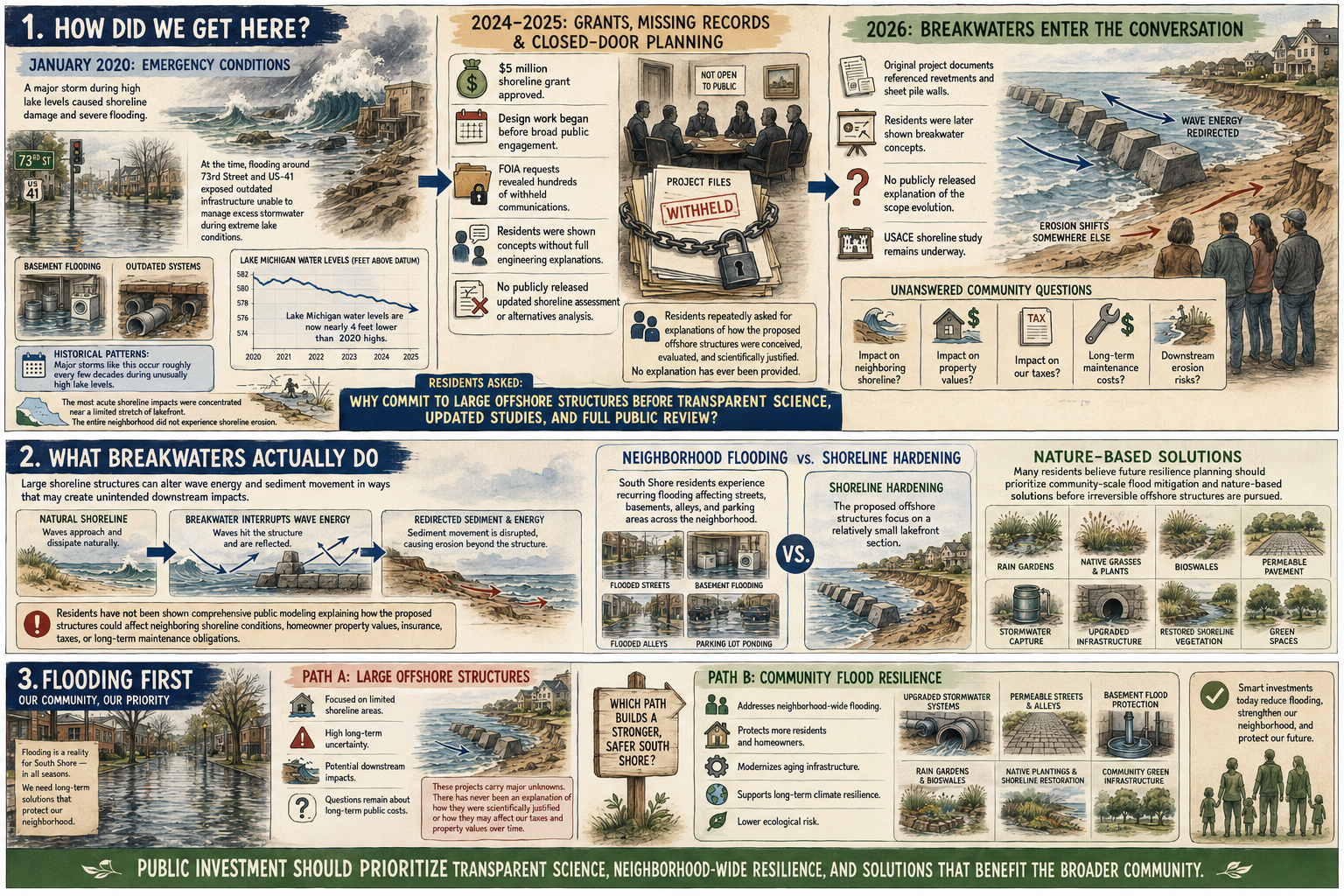
WHAT IS GOING ON HERE?
Every time it rains hard in South Shore, basements flood. Streets turn into rivers. Families pump water out of their homes, replace ruined belongings, and fight mold for months. This is happening right now, in one of only four Chicago neighborhoods researchers have identified as being at the highest risk of urban flooding in the entire city.
Yet despite the suffering of overtaxed homeowners, struggling pensioners, and working families already stretched thin by decades of disinvestment and rising insurance costs, the City of Chicago is advancing a $5 million shoreline project between 71st and 75th Street — lakefront breakwaters that South Shore never asked for, that have no updated environmental review, and that peer-reviewed science shows will cause permanent damage to our shoreline, our water quality, and our neighbors up and down the lake — with an assumed construction start of Fall 2026.
So why is $5 million going into the lake while your basement floods?
WHAT THIS PETITION CALLS FOR:
• Pause the current breakwater proposal between 71st and 75th Street
• Redirect funding toward flood mitigation solutions residents actually need
• Require transparent environmental review and engineering analysis
• Evaluate nature-based alternatives alongside hard infrastructure
• Ensure meaningful community input before any construction begins
This is the last Black lakefront residential community in America. The stretch between 71st and 75th Street, home to a 98% Black residential population, is being targeted for permanent hard infrastructure without a single community meeting that disclosed the full picture, without a single environmental study specific to this project, and without anyone asking residents what they actually need.
What residents need is flood relief. What they are getting is concrete & stones in the lake.
We recognize that climate change and extreme weather pose real risks to both Chicago’s shoreline and its neighborhoods. The question is not whether adaptation is needed, but whether this specific project is scientifically justified, environmentally responsible, and aligned with the actual priorities of South Shore residents.
FOIA (Freedom of Information Act) records reveal that:
🔴 Private properties between 71st and 75th Street are named as the project focus zone with no disclosed property impact analysis, no easement records, and no eminent domain assessment ever made public.
🔴 The urgency is driven by a grant expiration deadline, not an independently assessed hazard. Someone decided South Shore would pay for it with permanent concrete in our lake.
🔴 The environmental basis for this project is a 2020 assessment written during a different lake level emergency. No updated analysis has been produced. (Full FOIA analysis: https://tinyurl.com/4sh34tdj)
🔴 Lake Michigan has been below its long-term average water level since October 2024 and is forecast to remain below average. The lake is now more than 4 feet lower than its 2020 peak. The extreme high-water conditions that triggered the 2020 emergency no longer exist today. (Source: https://wicoastalresilience.org/march-2026-water-level-update) And 2020 conditions won't repeat in the next 30 years as historical data shows (Source: https://www.youtube.com/watch?v=i4qVfVIXm4E, https://tinyurl.com/5n7pxjke)
🔴 The project scope changed from revetments to breakwater concepts with no documented justification and no community input.
WE SUPPORT REAL FLOOD MITIGATION
South Shore residents are not opposing investment in resilience. We support investments that directly address the flooding residents actually experience every year, including:
• upgraded stormwater systems
• permeable pavement
• rain gardens
• bioswales
• green infrastructure
• community-supported nature-based resilience solutions
South Shore deserves infrastructure investments grounded in science, transparency, and the real needs of residents.
Here is a new interactive website documenting flooding complaints in South Shore using live Chicago 311 data:
https://south-shore-floods.streamlit.app/
THE REAL CRISIS IS IN YOUR BASEMENT:
University of Chicago researchers identified South Shore as one of only four Chicago neighborhoods at highest risk of urban flooding. (Source: https://news.uchicago.edu/story/students-identify-chicago-neighborhoods-most-risk-urban-flooding) In 2023 alone, 70,000 Chicago homes flooded, overwhelming sewers across the South Side and driving hundreds from their homes. (Source: https://www.wbez.org/environment/2026/04/10/flooding-chicago-climate-change-deep-tunnel-mold-metropolitan-water-reclamation-district-soaked) South Side families are flooding repeatedly, with homeowners racking up tens of thousands of dollars in basement repairs caused by aging city sewer infrastructure over 100 years old. (Source: https://www.fox32chicago.com/news/chicago-south-side-home-floods-again-family-demands-city-fix-ongoing-problem)
Streets flood. Basements flood. Mold grows. Nobody comes. But there is $5 million ready to drop concrete in the lake.
The neighborhoods getting hit the hardest should not have to lobby for basic protection. South Shore is being skipped for flood relief and targeted for lakefront infrastructure it never requested.
We are not against investment in our lakefront. We are against $5 million in permanent infrastructure being rushed through without science, without transparency, and without us.
HERE IS WHAT PEER-REVIEWED SCIENCE SAYS ABOUT BREAKWATERS:
(Full study: Saengsupavanich et al., "Environmental impact of submerged and emerged breakwaters," Heliyon, 2022: https://pmc.ncbi.nlm.nih.gov/articles/PMC9813723)
BEACH AND SHORELINE DESTRUCTION: Breakwaters permanently interrupt sediment transport and hydrodynamics along the entire shoreline. The damage does not stop at 75th Street. Promontory Point, Rainbow Beach, every neighbor up and down South Shore Drive absorbs the consequences through accelerated downdrift erosion. (https://beachapedia.org/Shoreline_Structures)
EROSION CHAIN REACTION: Breakwaters intended to protect one stretch actively accelerate erosion elsewhere. Deposited sediment between breakwaters blocks all sediment flow behind them, creating a shore-parallel seawall effect that worsens downdrift erosion for years after construction. (https://pmc.ncbi.nlm.nih.gov/articles/PMC9813723)
DANGEROUS CURRENTS: Studies document that strong eddies and currents produced between breakwater gaps dramatically increase drowning risk at public beaches, with averages of 67 victims per year recorded at studied sites. This is a public safety issue for a lakefront where South Shore families swim every summer. (https://pmc.ncbi.nlm.nih.gov/articles/PMC9813723)
WATER QUALITY AND HYPOXIA: Breakwaters create water stagnation, producing hypoxic dead zones in summer, degraded water quality, and conditions that drive beachgoers away from the very shoreline this project claims to protect. (https://pmc.ncbi.nlm.nih.gov/articles/PMC9813723)
ECOLOGICAL CATASTROPHE: Hard engineering structures mechanically destroy lake bottom habitats, reduce dissolved oxygen, intensify turbidity, and permanently alter the ecosystem. No environmental review specific to this project has ever been produced. We do not know what this does to our stretch of Lake Michigan because nobody looked. (https://climate-adapt.eea.europa.eu/en/metadata/adaptation-options/groynes-breakwaters-and-artificial-reefs)
COST: Nature-based alternatives cost two to five times less than hard structures like breakwaters. The city chose the most expensive option for a problem that is shrinking, not growing. (https://pmc.ncbi.nlm.nih.gov/articles/PMC9813723)
THE NON-ADAPTIVE TRAP: Once you pour concrete, you are locked in for generations. Hard coastal structures artificially fix the coastline but compromise the ability of beaches to adapt to changing conditions. Breakwaters are costly to build, costly to maintain, and incapable of responding to a changing climate. Neighbors in Ogden Dunes, Indiana spent $5 million trying to undo the erosion damage caused by a single Lake Michigan breakwater. Watch what they went through, because this is exactly what they are about to do to South Shore: https://www.youtube.com/watch?v=0oJ0UtZIbx0
We, the undersigned, call on the Illinois Department of Commerce and Economic Opportunity (DCEO), the City of Chicago, and the Mayor's Office to:
- Pause advancement of the breakwater project pending a full environmental review and genuine community process.
- Amend Grant 23-203555 to redirect funds toward flooding mitigation solutions that have demonstrated community support.
- Ensure any redesigned scope includes nature-based alternatives evaluated on equal footing with hard engineering.
- Guarantee no construction begins until affected property owners and South Shore residents have had meaningful input.
The last Black lakefront residential community in America did not get a study. It got a construction schedule.
Construction is currently assumed to begin as early as Fall 2026, making immediate public oversight and intervention essential before irreversible shoreline modifications move forward.
Read the full Fact vs. Fiction breakdown of this project, including the missing studies, the Army Corps questions, and the FOIA record.
TAKE ACTION NOW
Sign this petition and then contact decision-makers directly. Your message does not have to be long. Tell them you are a South Shore resident, you oppose the breakwater project as currently designed, and you want the $5 million redirected to community-supported flood mitigation.
Mayor Brandon Johnson City Hall, 121 N. LaSalle Street, Chicago, IL 60602 Phone: 312-744-3300 chicago.gov/mayor
Illinois Department of Commerce and Economic Opportunity (DCEO) 500 E. Monroe Street, Springfield, IL 62701 Phone: 217-782-7500 Chicago office: 312-814-7179 dceo.webmaster@illinois.gov
Share this petition with every South Shore neighbor, block club, and community organization you know. The grant clock is running. Construction is assumed to start this fall. The time to act is now.
Petition by

To:
Mayor Brandon Johnson, Illinois Department of Commerce and Economic Opportunity (DCEO)
From:
[Your Name]
Every time it rains hard in South Shore, basements flood. Streets turn into rivers. Families pump water out of their homes, replace ruined belongings, and fight mold for months. This is happening right now, in one of only four Chicago neighborhoods researchers have identified as being at the highest risk of urban flooding in the entire city.
Yet despite the suffering of overtaxed homeowners, struggling pensioners, and working families already stretched thin by decades of disinvestment and rising insurance costs, the City of Chicago is advancing a $5 million shoreline project between 71st and 75th Street — lakefront breakwaters that South Shore never asked for, that have no updated environmental review, and that peer-reviewed science shows will cause permanent damage to our shoreline, our water quality, and our neighbors up and down the lake — with an assumed construction start of Fall 2026.
FOIA records reveal that the environmental basis for this project is a 2020 assessment written during a different lake level emergency, with no updated analysis ever produced. Lake Michigan is now more than 4 feet below its 2020 peak and has been below long-term average since October 2024. The emergency this project was designed around is over. The project scope changed from revetments to breakwater concepts with no documented justification and no community input. Private properties between 71st and 75th Street, home to a 98% Black residential population and the last Black lakefront residential community in America, are named as the project focus zone with no disclosed property impact analysis, no easement records, and no eminent domain assessment ever made public. The urgency is driven entirely by a grant expiration deadline, not an independently assessed hazard.
Peer-reviewed science is unambiguous: breakwaters permanently alter sediment transport, accelerate erosion on neighboring shorelines, create dangerous rip currents, produce hypoxic dead zones, and mechanically destroy lake bottom habitats. Nature-based alternatives cost two to five times less and adapt to a changing climate. Hard structures do not.
The neighborhoods getting hit the hardest should not have to lobby for basic protection. South Shore is being skipped for flood relief and targeted for lakefront infrastructure it never requested.
We call on you to:
Pause advancement of the breakwater project pending a full environmental review and genuine community process.
Amend Grant 23-203555 to redirect funds toward flooding mitigation solutions that have demonstrated community support.
Ensure any redesigned scope includes nature-based alternatives evaluated on equal footing with hard engineering.
Guarantee no construction begins until affected property owners and South Shore residents have had meaningful input.
The last Black lakefront residential community in America did not get a study. It got a construction schedule. That is not acceptable, and we are asking you to change it.