Restore the Dunsmuir Hellman Historic Estate: Protect Oakland's Most Storied Mansion
City of Oakland
About the Dunsmuir Hellman Historic Estate
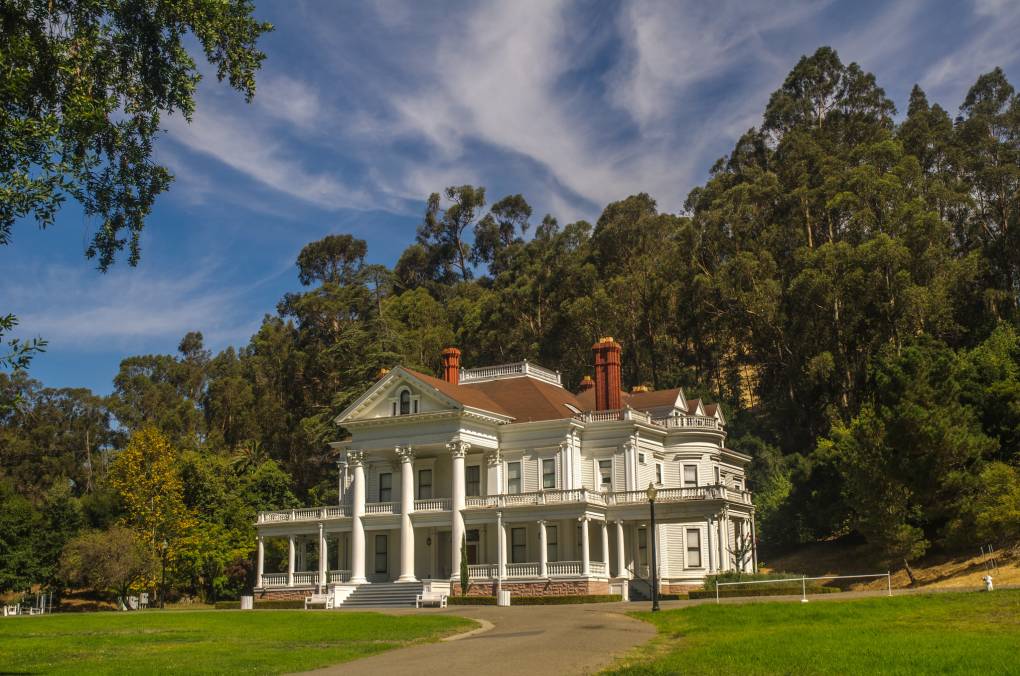
Built in 1899 and set on 50 acres south of the Oakland Zoo, the Dunsmuir Hellman Historic Estate is one of the most architecturally striking mansions in California. Its 37-room Neoclassical Revival structure — crisp white, anchored by three massive columns, and spread across four floors including a wine cellar and servants’ quarters — is a rare, intact survivor of the Gilded Age in the East Bay.
The estate takes its name from Alexander Dunsmuir, the Canadian coal magnate who commissioned it as a wedding gift for his wife Josephine. Their tenure was tragically brief: Alexander died on their honeymoon, and Josephine passed away less than a year later, leaving the mansion barely occupied by its builders. The Hellman family, one of California’s most prominent banking dynasties, subsequently took residence and gave the property its enduring name.
The City of Oakland acquired the estate in the 1950s. It has been listed on the National Register of Historic Places, recognizing its exceptional significance to the architectural and cultural heritage of California.
A Landmark Preserved by Accident
The Dunsmuir Hellman Estate has survived into the 21st century — but not by design. As historian Christopher Pollock has observed, this is “preservation that happened by accident.” The mansion’s survival owes less to any coherent public commitment than to circumstance and the efforts of a series of stewards working without adequate support.
The Oakland Department of Parks, Recreation & Youth Development describes the Dunsmuir Hellman Estate on its own website as “a 37-room Neoclassical Revival Mansion set upon 50 acres of beautifully landscaped grounds” and “one of Oakland’s premier rental venues for spectacular events.” The reality has not kept pace with that description.
The city displaced its longtime nonprofit steward on the premise that it could generate more revenue from the property on its own. It has instead presided over an estate that its own users now describe as too dangerous to visit.
For nearly four decades, the estate was home to one of the Bay Area’s most beloved heritage events: the Art Deco Society of California’s annual Gatsby Picnic, which drew crowds to the grounds each summer for live music, vintage cars, period costumes, and dancing. That tradition ended in 2025, when the Art Deco Society announced it was relocating the Gatsby Picnic to History Park in San Jose. Board member Sarah Rice explained the decision:
“The mansion, which we used to be able to tour, has fallen into a state of disrepair. Even after the interior was closed off, we were allowed to continue using the porch for photos. Now the porch has been left to the same fate as the rest of the building making it too dangerous to use as well. Furthermore, leaks in the roof have allowed water incursion and the building is apparently infested with mold. The abandoned swimming pool and adjacent buildings are in imminent danger of collapsing. That area has been closed off for years now, but its deterioration poses a threat to anyone attempting access. The same can be said for the various outbuildings on the property. Finally, the grounds themselves have been left to deteriorate year after year. It has gotten to the point where we don’t believe that it is safe for a large group of people and vintage cars to venture onto the central field without risk of injury.”
This is a city-owned property described by its own stewards as too dangerous for public use — on a site the city markets as one of its “premier rental venues.”
The Crisis: Managed Decline
The departure of the Gatsby Picnic is a warning sign, not an isolated incident. When a beloved annual event that drew hundreds of visitors to a historic site for forty years concludes that the property is too dangerous to use, the city can no longer claim that the status quo is working.
Oakland’s track record with historic properties left in institutional limbo is not encouraging. The Miller Avenue Branch Library — once listed on the National Register of Historic Places — burned down in 2018 after years of neglect. The J. Mora Moss House in Mosswood Park has sat boarded up for decades. The Camron-Stanford House, Oakland’s last Victorian mansion on Lake Merritt, suffered a fire in April 2026 after years without a secure lease or reliable funding.
The Dunsmuir Hellman Estate faces the same pattern: not sudden catastrophe, but the slow attrition of deferred maintenance, restricted access, and the absence of a plan. Roof leaks go unrepaired until they become moldy. Unsafe porches get cordoned off rather than fixed. Outbuildings are left to collapse rather than stabilized. Every year without a funded restoration strategy is a year of further, irreversible loss.
The estate is large enough and significant enough to serve as a genuine civic destination — a house museum, an educational resource, a cultural anchor for the surrounding community, and a source of income for the City of Oakland. Comparable properties, such as Filoli in Woodside, demonstrate what publicly accessible historic estates can become when given serious institutional support. Oakland has the asset. What has been missing is the will.
What We Are Asking For
We call on the City of Oakland to take the following concrete steps:
- Commission a comprehensive conditions assessment of the Dunsmuir Hellman Estate, documenting the current state of the structure, interiors, and grounds, and identifying stabilization and restoration priorities
- Develop and fund a multi-year restoration plan with dedicated budget allocations — not deferred maintenance — to address deterioration and return the estate to a condition befitting a National Register landmark
- Open the historic interiors to regular public access, in partnership with preservation organizations, as a house museum, educational site, or interpretive destination
- Establish a transparent stewardship model — whether through a renewed nonprofit partnership, a conservancy, or direct city management with dedicated staff — that ensures the estate receives consistent, professional care rather than being managed as a side function of the city’s events business
- Commit publicly that the Dunsmuir Hellman Estate will be managed as a historic and educational resource, not solely as a revenue-generating event venue
Why It Matters
The Dunsmuir Hellman Estate belongs to every Oaklander. The city has held it in trust for more than seventy years. In that time, the federal government has recognized it as a landmark of national significance. And yet its interiors decay behind closed doors while the public that owns it is kept out.
Oakland has a choice. It can continue the accidental preservation that has brought the estate this far — and risk losing it to the same managed neglect that has claimed other landmarks. Or it can make a deliberate decision to treat the Dunsmuir Hellman Estate as the extraordinary public asset it is, invest in its restoration, and open it to the community it has always belonged to.
Sign this petition to demand that the City of Oakland restore and open the Dunsmuir Hellman Historic Estate — for this generation and every one that follows
Sponsored by

To:
City of Oakland
From:
[Your Name]
We, the undersigned residents, neighbors, and supporters of Oakland's historic heritage, call on the Oakland City Council and the Mayor to immediately develop and fund a restoration plan for the Dunsmuir Hellman Historic Estate — and to commit to opening this publicly owned landmark to the full public as a site of history, education, and community use.