Stop Olympia Airport Growth
To the Port of Olympia
This Petition to Port of Olympia Commissioners states: "I am a resident of Thurston County. I oppose any plan to expand air traffic at the Olympia Regional Airport. Please protect our county's quality of life by voting against any such plan."
Latest developments — November 2026
Port of Olympia states that the sale to Vesper Aviation will result in merely a continuation of existing operations at Glacier Aviation. Vesper Aviation does not identify a single airport in its advertised portfolio where it is simply continuing existing operations without also offering new hangar development.
In a November 28, 2023 letter to Renton's Public Works Administrator, Vesper founder Jon Wenrich wrote: “From the outside perspective, little in fact will appear to change at Pro-Flight for quite some time.”
Yet under two years later, Pro-Flight's flight-school operations ended, Vesper began marketing corporate jet facilities, and noise from increased jet traffic prompted the Mercer Island City Council to write a letter complaining. Source: 22:55.
As to jets already using Glacier Aviation, it is true that jets can take off at 4 a.m. from its jet center today. The question is how often they will do so in the future. We can get some idea by looking at Renton. Retired Renton City Councilman Randy Corman explained in a phone call with us:
“Vesper switched their operation in Renton--without getting any community input--from mixed light planes to business and private jets. In Olympia, if Vesper does this, you should expect a lot of middle of the night flights. They will think nothing of the fact that they wake up 100 families if they take off at 4am.”
Vesper is a relatively new company with an advertised presence at four airports across the United States. In all four airports, Vesper sells hangar construction. Vesper advertises “build-to-suit” hangars at Renton Municipal Airport, Fort Worth Spinks Airport, and Fort Worth Meacham Airport. At Chandler Municipal Airport, the city has approved a Vesper development of 29 new executive hangars.
Yet the Port of Olympia maintains that Vesper will simply continue Glacier Aviation's existing operations.
The proposed contract exposes the Port to litigation if it refuses to approve future hangar development
On Monday, November 23, the Port Commission is expected to approve a lease that could govern airport development for the next 50 years.
Although future major construction would require Port Commission approval, the proposed lease expressly prohibits the Port from unreasonably withholding, conditioning, or delaying that approval.
This creates a significant contractual constraint on future commissioners. If Vesper proposes additional corporate jet hangars and the Port refuses approval, Vesper could argue that the refusal is unreasonable and sue the Port for breach of contract. The Port would retain the authority to evaluate future proposals, but that authority would be subject to a contractual standard enforceable by Vesper.
The Port could preserve substantially more control over its airport property by retaining ownership of the existing FBO building and limiting the new lease to 10 years, without automatic extensions.
Long-term airport leases (like 30 years) are commonly used to support substantial capital investments, particularly major construction.
If the objective at Olympia is merely to maintain existing services, why is the Port selling a publicly owned building and granting a lease that could last half a century?
The financing needs of one prospective tenant should not dictate public policy for the next 50 years.
We are asking commissioners to:
Conduct an environmental review under the State Environmental Policy Act (SEPA) before approving the proposed Vesper transaction.
Retain public ownership of the FBO building rather than sell it to Vesper.
Amend Section 1.3 to limit the ground lease to a maximum of 10 years and eliminate the contractual extension options in Section 1.4. Any subsequent lease must be separately negotiated and approved by the Commission.
Remove the contractual reasonableness standard for approving major construction in Section 19.1(c), subject to applicable law.
Issue a Request for Proposals (RFP) if Vesper is unwilling to accept these terms, allowing other qualified operators to compete for the opportunity to continue existing airport services.
Please contact commissioners NOW and/or give public comment on Monday, November 23rd.
When: 4:00 p.m.
To comment in person: 626 Columbia Street NW, Olympia, Olympics Room, Suite 1-B
To comment on Zoom: click here to register
Commissioner emails:
KragU@portolympia.com
JerryT@portolympia.com
SarahM@portolympia.com
JoelH@portolympia.com
JasmineV@portolympia.com
A warning from Renton: Mercer Island City Council raises concerns about nighttime jet traffic
Similar to how the Port of Olympia is characterizing things, Renton's mayor characterized Vesper's entrance into the airport in April 2024 as the continuation of an existing business rather than the introduction of a new one.
18 months after Vesper arrived, the neighboring Mercer Island city council was formally complaining about increased nighttime jet traffic. On September 16, 2025, the Mercer Island City Council unanimously authorized a letter to Renton's airport director expressing:
“growing concerns regarding significant increases in low-altitude, noisy jet and turboprop overflights occurring at night.”
The council raised concerns about both public safety and quality of life. It requested changes to flight procedures to reduce the impacts on Mercer Island residents.
Read the Mercer Island City Council's September 17, 2025 letter.
Former Renton City Councilmember Randy Corman issued a paragraph-by-paragraph rebuttal of the Renton Mayor's April 2024 statement that "this is not a new business, but a potential shift in focus of the business." Corman has documented the consequences of Renton's shift toward business jet operations:
September 12, 2025: Mercer Island City Council expresses concern about Renton’s new business jet traffic
November 13, 2025: Noise issues intensify at Renton Airport; Mercer Island increasingly frustrated by overnight jets
There is an important parallel here. Like Mercer Island, the cities surrounding the Olympia Airport do not own the airport but their residents bear the consequences of decisions made by the airport's owner.
Renton's runway is shorter than Olympia's. Yet it has not prevented significant problems with jet noise.
Another warning from Santa Monica, where staff were forced to resign due to jet noise
This same pattern occurred previously at Santa Monica Airport, where controversy over jet traffic and noise was followed by calls for the resignation of senior city staff. Similar to what is happening at the Port of Olympia, there were allegations that staff misled the City Council about the economic necessity of granting longer aviation leases rather than maintaining month-to-month tenancies.
One of the officials specifically accused of misleading the Santa Monica City Council was Martin Pastucha, the Assistant City Manager and former Public Works Director. He left Santa Monica in 2016 amid the airport controversy. Previously, as Public Works Director in Pasadena, he had overseen a department in which a $6.4 million embezzlement scheme had operated for years. Investigators found that Pastucha signed some payment authorization forms associated with the fraudulent transactions. Two of his subordinates were sentenced to prison, but Pastucha was not charged.
He then became Public Works Administrator in Renton, where he may have helped connect the retiring owners of Pro-Flight with their buyer, Vesper. Just like in Santa Monica, Pastucha has been criticized for encouraging corporate jet traffic to expand at the Renton Airport.
Olympia Airport is attractive as a regional jet storage facility
Olympia Airport is attractive primarily as a regional storage and "repositioning" base—meaning jets are housed in Olympia between trips and then flown empty (repositioned) to pick up passengers at congested hubs farther north. Because hangar space at major Seattle-area airports like Boeing Field and Renton is severely constrained with long waitlists and high fees, operators look to OLM for available land, competitive lease rates, and room to build modern storage and maintenance facilities. The airport already supports business jet operations with a 5,500-foot primary runway, instrument landing approaches, and on-site Jet-A fueling, while offering faster turnarounds and fewer air traffic delays. Additionally, its location in Washington's state capital provides convenient access for government, corporate, and South Sound travel without the gridlock of I-5.
Vesper is an arm of a private equity firm that expands corporate jet services
Dark Horse Aviation describes itself as a real estate private equity firm specializing in business aviation hangar acquisitions and development. Jon Wenrich serves as the founder and CEO of Dark Horse Aviation as well as the CEO of Vesper Aviation.
Dark Horse acts as the investment and development sponsor, acquiring hangars and airport businesses and incorporating them into the expanding Vesper Aviation network of fixed-base operators (FBOs).
This resembles a private equity strategy known as a roll-up. A roll-up involves acquiring a series of smaller, independently operated businesses in the same industry and combining them into a larger enterprise. The objective is to increase profitability through economies of scale, shared operations, and potentially a higher resale value for the combined business. The OECD has examined this practice. It identifies potential concerns about competition and market concentration.
This acquisition strategy was evident in Renton in 2024, when Dark Horse negotiated the acquisition of Pro-Flight Aviation and the assignment of its ground lease. The facility subsequently began operating under the Vesper Aviation brand.
The Port is not simply facilitating the transfer of a local business from one operator to another. It is facilitating the expansion of a private equity-backed network of aviation businesses.
Why should the public surrender decades of bargaining power to facilitate a private equity firm's acquisition strategy? The Port's responsibility is to protect the long-term interests of the public, not to maximize returns for private investors.
Vesper endangers local jobs and flight training
Glacier Aviation's flight school may be at risk of being replaced by corporate jet storage, potentially eliminating local jobs and educational opportunities. The nearby SpanaFlight is also reportedly for sale. If Vesper acquires both businesses and replaces their flight training operations with jet storage, Olympia Regional Airport could lose two of its three flight schools. Dozens of local jobs could be at risk.
The economic incentives behind the ongoing consolidation of airport fixed-base operators (FBOs) help explain this concern. In its July 2020 report, Despite Headwinds, Consolidation of Fixed Base Operators Will Continue, investment banking firm William Blair identifies three principal categories of services that investors evaluate when acquiring FBOs: aircraft fueling and hangar rental; aircraft maintenance, repair, and overhaul; and aircraft charter and management.
Flight training is conspicuously absent from this list. William Blair explains that fueling and hangar rental are particularly attractive to investors because of their profitability, with hangar rental requiring very little labor. This may help explain why we have not identified a single flight school operating in Vesper's facilities. A helicopter training school uses the airfield at Vesper's Fort Worth location, but apparently not its buildings.
During our November 17 meeting, former Renton City Councilmember Randy Corman described what happened when Vesper purchased the FBO Pro-Flight Aviation. Pro-Flight had provided flight training, aircraft rentals, aircraft repair services, and hangar space primarily serving smaller, propeller-powered aircraft.
According to Corman at 22:55, the flight school closed when the new operator took possession, and space previously occupied by flight school aircraft was marketed for business jets.
When asked whether replacing Olympia's flight schools with jet storage space would reduce employment, Corman responded:
“You would lose jobs, almost certainly. And, you'd lose opportunity for students, too.”
He compared the value of flight schools to that of colleges, asking whether Renton would close Renton Technical College so that a wealthy person could park a jet there. Watch at 1:08:01.
Corman's comparison underscores what is at stake. Flight schools employ instructors, maintenance personnel, and other workers while providing career opportunities for aspiring pilots. Corporate jet storage can generate substantial revenue with comparatively few employees.
Before granting Vesper control of public airport property for up to 50 years, the Port should determine how flight training, local employment, and educational opportunities will be protected.
Did the Port actively seek out Vesper?
In an August 28, 2026, letter to Glacier Aviation, the Port explained that it was allowing one of Glacier's leases to continue on a month-to-month basis because of “the active and ongoing negotiations between the Port and a new tenant for this property.”
The letter confirms that the Port was negotiating directly with a prospective new tenant. It raises an important question: Did Glacier Aviation independently find Vesper as a buyer, or did the Port actively seek out Vesper as a replacement airport operator?
Glacier Aviation would necessarily have been involved in negotiating the sale of its business. But the Port, not Glacier, controls the terms under which publicly owned airport property is leased.
If the Port was actively seeking a new tenant, why didn't it first establish lease terms that protect the public interest and then invite competitive proposals from qualified aviation businesses?
Even if Glacier independently found Vesper, the Port was not obligated to structure its ground lease around the buyer's financing needs. It could have established its own requirements concerning lease duration, permitted uses, future development, and the preservation of flight training.
Instead, commissioners are being told that Vesper needs a long-term lease to finance its acquisition. But financing the purchase of an existing business is different from financing major new construction. For example, under the SBA's 7(a) loan program, business acquisition loans generally have maximum repayment terms of 10 years.
Similarly, the National Academies' research on airport leases recognizes the importance of relating lease duration to the tenant's capital investment. Longer ground leases can be justified when tenants must recover substantial investments in new facilities.
But the Port claims that no major new construction is contemplated and that Vesper will merely continue existing operations. Why, then, isn't the Port proposing lease terms that match?
The Port's responsibility is not to ensure that a particular private business transaction succeeds. Its responsibility is to determine what lease terms best serve the public. It should invite competitive proposals from prospective tenants. It should not allow one prospective tenant's financing needs to dictate public policy for the next 50 years.
Lease duration is a tool for controlling airport development
On November 17, we met with former Renton City Councilmember Randy Corman to discuss the proposed Vesper transaction. Corman served on the Renton City Council for 28 years, helped write Renton Municipal Airport's leasing policy, and spent much of his professional career working with the FAA as a Boeing aircraft certification manager. Watch our November 17 discussion with Randy Corman (1 hour, 24 minutes).
Corman explained that Renton uses lease duration as a tool for determining the type of development that occurs at its airport.
For tenants occupying existing facilities and assuming responsibility for building maintenance, a five-year lease may be appropriate. Renton generally reserves leases of 20 to 30 years for situations in which the city actually wants a tenant to construct new facilities.
As Corman explained at 52:14:
“We do those long leases only when there's construction planned and it's construction that we want.”
He explained that if Vesper were given a five-year lease with a provision requiring improvements to revert to airport ownership at the end of the lease:
“You could count on them to not build anything of significance.”
Conversely:
“As soon as you grant them a 30-year lease, they could build something significant.”
When asked about the inconsistency between the proposed 30-year lease and the Port's assurances that Vesper would merely continue Glacier's existing business, Corman responded:
“I 100% agree with you. That's, it's inconsistent. It doesn't make sense.”
Renton's approach is consistent with a broader principle of airport management: shorter leases preserve an airport's ability to respond to changing circumstances. In its publication The Airport Tenant Relationship, Chapter 7, Airports Council International observes:
“As older contracts expire, many airports are routinely shortening the term on renewals”
Although this observation concerns airport cargo facilities rather than fixed-base operators, the underlying principle is analogous. Airports have an interest in preserving flexibility over how publicly owned facilities are used. Longer leases may be justified when tenants undertake substantial new construction, but shorter leases allow airport operators to periodically reconsider their tenants, permitted uses, and development priorities.
The Port is proposing precisely the type of lease that another publicly owned Washington airport uses to encourage major construction. Rather than committing to a lease that could last half a century, the Port should preserve its flexibility to determine how this public property is used in the future.
Does Vesper really need a 50-year lease to obtain financing?
One argument being made in support of the proposed lease is that Vesper needs a long-term lease to obtain bank financing for its purchase of Glacier Aviation's business, which has a much higher price than the $102,000 price for the office building. The claim is that 30-year financing is standard.
But financing the acquisition of an existing business is fundamentally different from financing major new construction. Conventional business loans typically have five-year terms with ten-year amortization schedules.
Vesper is purchasing an established, income-producing business, not constructing a new facility requiring decades to recover its investment. Assuming Glacier is profitable, Vesper would acquire an operating revenue stream from the outset.
Moreover, Vesper is backed by Dark Horse Aviation, a private equity firm that raises investor capital to acquire aviation businesses and hangars. Vesper may have access to equity financing through its parent company rather than relying entirely on a long-term bank loan. The Port should determine what financing is actually necessary instead of assuming that Vesper's preferred arrangement requires a 30-year lease.
Airport leasing practices recognize the distinction between acquiring existing facilities and undertaking major construction. A 2024 National Academies report, Legal Considerations for General Aviation Lease Development at Airports, states that many airports have adopted policies tying lease duration to the amount of capital investment. It includes an example recommending 5- to 10-year leases for capital investments up to $200,000, with longer terms for larger investments.
Lakeland, Florida, provides a particularly useful comparison because its city commission approved two very different leases for flight-school operations, distinguishing between the acquisition of an existing business and the construction of a new facility.
In September 2025, the Lakeland City Commission unanimously approved a five-year lease specifically to facilitate the acquisition of an existing flight school, occupying approximately 17,000 square feet of hangar and office space. Three additional three-year extensions were available, but only upon mutual written agreement.
See the September 15, 2025, Lakeland City Commission minutes, PDF pages 15–16.
By contrast, in December 2024, Lakeland approved a 20-year lease for construction of a new flight-school facility, involving approximately 15,400 square feet of building space and an investment of up to $4.081 million. That lease also provided two additional 10-year extension options, but only by mutual written agreement.
These two transactions demonstrate that a publicly owned airport can distinguish between acquiring an existing aviation business and undertaking substantial new construction when determining an appropriate lease term. Even for a project involving approximately $4 million in new construction, Lakeland retained discretion over whether to extend the lease beyond its initial term.
Unlike Lakeland, the Port of Olympia is proposing to surrender its discretion over whether to extend the lease. Vesper would have the unilateral right to extend its initial 30-year lease for an additional 20 years, provided it satisfies the lease conditions. And unlike Lakeland's new-construction project, Vesper is not being required to construct a new facility to justify its lengthy lease.
Two of Glacier's three leases are already month-to-month, and the third expires in January 2029. The Port is creating substantial new leasehold rights to facilitate this private business transaction.
The longer the lease the Port is willing to grant, the more valuable Glacier's business potentially becomes to a prospective buyer. And that higher purchase price then results in the bank requiring a longer lease term, which can then drive up the price, and so on. The argument becomes circular.
The Port may be creating the very financing need that is being used to justify the lengthy lease.
The Port is bucking a trend in airport management. As older contracts expire, regulators, airport operators, and local officials are increasingly pushing for shorter leases. Why is the Port going backwards?
The shorter terms provide airport operators with greater flexibility to adjust pricing, investment policies, and space allocation. While often for five years or less, many contracts may even take the form of yearly or month-to-month operating agreements. As older contracts expire, many airports are routinely shortening the term on renewals and/or inserting more adjustments of rates and charges into existing agreements.
The Port has not demonstrated that Vesper needs more than 10 years to finance this acquisition. If Vesper claims otherwise, it should provide written evidence identifying its financing arrangements and its lender's minimum ground-lease requirements. A 10-year lease would preserve the Port's ability to reassess the property's use, environmental impacts, and community needs without guaranteeing additional decades of control over public property.
The Port's objective should be to ensure the continuation of desirable aviation services on terms that protect the public interest, not to ensure the success of a particular private business transaction. If Vesper cannot make the acquisition financially viable with a 10-year lease, the Port should solicit competitive proposals from other qualified operators.
The financing needs of one prospective tenant should not dictate how publicly owned property is used for the next half century.
A shorter lease offers a practical solution
A company contemplating spending millions of dollars on new hangars needs sufficient time to recover its investment and earn a return. A 30- to 50-year ground lease provides that opportunity. A five- to ten-year lease, particularly one requiring improvements to revert to public ownership at expiration, makes such an investment considerably less attractive.
A shorter lease would also allow future commissioners to periodically reassess whether the activities occurring on the property continue to serve the community's interests.
If Vesper genuinely intends to continue Glacier's existing operations rather than substantially expand aviation infrastructure, why would it need a potential 50-year lease?
Commissioners do not need to reject the transaction altogether to protect the community from major airport expansion. They can negotiate a shorter lease.
What happens if Vesper sells its business?
The Port should not grant Vesper long-term development rights that could become a valuable asset for resale to a larger corporate aviation operator. Vesper could profit from selling those rights while the community would be left living with the consequences for decades.
Vesper is a young company. Its website was launched in 2024. Its rapid acquisition of aviation businesses raises an important question: Is the company assembling a portfolio of airport facilities with the eventual objective of selling the combined enterprise to a larger aviation company or investment firm?
This is a common business strategy known as a roll-up. Securing long-term leases, acquiring buildings, expanding facilities, and consolidating operations can significantly increase the resale value of a business.
The lease states that the Port cannot "unreasonably" withhold consent to Vesper assigning its lease to another company. The Port Commission should be making decisions based on what the agreement legally allows, not merely on what the prospective tenant says it currently intends to do.
Does the Port really lack local control over airport expansion?
Port officials have repeatedly suggested that federal law prevents the Port from choosing not to accommodate airport growth.
But federal restrictions on limiting aircraft access to existing facilities are not the same as federal requirements to construct additional facilities.
FAA Order 5050.4B, paragraph 201(a), states that the airport sponsor is:
“responsible for deciding when and where airport development is needed and for building and operating airport facilities.”
Furthermore, the FAA's airport planning guidance, Advisory Circular 150/5070-6B, paragraph 801(a), expressly recognizes that an airport sponsor may decide that continued airport growth is not in the community's best interest, even when that decision results in unmet aviation demand.
The Port must comply with federal requirements concerning reasonable and nondiscriminatory airport access. But those requirements do not establish an unconditional obligation to approve every proposed expansion of airport infrastructure. Listen to a discussion of this by Randy Corman at 25:15.
Q: Is Vesper Aviation a developer or merely an FBO operator?
A: It is both. According to the City of Chandler's official announcement of its arrangement with Vesper Aviation in Arizona, the city states: “Vesper Aviation is a rapidly growing developer, owner and operator of FBOs and hangars.” Source: “City of Chandler approved ground lease with Vesper Aviation to expand hangar capacity at Chandler Municipal Airport: Family-backed Vesper Aviation plans new hangar campus to address longstanding aircraft-storage demand,” August 12, 2026.
Q: Are no new hangars possible with this deal because of the layout and size of the parcel?
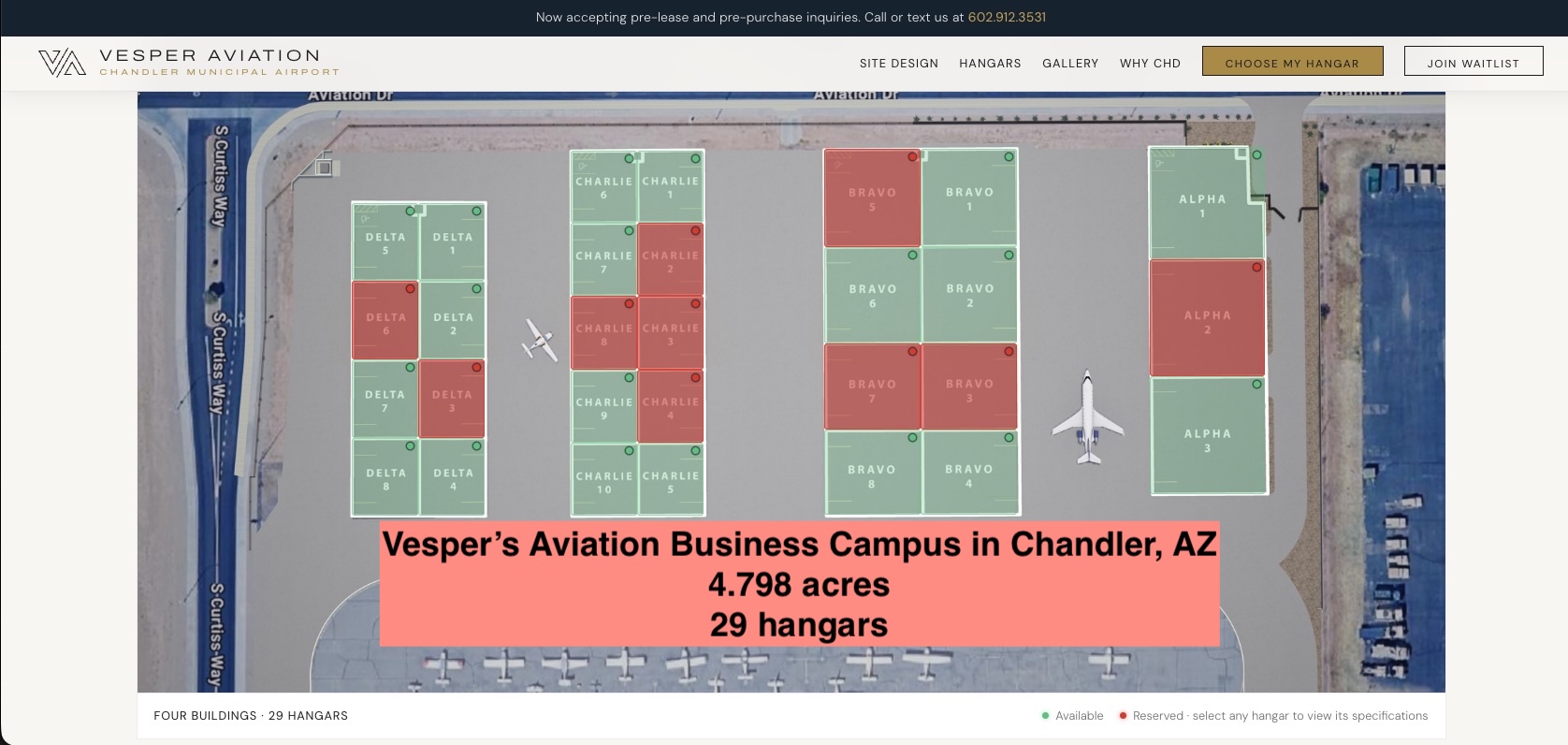
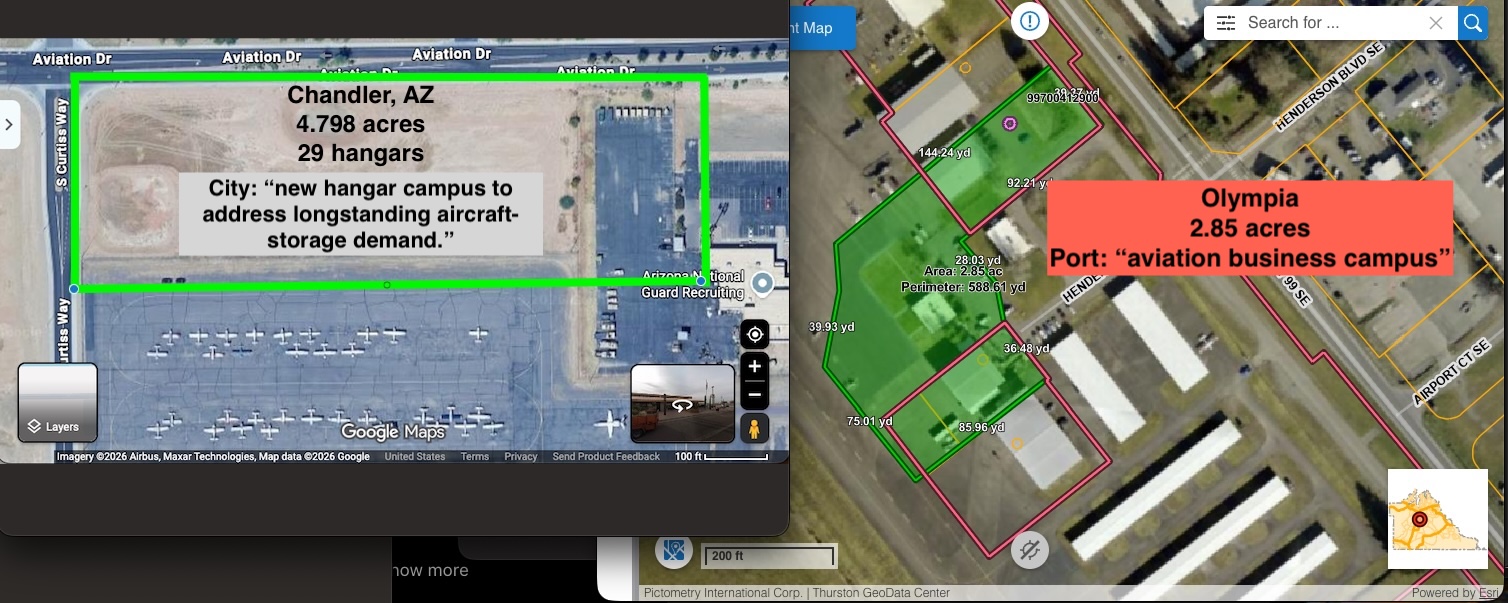
A: The proposed Vesper lease at OLM covers approximately 2.85 acres. Even after subtracting the 10,000 square feet designated for stormwater, approximately 2.62 acres remain. By comparison, Vesper's Chandler project in Arizona will accommodate 29 hangar units on 4.798 acres. Excluding Olympia's stormwater area, the Olympia leasehold is still approximately 55% as large. (The Chandler acreage may also includes stormwater infrastructure.) That comparison does not establish how many additional hangars could fit on the Olympia property. The sites have different configurations, existing improvements, and operational constraints. But existing buildings can be demolished and replaced over the course of a 50-year lease. Neither the existence of buildings nor the size of the parcel establishes that additional hangars are impossible. Also, a nearby aviation property at 7529 Old Highway 99 SE, currently occupied by a SpanaFlight facility, is listed for sale. The property encompasses approximately 1.52 acres. If Vesper purchases that facility and acquires its associated ground lease, Vesper would control approximately 4.37 acres at Olympia Regional Airport, or 4.14 acres even after excluding Glacier's designated stormwater area. That is approximately 86% of the Chandler project's acreage. Although we do not know whether Vesper intends to acquire the SpanaFlight building, its availability warrants consideration by commissioners before approving a potential 50-year lease.
Even after excluding the 10,000 square feet designated for stormwater, the Olympia leasehold is equivalent to approximately 16 hangars at Chandler's development density, or 25 hangars if Vesper also acquires the nearby SpanaFlight property. These figures are acreage comparisons, not site-specific engineering estimates.
Below are maps comparing the proposed Vesper leasehold at OLM with Vesper's parcel in Chandler, Arizona, where 29 hangars are being developed. This is precisely the type of comparative analysis that commissioners should be receiving from Port staff to help them understand the long-term development potential of the property before committing it to Vesper for up to 50 years. If staff believe additional hangars are physically impossible, they should provide a site development analysis demonstrating that conclusion. The public should not have to conduct this due diligence on behalf of the Port.
Future SEPA review and City of Tumwater permitting do not protect the community from airport expansion.
The Port claims the public is protected because Vesper's future expansion proposals will be subject to environmental review (“SEPA review”) and City of Tumwater permitting. But these processes do not prohibit major construction; they are standard procedures through which major construction is routinely approved.
SEPA review may identify environmental impacts and require mitigation, but it rarely prevents a project from proceeding. The residents who successfully challenged the Port's environmental review of its Airport Master Plan Update in 2025 know firsthand how difficult, expensive, and time-consuming it is to challenge an inadequate SEPA determination, even with strong legal and factual arguments. Residents rarely win such cases. And the public should not have to repeatedly undertake that burden as individual expansion projects are proposed over the coming decades. I
The Port should not grant a lease that facilitates major construction and then expect the public to rely on future environmental reviews and permitting processes to prevent that construction. Commissioners can substantially reduce the risk now by shortening the lease.
Join our Facebook page: Linktree
Background
The Port of Olympia has been planning for years to greatly expand air traffic at Olympia Regional Airport. Its draft Airport Master Plan Update calls for a six-gate passenger terminal, 131 new hangars, and substantial increases in aviation activity. Residents successfully challenged the Port's environmental review in December 2025, prompting the Port to withdraw its environmental determination and suspend adoption of the plan in May 2026. But the Port's ambitions for airport growth remain. The proposed Vesper lease could provide another pathway to expansion, one project at a time, without adopting the Master Plan Update. The Commissioners should not allow airport expansion to proceed through individual real estate transactions without adequate environmental review and meaningful public scrutiny.
The Port set an aggressive path for airport growth far beyond what is needed to accommodate the 1% annual growth that the Port forecasts for aviation demand in the future. The Port has said that the FAA requires this Master Plan Update. But it is the Port, not the FAA, that has decided to fill that plan with unnecessary pork. The Port is "responsible for deciding when and where airport development is needed and for building and operating airport facilities." FAA Order 5050.4B, para. 201(a).
Piston-engine aircraft continue to use leaded fuel despite a ban on leaded automotive fuel and lead based paint more than 29 years ago. Lead is a potent neurotoxin that can affect almost every organ system in the body. The lead pollution is already adversely affecting the livability of our communities, putting our health, safety and quality of life at risk. Prior EPA Administrator Michael Regan said in a statement, “When it comes to our children the science is clear, exposure to lead can cause irreversible and life-long health effects."
Noise is considered one of the most detrimental environmental effects of aviation. There is sufficient evidence of a marked negative effect of aircraft noise exposure on children’s cognitive skills. There is also sufficient evidence that aircraft noise increases the risk of hypertension, stroke, and heart disease; disturbs sleep; and can impair sleep recuperation.
Airports are major sources of ultrafine particles (UFPs) and other harmful pollutants.Key pollutants include:
-
UFPs
-
Nitrogen dioxide (NO₂)
-
Black carbon
-
Volatile organic compounds (VOCs)
-
Particulate matter (PM2.5, PM10)
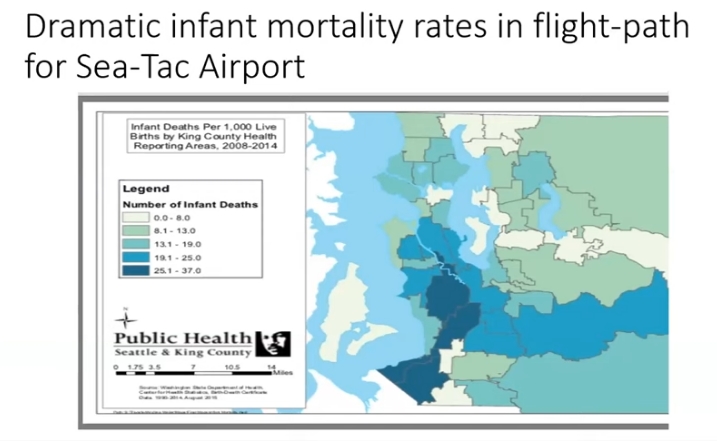 The map above from a 2023 presentation shows the high infant mortality rates that exist in the same location as the plume of ultrafine particles from the SeaTac Airport.
The Master Plan Update benefits the few at the expense of the many. Companies such as Amazon, along with private airplane owners, would benefit from increased airport infrastructure. But that would come at the expense of quality of life for many more Thurston County residents.
If a person wants convenience in getting on an airplane, it's easy to take a FlixBus from downtown Olympia to SeaTac Airport. This direct route runs reliably 7 days a week, with two trips a day each direction. It is clean, comfortable, on time, and very pleasant. The trip to SeaTac is only 1 hour and 15 minutes, and the round trip cost is only between $32 and $45. The buses run on the same schedule 7 days a week. Departing times from Olympia are 9 am and 11:40 am. Coming back, the bus leaves the airport at 4 pm and 5:05 pm. Alternatively, you can take Intercity Transit (#600 or #610) from the Olympia Transit Center to Lakewood P&R (for free) and then the Sound Transit 574 to the airport ($3).
- 405.25 acres of development (i.e., new impervious surface) and 25 acres of farmland on what is now prairie. (See Ch. 4 at pdf pages 39-40).
- 40,000 square foot passenger terminal (See here at pdf pages 34, 38, 39, 42, 49)
- 610 parking spaces and room for more (See here at pdf pages 36, 42, 50)
- 131 new hangars for more aircraft including larger jets (See Ch. 2 at pdf pages 26, 29, 31, 32; see Ch. 4 at 42; see Ch. 5 at pdf pages 15-18). By contrast, if the Port truly were planning to meet the 1% growth in aviation demand over 20 years that it claims it is aiming for, the Port would be planning for only 24 additional hangars (about 1–2 hangars per year on average added to the current 108 hangars at the airport). Its plan indicates it seeks a 4% growth rate.
- A 259,000 square foot area for passenger and cargo aircraft parking and loading and unloading (See here at pdf pages 35, 40, 42, 50)
- 6 gates (See here at pdf pages 35, 40, 42, 50)
- 40,000 square foot deicing pad (See here at pdf pages 35, 38, 40, 43, 50)
- A doubling of the capacity for aviation fuel storage. See Ch. 4 at pdf page 20 here.
- Additional turf runway of 60' x 2,000', which would be a foot in the door to a new paved runway (See here at pdf page 39, which states, "An additional landing area is proposed in the preferred alternative. This landing area will be in the grass . . . ." See Ch. 4 at pdf page 42 for a diagram with the runway in tiny font in the middle of the page).
- Additional helipad to accommodate increased noisy helicopter traffic (See here at pdf page 18 and see here at pdf page 26)
- Projects that could increase capacity up to as high as 630 operations per day (315 landings and 315 takeoffs daily) (See here at pdf page 12, citing a proposed 230,000 operations per year). Current traffic is around 200 per day (73,000 per year) as of November 2022.
- Opportunities for increased operations up to 59 instrument flight rule and 98 visual flight rule takeoffs and landings per hour. (While the Port claims these numbers won’t be reached, their own Plan cites these figures as an airport potential.) (See here at pdf page 12)
The Plan's proposed developments would threaten the wells that provide most of Tumwater's drinking water. Bush Wellhead, which is a mile west of the airport by Bush Middle School, is now Tumwater's largest source of drinking water. See also pdf page 27 here and also pdf page 87 here (at figure 3-7). The airport is in the Bush Wellhead's protection zone. See map here. That means it is in the zone where contamination of well-water is a risk. The Master Plan includes a 40,000 sq. ft. de-icing facility. De-icing chemicals are not safe in drinking water. The chemicals could leak into the aquifer supplying the water for the Bush Wellhead. De-icing facilities are engineered to minimize leaks into groundwater, but leaks can still occur if systems are not properly maintained or if they fail due to wear and tear, improper design, or extreme weather events.
The large amount of new impervious surface planned would likely diminish drinking water supplies and hurt salmon runs. A 2001 study found a significant amount of seepage and springs just east of the airport at the Deschutes River. In fact, the airport is one of three major groundwater input areas into the river. A prior study (see pdf page 13) found that much of the instream flow in the Deschutes in the south Tumwater area is from groundwater, except during winter when it is from rain. The airport is in a critical aquifer recharge area - extreme (CARA I), which means it sits on the most pervious soil with the highest water table that is most susceptible to contamination from spills. It is also the most important soil for recharging the aquifer from which we obtain drinking water, and in turn, from which the Deschutes maintains its instream flows. The Department of Ecology already deems the river as high risk for low instream flows (which endangers salmon by elevating the temperature). Click here and see pdf page 8. The river is 1,200 feet away. Because of the speed of the recharge, it would not be possible to prevent spills from polluting the river. Additionally, paving over the CARA I soils would reduce instream flows further. These are all the same effects that the county hydrologist found for a proposed development a mile south of the airport (called BAR Holdings/Salish Landing) on Old Highway 99. The two sites share the same hydrological dynamics with the river. Click here and go to page 2 of his report on BAR Holdings.
The plans for all the new impervious surface at the airport threaten treaty rights. The Deschutes River at the airport is a "usual and accustomed fishing ground" of the Squaxin Island Tribe. The Tribe holds reserved fishing rights in the Deschutes watershed under the 1854 Treaty of Medicine Creek. Under this Treaty, the Tribe claims Treaty-reserved water rights under federal law that are necessary to support healthy salmon populations. See pdf page 17 here. Reserved water rights are necessary to fulfill the promises and purpose of the Treaties. Federal Indian water rights retain a senior priority date over all other federal and state water rights holders and state instream flow rules. The Port's plans for so much impervious surface would impair the aquifer recharge, which in turn would reduce the amount of cool groundwater entering the river through the many seeps and springs just east of the airport. This would increase temperatures in the Deschutes River, harming salmon, which need cool water.
The demand for air cargo capacity has skyrocketed due to the growth of online retailers. Amazon-type businesses are creating a huge desire for more air cargo capacity around the country. Projections indicate significant growth in regional air cargo demand, with expectations to more than double by 2050. This anticipated increase could present future opportunities for the Olympia Airport to develop and expand its air cargo services, especially if capacity constraints arise at larger hubs like Sea-Tac. The draft Plan would enable the Olympia Airport to become a regional air cargo distribution center. The Port indicates that the airport could accommodate air cargo carriers using single or twin-engine aircraft. This would result in a dramatic increase in lead, UFPs, and noise pollution in our county. With all the new huge warehouses recently built and planned in Tumwater, cargo flights would likely be occurring at all hours. Warehouse jobs are typically not good jobs. Amazon warehouses drain local economies because they take more money out than they put in. Virtually all the warehouse jobs are temporary at Amazon, with no opportunity to become permanent. Moreover, the claim that warehouses are good for Tumwater because they bring in jobs is incorrect. Thurston County does not suffer from a lack of jobs. It has a stable job market, since it's the capital city.
Myth: Tumwater and state agencies have no control over expansion of air traffic at the Olympia Airport.
Fact: The FAA must consider state and local water protection laws (like state wellhead protection programs). Those state and local laws can require the FAA to mitigate impacts or rethink its project scope. The FAA also must consider whether an airport expansion violates federal laws such as the Clean Water Act, Safe Drinking Water Act, or other environmental laws. The FAA can decide not to fund a project that does not comply with these state and federal laws. Also, Washington has what’s called “primacy” under the federal Safe Drinking Water Act. That means the FAA and other federal agencies must coordinate with state agencies when projects, such as airport expansion, might impact drinking water resources. See Primacy Regulations, 40 CFR Part 142, Subpart B, 1976. Primacy means Washington state agencies are responsible for enforcing federal drinking water regulations within the state. The state Dept. of Health’s Office of Drinking Water oversees public water systems, ensuring compliance with both federal and state drinking water standards. The state has the authority to:
- Implement wellhead protection programs (like the wellhead protection area for the Bush Wellhead) and other safeguards for drinking water sources.
- Set and enforce drinking water standards (which must be at least as strict as federal standards).
- Monitor water quality and require public water systems to conduct testing.
- Take enforcement actions if a system violates regulations.
The EPA retains oversight and can step in if the state fails to meet federal enforcement requirements. However, because Washington has primacy, the FAA and other federal agencies must coordinate with state agencies when projects, such as airport expansion, might impact drinking water resources.
In addition, the City of Tumwater also has a role to play. It can delay, modify, or impose conditions on air traffic expansion if there is a legitimate environmental or drinking water risk. If the EPA determines that FAA-funded expansion would contaminate an aquifer or reduce the supplies of drinking water in that aquifer, the FAA could deny funding.
The Port's actions over the last 30 years demonstrate that it will likely continue trying to expand (and pave over our critical aquifer recharge areas) until local governments put their foot down. In 1994, an EIS on Port properties said there were no plans to expand the airport and thus no need to include the airport in the EIS. But at the same time, the EIS stated the Port had done an airport market study and was looking at "potential alternatives." Click here and go to page 135 (then use the bookmark feature to jump to other highlighted statements). After that study, there began a slow expansion of the airport's capacity and footprint. During the late 1990s to about 2001, the Port extended its runway protection zone by forcing people out of their homes along Case Road south of the airport and giving them money in return ($5.5 million total). It was extremely upsetting to those people to lose their homes. (All the deeds are available at the auditor's website. We found a deed from 1997. It was somebody's house then. Now it is a field). In 2005, the Port extended the main runway to allow more types of jets to land, so that higher speed business jets could use the airport. In 2006 it strengthened the runway. In 2008, the Port completed a $15 million improvement plan, which included removing a hump in the runway (a "line of sight" project) and strengthening the main runway to accommodate heavier aircraft. In January 2023, the Port told the Capitol Little League that it wouldn't renew their lease on land that had been home to ballfields at least since 1990 (as seen in historical aerial maps on Google Earth). The Capitol Little League in particular had leased the ballfields since 1999. The Port falsely claimed, "the FAA made us do it." The Port hid from the league and the community the fact that the FAA allows exceptions to the rule for recreational facilities that provide a public benefit for land that isn't needed for airport activities. After public outcry, the Port decided to allow the Little League to stay until 2028. The League is having to fundraise to try to find a new home.
A statewide group is looking for existing airports that could be expanded, and the Port is offering up the Olympia Airport. To help accommodate a projected capacity deficiency at SeaTac of 400,000 annual operations, the Legislature established a group to investigate which airports might handle overflow from SeaTac. The Olympia Airport is one being considered. The Master Plan Update shows plans for an enlarged 259,000 sq. ft. commercial (passenger and cargo service) aviation area, a new 40,000 sq. ft. terminal with 610 parking spaces, parking/loading/unloading area for aircraft, 6 gates, 40,000 sq. ft. aircraft deicing area, a new helipad, and 131 new hangars for private aircraft and larger jets. (See above for source links.)
Electric airplanes will not soon replace airplanes that use fossil fuel. This technology is decades away from being able to be used on a wide scale. By the time this technology becomes widespread, we will have electric rail to downtown Olympia because we’re at the beginning of a rail renaissances now. Also, most electric and hybrid-electric aircraft currently in development are smaller, with capacities of 9 to 19 passengers, making them suitable for air taxi and charter services rather than replacing current regional aircraft. And as discussed below, air taxis don’t need airports. They use vertiports. As for larger regional airplanes, aviation experts admit they will not be happening on any large scale in the foreseeable future. One reason is that current airplanes are very expensive, and they're often kept in service for more than 30 years. Even if someone comes up with an electric plane that can carry a lot of passengers, no for-profit airline is going to give up their still-running plane while it's in good shape. Meanwhile, Washington state is actively investing in passenger rail, including faster and more frequent Amtrak Cascades service, improved access to Sea-Tac, and planning for ultra-high-speed rail. These rail upgrades will offer Olympia residents faster, more reliable, and more affordable travel options long before electric aviation becomes viable. It makes far more sense to focus public investment and planning on enhancing rail connectivity rather than speculative aviation infrastructure. The Port has a long history of boondoggles--a pattern of wasting taxpayer money on unrealistic projects that claim to create jobs but instead just put taxpayer money into developers' pockets, with the Port and taxpayers getting the short end of the stick in the long run
If you want air taxis, don't look to the Olympia Airport for that. Market forces will likely put them elsewhere. Their main advantage to the wealthy few who will use them is the ability to bypass traditional airports by using smaller, strategically placed "Vertiports." Vertiports can be built on rooftops, parking garages, or near transportation hubs. Air taxis look like big drones. They are intended for people who want to save time by flying over your homes and protected nature spaces. Air taxis will only carry 2-4 people who can afford the high-priced tickets. As a result, flying taxis will provide little or no benefit and will not help the congested traffic situation. It seems to be one company, Joby Aviation, that is really pushing (hyping) this at cities across the world. Read this petition for more information about the noise and safety concerns that would come with air taxis. Petition · STOP FLYING TAXIS IN SOUTHERN CALIFORNIA - United States · Change.org. Flying taxis are not actually quiet. Industry is proud that flying taxis are quieter than helicopters, but even all-electric flying taxis will have multiple loud rotors like helicopters, and with a cruising altitude below helicopters (only 400 feet Above Ground Level), flying taxis will sound similar to helicopters. Over time, the FAA and the aviation industry intend to scale up operations with thousands of flying taxis operating in high densities across most urban areas in the United States.
The Port has failed to do an in-depth environmental review as required by SEPA. There has never been a serious environmental study of direct and indirect cumulative impacts caused by airport development/growth and operations at this airport. The State Environmental Policy Act (SEPA) requires an in-depth review if significant environmental impacts are “likely to occur” as a result of a non-project decision. The Port's 2/6/2025 environmental review claims that an in-depth review isn't needed until later. But the Port is ignoring the many adverse impacts that would occur if its plans materialize, including serious public health risks that come from increased emissions and noise.
We need a thorough environmental review now. Waiting to do that until discrete projects begin will lead to piecemealing, which is prohibited by SEPA and NEPA (the National Environmental Policy Act). It will also prevent commissioners and the public from seeing all of the many impacts that this Plan will have on our community's health.
The proposed expansion is contrary to elected officials' prior rejection of an expansion of air traffic at this airport. Several years ago, elected officials in counties throughout Western Washington were asked whether they wanted to sponsor expansion of their existing airport to help address the projected future capacity deficiency at SeaTac. Thurston County Commissioners and Port Commissioners declined to sponsor such a venture. Yet now the Master Plan Update would greatly enable far more air traffic at the Olympia airport, presenting significant health risks to the community, as well as additional financial burdens, while seriously degrading quality of life in our county.
The math is not adding up. It has been said that the Master Plan Update would merely increase air traffic by 5%. Yet the Port plans to double the capacity for aviation fuel storage. See pdf page 20 here. The 5% figure is incorrect for additional reasons. For example, projects in the Plan would increase capacity to 630 operations per day, compared to around 200 per day as of November 2022 (See here at pdf page 12, citing 230,000 operations per year).
Killing the gophers goes hand in hand with degrading the community's quality of life. The fate of the Olympia pocket gophers at the airport is closely tied to Thurston County's fate. The Plan states that airport growth is dependent on more hangars, and those additional hangars will be built on the prairie habitat where the threatened Olympia pocket gophers live, if the federal government approves a Habitat Conservation Plan that allows more development. See pdf pages 12, 14, 24, 26 here. So, the goal is to pave over the last remaining critical prairie habitat, killing many threatened gophers, in order to increase airport traffic that will degrade the quality of life of people living in Thurston County. This makes no sense.
Please contact us to volunteer: StopOlyAirportGrowth@gmail.com

Sponsored by

To:
To the Port of Olympia
From:
[Your Name]
P E T I T I O N
To: Port of Olympia Commissioners:
I am a resident of Thurston County. I oppose any plan to expand air traffic at the Olympia Regional Airport. Please protect our county's quality of life by voting against any such plan.
Thank you.