Stop the Execution of Curtis Beasley in Florida
Florida Board of Executive Clemency and Governor Ron DeSantis
.png)
Curtis Beasley is scheduled for execution in Florida on September 29, 2026, for the 1995 murder of Carolyn Monfort.
Additional information from our allies at Floridians for Alternatives to the Death Penalty is below.
Join the Virtual Sit In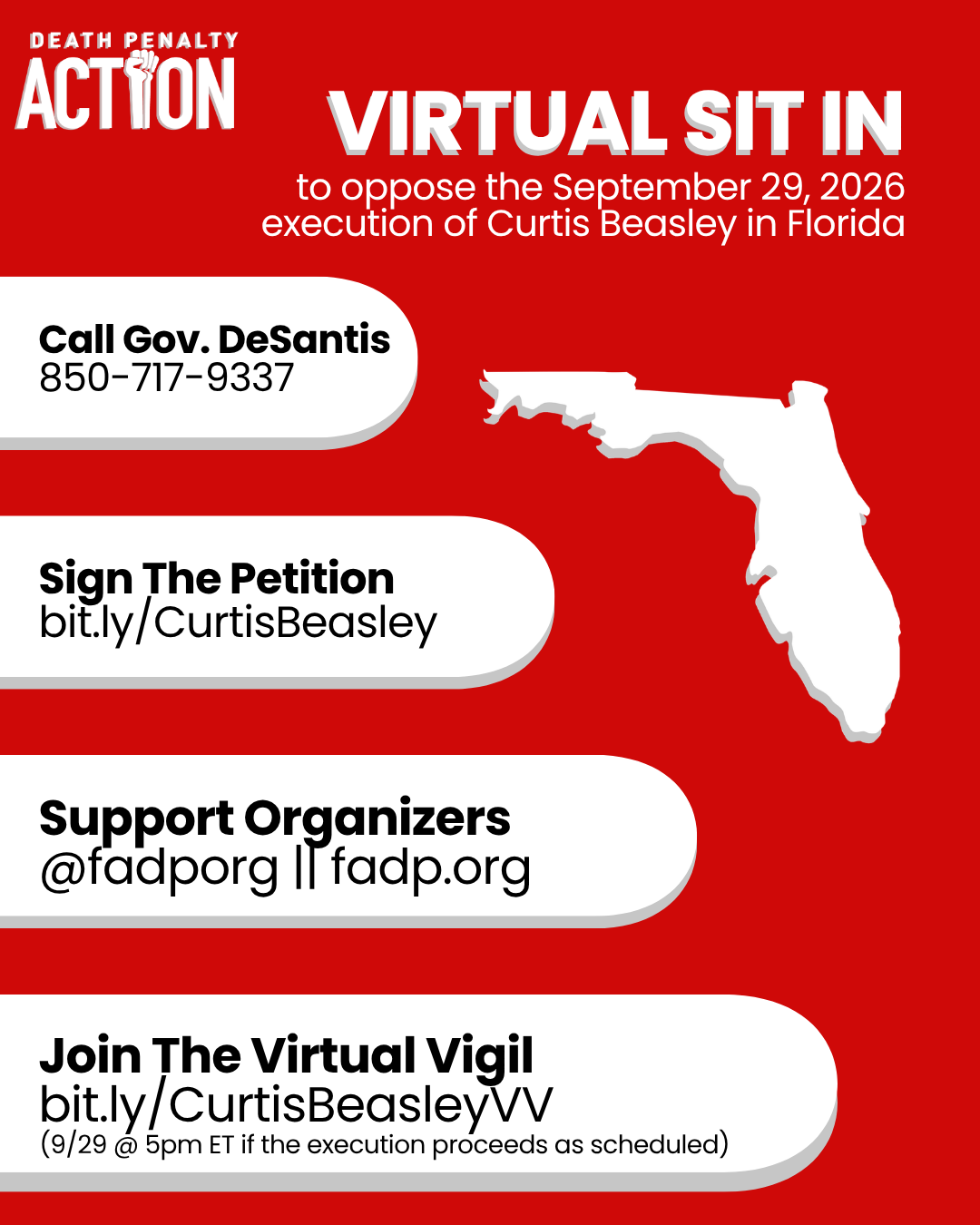
Call Gov. DeSantis at 850-717-9337 with the following message:
"Hi. My name is [your name]. I am calling to urge Gov. DeSantis to reverse course and halt all plans to execute Curtis Beasley on September 29, 2026. As someone who purports to follow Christian teachings, it is deeply disappointing that he does not extend these teachings to the individual condemned to death in the state of Florida. Please do not move forward with the execution of Curtis Beasley."
REGISTER FOR THE 9/29 VIRTUAL VIGIL BEGINNING AT 5PM ET.
FROM FADP
Florida plans to execute Curtis Wilkie Beasley, Sr. on September 29, 2026, for the 1995 murder of Carolyn Monfort in Polk County. The State’s case against him was entirely circumstantial. At sentencing, two jurors voted against death, but the judge imposed a death sentence following the jury’s 10–2 recommendation. Mr. Beasley is now 77 years old and has spent more than 28 years on death row.
In a September 4 filing, his attorneys ask the court to hear evidence and vacate his death sentence. Their motion raises four concerns about whether Florida can constitutionally carry out this execution.
Florida plans to execute a man in serious decline
Mr. Beasley’s attorneys argue that executing him at age 77, in his current physical and cognitive condition, would be cruel and unusual punishment. He now needs a wheelchair to travel beyond very short distances and has reported experiencing brain fog. A psychologist who evaluated him found depression and significant risk factors for vascular dementia, but could not complete the planned testing because of transportation delays in bringing a wheelchair to Mr. Beasley, limited time, and his fatigue.
The warrant period leaves too little time for meaningful review
Governor DeSantis signed Mr. Beasley’s death warrant on August 26 and scheduled his execution just 35 days later. His attorneys had less than seven business days to file this motion. They argue that the State cannot compress the timeline for investigating a person’s health and legal claims, then treat the resulting gaps in evidence as a reason to proceed.
Florida’s system for appointing private postconviction attorneys to represent a small number of people on death row (including Mr. Beasley) makes the rush especially consequential. Mr. Beasley’s lawyers work at a small firm without its own investigators, mitigation specialists, or mental health experts. To investigate a new claim, they must secure funding approval and then find qualified outside professionals who are available and willing to work under the State’s payment rules. The warrant clock does not stop while they do that. In this case, counsel arranged a psychological evaluation, but the expert could not finish testing before the filing deadline. The defense argues that this timetable denies Mr. Beasley a meaningful opportunity to bring his claims before a court.
There is no rhyme or reason for choosing who receives a death warrant
Mr. Beasley’s attorneys also challenge the process that put him on Florida’s execution calendar. The governor can select someone from death row for execution without providing a public explanation or applying a stated selection standard. The motion argues that giving one official such unchecked power over who will be executed, and when, makes the process arbitrary and violates constitutional protections.
No jury unanimously chose death
Mr. Beasley’s jury did not unanimously recommend a death sentence: two jurors voted against it. The U.S. Supreme Court found this nonunanimous sentencing scheme unconstitutional in 2016, but the Florida Supreme Court applied the law retroactively only to those sentenced after 2002.
Mr. Beasley’s attorneys point to Kian v. Florida, now before the U.S. Supreme Court. Kian concerns whether the Constitution requires a 12-person jury in serious felony cases, rather than a unanimous death recommendation. But its examination of the historical right to a jury trial could bear on Mr. Beasley’s argument about what jurors, rather than a judge, must decide before the State can take a life.
This is already the 17th death warrant of 2026, following an unprecedented execution pace in 2025, when Florida led the nation with 19 executions. Florida is on track to exceed this tragic and dark record in 2026.
While most states have moved away from the death penalty, Florida is accelerating executions at an alarming rate. Each warrant signed underscores the state’s embrace of a punishment that is arbitrary, racially biased, and out of step with evolving standards of decency.
Please sign the petition asking Governor Ron DeSantis and the Florida State Board of Executive Clemency to do everything within their power to stop this execution, including issuing a stay, and seeking a path to clemency in the case.
Sponsored by

To:
Florida Board of Executive Clemency and Governor Ron DeSantis
From:
[Your Name]
We are writing to you regarding Curtis Beasley, who is scheduled for execution in Florida on September 29, 2026, for the 1995 murder of Carolyn Monfort.
We believe in accountability and have sympathy for the victim's family members, friends, and community. Their loss is tragic and unimaginable. But true justice and accountability do not require execution. A sentence of life without the possibility of parole protects society while also recognizing the human capacity for redemption and the role of childhood trauma in shaping adult behavior.
Florida’s record-breaking pace of executions is a moral and constitutional crisis. Each new warrant signed undercuts the rule of law, retraumatizes families, and moves us further from true justice.
We are concerned that while the vast majority of states with capital punishment continue on a downward trend of executions, Florida is going against this trend by resuming and increasing the frequency of executions - exceeding previous state records.
We, the undersigned, ask that you do everything within your power to stop this execution, including issuing a stay, and seeking a path to clemency in the case. By commuting his sentence to life in prison without the possibility of parole, you will send a message that the State of Florida does not need the death penalty to be safer, and that it only serves to perpetuate the cycle of violence.
Thank you for your time and attention to this serious matter.