Stop the Execution of Mark Geralds in Florida
Florida Board of Executive Clemency and Governor Ron DeSantis
.png)
Florida has scheduled a December 9, 2025 execution for Mark Geralds, sentenced to death for the 1989 murder of Tressa Pettibone. This is the third warrant in a row signed for a person whose right to representation in state court remains deeply uncertain.
Governor Ron DeSantis has scheduled the execution of Mark Allen Geralds for December 9, 2025 — the 18th execution this year, continuing the deadliest year in modern history.
Mr. Geralds was 22 years old at the time of the crime and has spent more than three decades on death row. His long and complex case raises serious questions about fairness, ineffective counsel, and outdated legal standards. Decades after his conviction, Mr. Geralds continues to challenge prosecutorial misconduct and ineffective assistance claims that have never been fully reviewed.
Florida’s record-breaking pace of executions is a moral and constitutional crisis. Each new warrant signed undercuts the rule of law, retraumatizes families, and moves us further from true justice.
SEE BELOW for addition considerations provided by our allies at Floridians For Alternatives to the Death Penalty.
Join the Virtual Sit In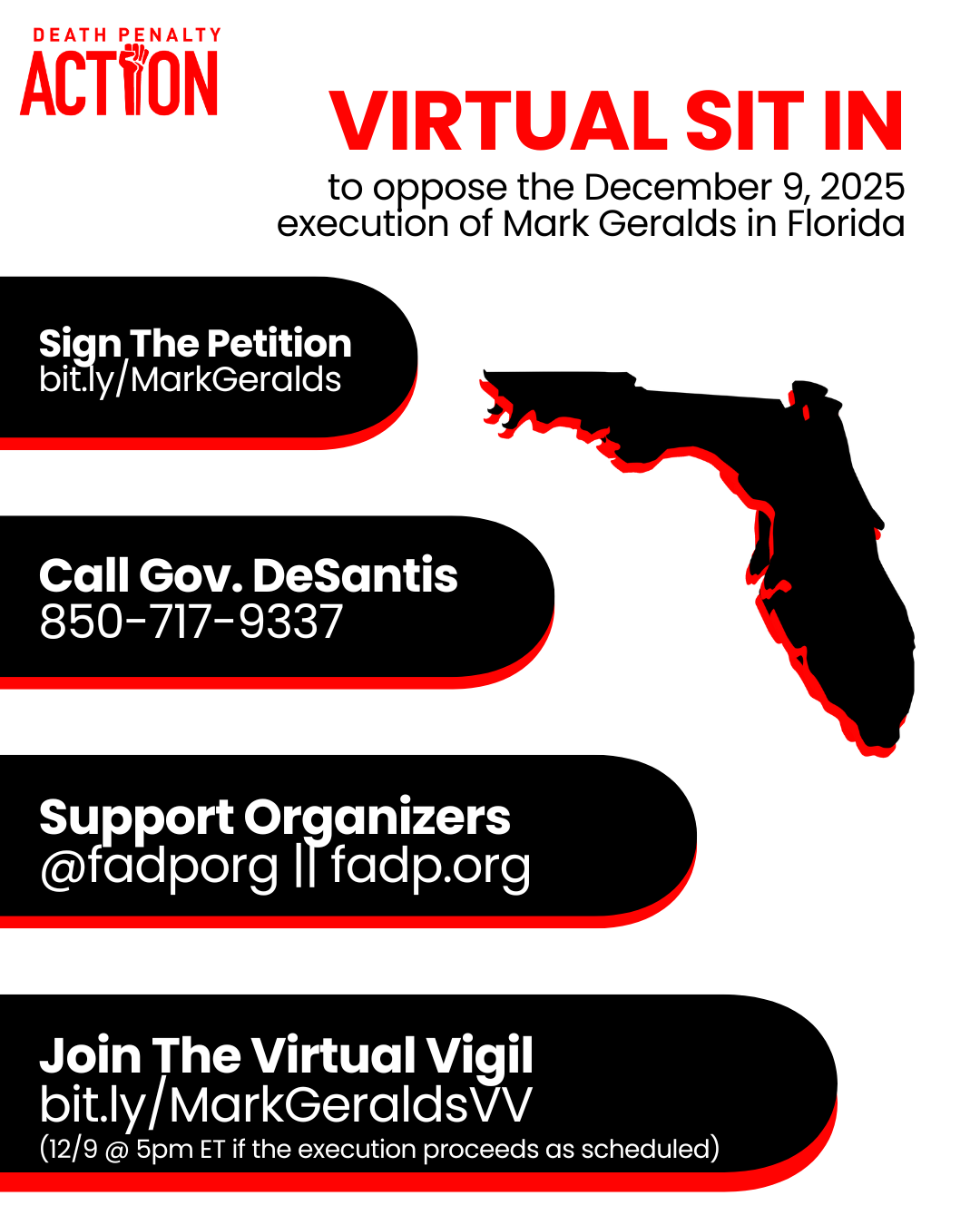
Call Gov. DeSantis at 850-717-9337 with the following message:
"Hi. My name is [your name]. I am calling to urge Gov. DeSantis to reverse course and halt all plans to execute Mark Geralds on December 9, 2025. As someone who purports to follow catholic teachings, it is deeply disappointing that he does not extend these teachings to the individual condemned to death in the state of Florida. Mark Geralds is also the third warrant signed in a row for a person whose right to representation in state courts remains deeply uncertain."
REGISTER FOR THE VIRTUAL VIGIL BEGINNING AT 5PM ET ON 12/9.
The Crime and the Unresolved Questions
The murder of Tressa Pettibone was a devastating and deeply traumatic crime, and nothing about recognizing the unresolved issues in Mark Geralds’ case diminishes the harm she suffered or the grief of those who loved her. Ms. Pettibone was attacked inside her home, where investigators documented signs of a violent struggle across multiple rooms and evidence that the perpetrator handled personal items, including a jewelry box, before driving her vehicle away from the scene. This was a chaotic, physical crime that left behind multiple forms of trace evidence. But even within the initial investigation, there were anomalies and gaps that were never fully addressed — issues that should have prompted deeper forensic testing, more careful suspect evaluation, and a more robust defense presentation than the one the jury received.
Unresolved Questions That Cannot Be Ignored
Mr. Geralds’ case follows the same pattern of systemic breakdown seen in these recent “volunteers,” but with even deeper unresolved questions. Forensic evidence collected from the victim’s home did not match Mr. Geralds, including blood, fingerprints, and hair, even though there were signs of struggle in multiple rooms, handling of household objects, and the movement of the victim’s vehicle. Most significantly, the bloody handkerchief found inside the home matched neither the victim’s nor Mr. Geralds’ blood type. No DNA analysis has ever been performed.
Key investigative materials — FDLE analyst notes, forensic reports, and interview notes pointing to other viable suspects — were never disclosed to the defense and surfaced only years later in a long-hidden State Attorney file.
And at trial, the jury heard none of this because defense counsel presented no defense case at all. They:
- called no witnesses,
- offered no experts,
- mounted no forensic rebuttal,
- did not challenge the State’s presumptive blood tests,
- failed to present Mark’s mental-health history,
- did not contradict the State’s thory of how he came to possess the jewelry,
- offered no alternative-suspect evidence,
- did not investigate or litigate DNA testing, and
- allowed biased jurors and improper prosecutorial arguments to stand unchallenged.
The record shows a guilt phase compromised by suppression, inadequate investigation, and defense failure at every critical stage.
Premature and Incomplete Clemency Review
Layered on top of that, Mr. Geralds’ clemency hearing was held prematurely — before his federal litigation had even concluded — an unusual and fundamentally unfair process that denied him the ability to present the full record of his case.
Why This Matters
Taken together, the suppressed evidence, the untested forensics, the mental-health history minimized at the waiver hearing, the absence of a meaningful attorney-client relationship, and the unprecedented pace of executions create a picture of a system that is grinding people down rather than seeking the truth. Without overstating what the evidence ultimately proves, it is clear that the jury never saw the whole picture and that the courts have never grappled with it.
While most states have moved away from the death penalty, Florida is accelerating executions at an alarming rate. Each warrant signed underscores the state’s embrace of a punishment that is arbitrary, racially biased, and out of step with evolving standards of decency.
We believe in accountability, but true accountability does not require execution. A sentence of life without the possibility of parole protects society while also recognizing the human capacity for redemption and the role of childhood trauma in shaping adult behavior.
Florida does not need the death penalty to be safe. This execution will not make us safer, it will simply add another act of violence to an already tragic story. Justice does not require death.
Please sign the petition asking Governor Ron DeSantis and the Florida State Board of Executive Clemency to do everything within their power to stop this execution, including issuing a stay, and seeking a path to clemency in the case.
Sponsored by

To:
Florida Board of Executive Clemency and Governor Ron DeSantis
From:
[Your Name]
We are writing to urge you to halt the December 9, 2025 execution for Mark Geralds, sentenced to death for the 1989 murder of Tressa Pettibone. This is the third warrant in a row signed for a person whose right to representation in state court remains deeply uncertain.
Mr. Geralds was 22 years old at the time of the crime and has spent more than three decades on death row. His long and complex case raises serious questions about fairness, ineffective counsel, and outdated legal standards. Decades after his conviction, Mr. Geralds continues to challenge prosecutorial misconduct and ineffective assistance claims that have never been fully reviewed.
Florida’s record-breaking pace of executions is a moral and constitutional crisis. Each new warrant signed undercuts the rule of law, retraumatizes families, and moves us further from true justice.
We are concerned that while the vast majority of states with capital punishment continue on a downward trend of executions, Florida is going against this trend by resuming and increasing the frequency of executions - exceeding previous state records.
We, the undersigned, ask that you do everything within your power to stop this execution, including issuing a stay, and seeking a path to clemency in the case. By commuting his sentence to life in prison without the possibility of parole, you will send a message that the State of Florida does not need the death penalty to be safer, and that it only serves to perpetuate the cycle of violence.
Thank you for your time and attention to this serious matter.