Your Right to a Quality, Affordable Education is Under Threat! Write to the Board of Trustees at Wright State University Now!
Daniel Palmer, Secretary to the Board of Trustees
Friends:
Wright State University is a public university. It belongs to all of us – the taxpaying community members of Ohio, students, and family members who have worked hard to afford tuition and receive what is promised and expected – a quality education at an affordable price. It is a dream destination for anyone – young or old – to set themselves up for a lifelong career, or to discover and change tracks in the middle of one. Often, it is also a place to return and complete your education in your sixties or even seventies. Wright State University has become a magnet for students because of the quality of education it provides. One reason is the background of faculty at this institution. Currently, faculty at Wright State University come from some of the top educational institutions of this country, and now love to call Dayton and Wright State their home. These faculty have set up their roots in Raider country, bought homes, formed communities, and contributed to the local economy by supporting local businesses. Indeed, it is a testament to Dayton and to Wright State that a majority of those who have come from outside Ohio have decided to stay in Ohio, in Raider country. The stability of faculty in the region directly translates into enormous benefit for the students who come here. Experienced teachers and researchers make a quality education possible.
Still, the Board of Trustees at Wright State University have chosen to undermine so much of the good and much of the human capital that exists at the University, thus putting in peril the present and the future of thousands of students who continue to flock to the institution. While the Board has paid lip service to student success, when it comes to actually putting resources into proven strategies - smaller class sizes and allowing faculty more time and attention to give to students - they have instead added more restrictions that obstruct faculty's ability to do their jobs. In October 2025, the Board dramatically paved the way to convert full-time faculty into at-will employees. Henceforth the Board and Provost of the University can fire any faculty member, regardless of their credentials, productivity, teaching ability, or length of service to the University. Faculty can be fired for any reason, including re-organizing / restructuring the university, and there are no protections from being fired because of politics-driven disapproval of a faculty member's research or scholarship. Job protection and tenure have historically allowed faculty to invest fully into the institution, building quality education and pursuing knowledge and truth without the threat of termination for political reasons. The new conditions of shared governance and job security will make faculty afraid to do their jobs fairly without fear of reprisals. That fear will cost students access to resources and faculty attention. Once you place faculty under constant threat of layoffs, to what extent will they be free to impart a fearless education? With this new policy, academic freedom is essentially dead at Wright State University.
And, there’s more. You need to be concerned by another important development at Wright State University that is going to impact generations of students. Recently, the University has set up the Center for Civics, Culture, and Workforce Development, which operates completely independent of the University's normal accountability structures. In other words, people employed in this Center answer to no one except the President of the University. This Center has also hired people to teach regular classes to the students, many of whom appear not to be as accomplished academically as one would expect from existing hiring standards in those disciplines. Meanwhile, faculty at the Civics Center are provided a generous salary and working conditions which are far better than regular faculty of the university who perform similar work and have far more expertise and experience. The most pernicious part of this Center is the following – the Board of Trustees draw on the legitimacy provided by the credentialed faculty of the university (those who got their PhDs, proved their mettle by sustained contributions to scholarship, teaching, and service) to lend validity to an Center in which a few select people are being hired to teach some students and write exclusive, unvetted curriculum. This is like asking whether you would like your children's football coach to be someone who has played football throughout their lives and knows the game intimately, versus someone who has only ever run a fantasy league team? That's the difference between faculty in the legacy units of the university (especially Humanities and Social/Political Sciences), versus those hired within the new Civics Center.
In sum, Wright State University is advertising and promising a quality and affordable education to generations of students on a false premise. By gutting the rights of faculty and undermining them by questionable hiring practices in the Civics Center, the Board has engineered an instability in the fundamental structure of the institution. These cracks are only bound to grow unless drastic remedial action is taken now.
All is not lost and you can help! Write to the Board of Trustees of Wright State University now to:
- Recognize that student success cannot be built by breaking the backs of the main labor force of the University, the faculty.
- Negotiate a fair contract with faculty that includes protections from frivolous firing, so that they can continue the great work of education
- Commit to responsibly managing tax-payer dollars in the operation of the Civics Center, so that the Center neither competes with, nor undermines, existing faculty who can easily meet the needs of students for civics education and workforce development.
- Stop using the credentials of existing faculty in the University as a shield to smuggle in poorly qualified faculty to teach the students at Wright State University.
- Understand that Ohio and Raider Country deserve better.
Above all, the Board of Trustees must remember that a public university such as Wright State University should remain just that – a public good, cherished by all and not only by a few. It is the responsibility of the Board of Trustees that the building blocks of the University remain strong to enable the institution to continue to serve the great people of Ohio and beyond.
For further details on Wright State University's conversion of full-time faculty into at-will employees, look no further than their retrenchment policy: new retrenchment (layoff) policy (Schedule D) in October 2025
Sponsored by

To:
Daniel Palmer, Secretary to the Board of Trustees
From:
[Your Name]
To: Wright State University Board of Trustees, etc
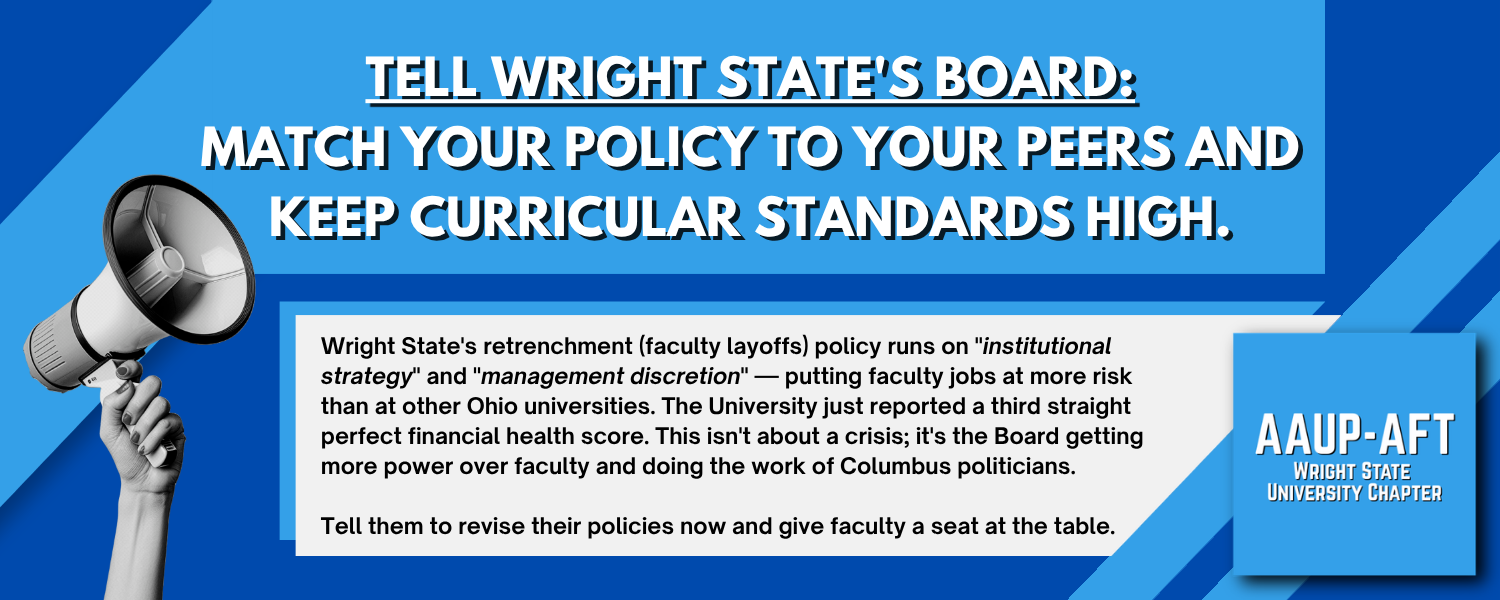
Retrenchment under Schedule D can be triggered by "institutional strategy" or "management discretion.” There is no exigency driving this policy. It gives the discretion the Board chooses to give itself, creating a climate of fear and threat to faculty livelihoods. The policy's refusal to meet basic professional standards suggests that political operatives are more important to University policy than the views of stakeholders like students, staff, and faculty. Given that, we ask the Board to:
Revise the retrenchment policy (Schedule D) so that it requires real notice, criteria tied to demonstrated need, and a binding faculty role and brings Wright State in line with peer Ohio universities that retain faculty expectations of continued employment.
End the Civics Center's exemption from normal curricular review and hiring processes, and involve faculty with relevant subject-matter credentials as active builders of its curriculum, not just after-the-fact reviewers, to preserve curricular integrity.
Negotiate a fair contract with AAUP-WSU that respects and strengthens shared governance.
I recognize legislation gives the Board authority, but that authority comes with a responsibility. I am asking the Board to use that authority with fairness toward the faculty who move here, build careers, and put down roots in this community — and honesty toward the students and families paying their tuition dollars to support the University's stated vision.