Build the Housing. Keep the Church. A Better Plan for 111 Fairmount Avenue
Oakland City Council, Office of the Mayor, Oakland Planning Commission, and the Unity Council
Oakland Heritage Alliance supports the affordable housing proposed for 111 Fairmount Avenue. We do not support demolishing a 1928 landmark to build it, because Oakland can have both.
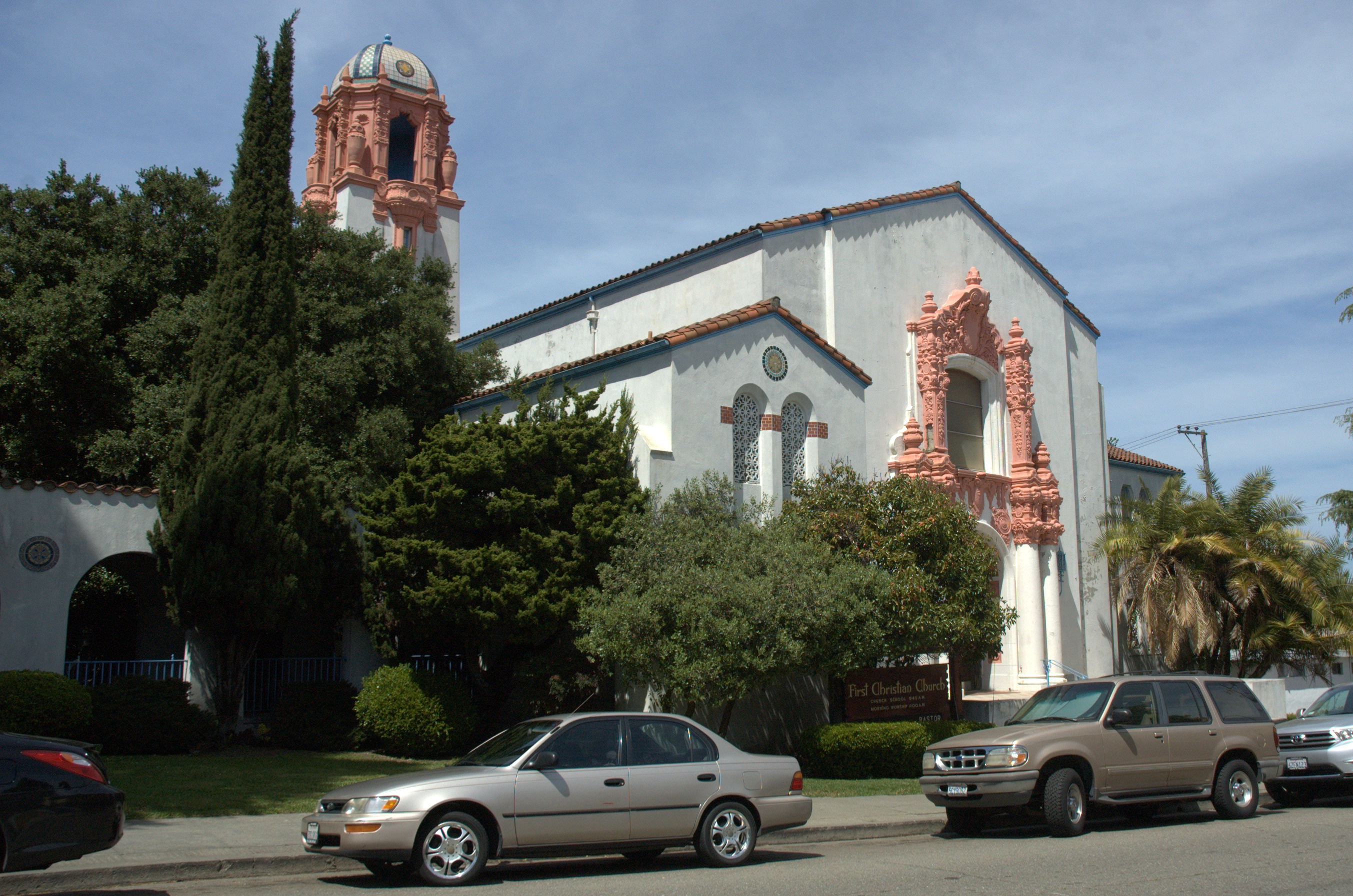
About the First Christian Church
Built in 1928 and designed by W.H. Weeks, one of California’s most prolific architects, the First Christian Church at 111 Fairmount Avenue is among the most architecturally significant buildings in Oakland. A masterwork of Spanish Colonial Revival design, it has anchored the corner of 29th Street and Fairmount in Broadway-Valdez for nearly a century with its Churrigueresque stucco ornament, glazed ceramic tile dome, and original stained glass.
The roughly 100,000-square-foot complex carries a B+1+ rating in Oakland’s Cultural Heritage Survey, placing it in the top fraction of one percent of all structures citywide, and is listed on the Local Register of Historical Resources.
This is not a forgotten building. It is one of Oakland’s finest.
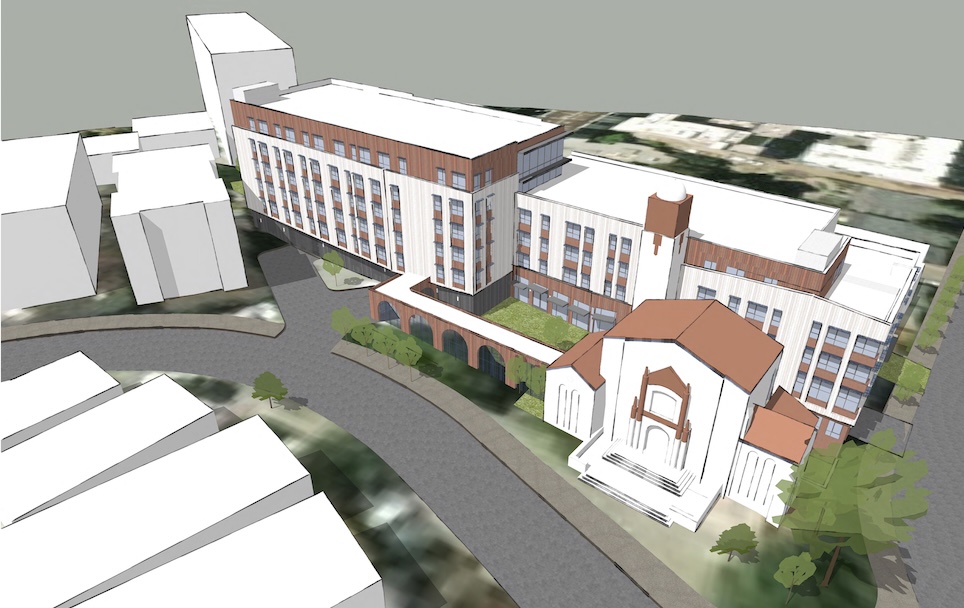
The Proposal: A Facadectomy
Unity Council and the Oakland Peace Center have proposed 91 units of 100% affordable housing here, for households earning up to 60% of Area Median Income. We support that goal fully and without reservation. Broadway-Valdez needs these homes, and these are responsible developers with a genuine commitment to the community.
But the current design by SmithGroup would demolish much more than half of the complex, enough that the City of Oakland considers it a demolition rather than a renovation, to make way for a new six-story structure. What survives is a facadectomy: the facade, bell tower, and front entry kept as a skin while the building behind them is removed. The sanctuary, the architectural heart of a 1928 masterwork, would be gone.
Keeping a facade while gutting the building behind it is not preservation. It is the appearance of preservation without the reality. And it is not necessary.
A Better Plan
There is a better way to build here, and it has two parts: put homes inside the church, and build more homes on its parking lot. Together, the reused building and new construction on the lot can deliver the affordable housing Oakland needs without erasing a landmark.
The possibilities go beyond housing. A reused building could hold homes, community space, or even a congregation once again, the way it has anchored this neighborhood for nearly a century. These are options worth exploring together.
We call on the City and the Unity Council to pursue, before the project moves forward:
- Adaptive reuse of the historic complex for homes and community use, not demolition behind a retained facade
- New construction concentrated on the parking lot, where homes can rise without tearing down the landmark
- A unit count that meets or beats the current proposal, using both the reused building and the lot
This is not preservation versus housing. It is a plan that delivers more of both.
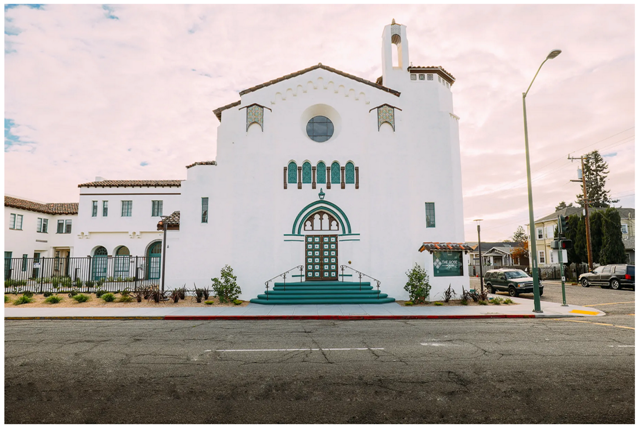
Oakland Has Already Done This
Oakland has shown that adaptive reuse of historic religious buildings can be done right. Rose on Bond, a former church in the Melrose neighborhood with a similar 1920s style, was converted into apartments while keeping its historic character, with new construction alongside. Brooklyn Presbyterian has an approved plan to do the same. In San Francisco, Buena Vista Terrace fit 42 homes inside the shell of a former church. We shared these examples, and more, in our comments to the developer in August 2025.
These projects show what is possible when a developer treats a historic building as an asset to build around, not an obstacle to work through. The First Christian Church deserves the same commitment.
An Invitation to Collaborate
We are not here only to object. We want to help find a solution, and we believe one is within reach. So far there has been no real study of alternatives and no community role in shaping this plan: we were asked to comment on a design that was already finished, not invited to help create it. We ask the Unity Council and the City to open a genuine, collaborative process, one that looks for the best outcome together.
Why It Matters
Affordable housing and historic preservation are not in conflict, and Oakland can prove it here. No one has shown that reuse is impossible. We are asking for a real study of adaptive reuse before any demolition is approved, and for a project held to a higher standard than a retained facade.
The First Christian Church is rated among the top fraction of one percent of all Oakland structures for a reason. It deserves a plan that rises to meet it.
Sign this petition to tell the Unity Council and the City of Oakland: build the housing, keep the church, and work with the community on a plan that does both.
Sponsored by

To:
Oakland City Council, Office of the Mayor, Oakland Planning Commission, and the Unity Council
From:
[Your Name]
We want the affordable housing planned for 111 Fairmount Avenue built. We also want Oakland’s 1928 First Christian Church, one of the highest-rated historic buildings in the city, still standing when it opens. Both are possible: put homes inside the church, and build more homes on its parking lot. We, the undersigned residents, neighbors, and supporters of Oakland’s historic heritage, call on the Unity Council and the City of Oakland to study that plan with the community before approving the demolition of a landmark.