We Need a Statewide Strategy for Data Centers—Before It's Too Late
Governor Mikie Sherrill, NJ Senate President Nicholas Scutari, Assembly Speaker Craig Coughlin, New Jersey State Legislature

New Jersey Needs a Statewide Strategy for Data Centers—Before It's Too Late
Data centers are not just technology projects—they are major consumers of water and electricity, with significant long-term regional consequences for our environment, utility infrastructure, and ratepayers.
Data Centers and New Jersey's Water Crisis
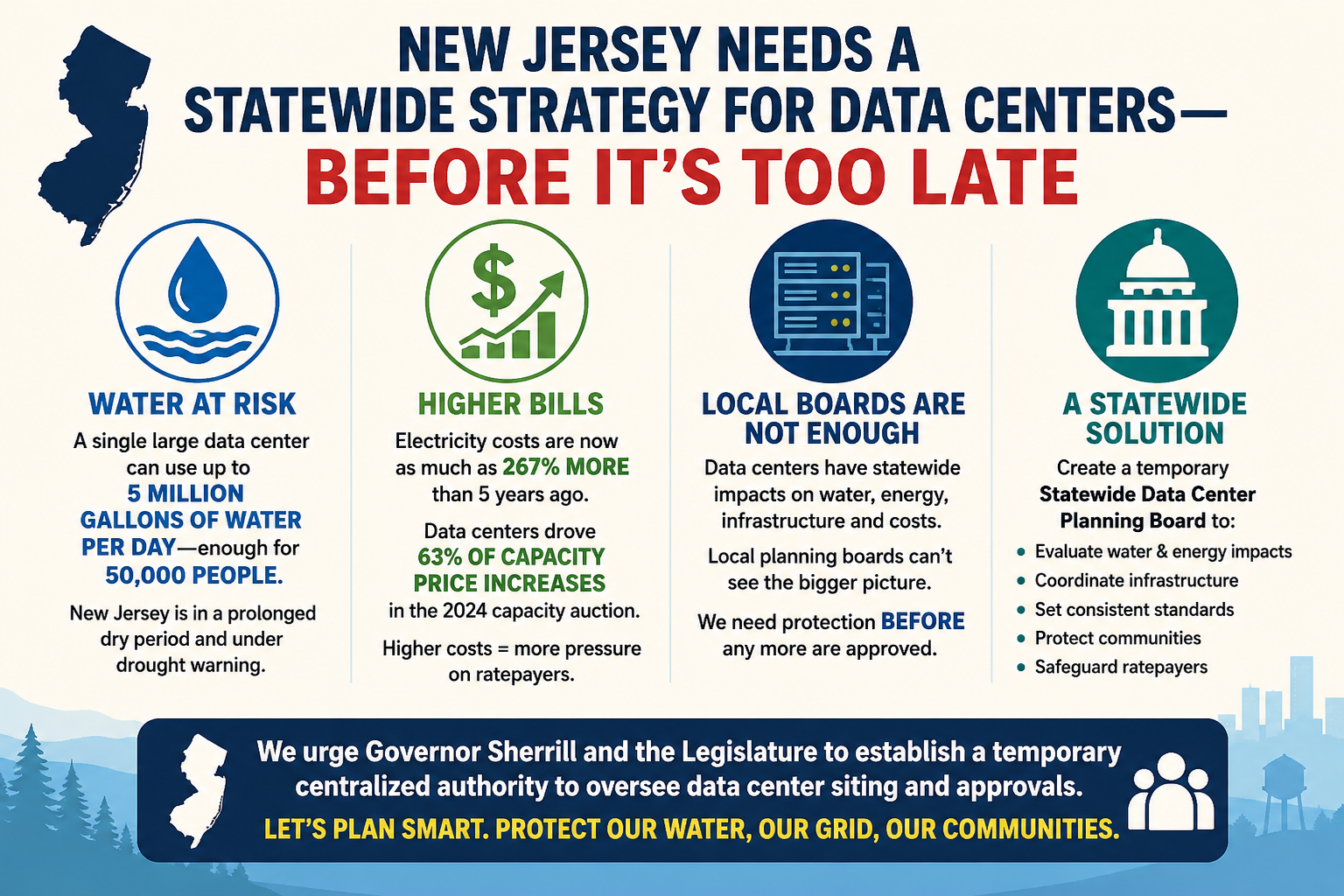
Modern data centers require enormous amounts of freshwater to cool servers operating around the clock. A single large facility can consume up to five million gallons of water every day—roughly the daily water needs of 50,000 people.
That level of consumption should give every New Jersey resident pause.
Our state has endured prolonged dry conditions, and much of New Jersey remains under drought warning. Mandatory outdoor water restrictions are in effect in certain parts of New Jersey.
Against that backdrop, approving water-intensive data centers without comprehensive statewide planning is both unsustainable and irresponsible.
The Hidden Cost: Higher Electric Bills
The impact extends to consumers’ pocketbooks.
New Jersey residents are already struggling with soaring electric bills. For many households, monthly electricity costs are now as much as 267% higher than they were just five years ago.
Demand from data centers is a significant contributor to that trend. At the 2024 regional electric capacity auction - the auction that helps determine future electricity costs throughout our region – demand from data centers accounted for approximately 63% of the increase in capacity prices.
Although Governor Mikie Sherrill has temporarily frozen certain electric rate increases, the growing pressures on the electric grid remain. As artificial intelligence continues its rapid expansion, the demand for computing power—and therefore for additional data centers—will accelerate.
Without thoughtful planning, New Jersey families and businesses will continue paying the price.
Local Boards Cannot Solve a Statewide Problem
The recently enacted law directing the New Jersey Board of Public Utilities to establish a new electric rate for large-load data centers, along with proposed guardrails to improve transparency, reporting, and oversight, represents meaningful progress.
However, these measures alone are not enough.
It does not answer the most fundamental question: Where should data centers be located, and how many can New Jersey responsibly support?
The experience of states such as Virginia – home to the nation's largest concentration of data centers - has already demonstrated the consequences: escalating energy demand, increasing water consumption, stressed infrastructure, higher electric costs, and growing community opposition.
These are not merely local land-use issues. They are statewide challenges with statewide consequences.
Yet decisions about where data centers are built are largely left to individual municipal planning and zoning boards. Those boards are charged with evaluating whether a particular project complies with local zoning and planning requirements. They are not designed or equipped to assess cumulative impacts on New Jersey's electric grid, shared water resources, transmission infrastructure, regional traffic, or the long-term costs ultimately borne by residents and businesses across the state.
No single municipality can realistically evaluate the combined effects of dozens of data centers operating throughout New Jersey. A project that appears acceptable when viewed in isolation may contribute to significant statewide impacts when considered alongside numerous similar developments.
A Statewide Planning Process Is Essential
Before additional data center projects move forward, New Jersey should establish a temporary statewide Data Center Planning Board or centralized review authority to evaluate their cumulative impacts and develop a coordinated statewide strategy.
Such a body should be empowered to:
- Evaluate statewide water availability and long-term water sustainability.
- Assess cumulative impacts on electric generation, transmission capacity, grid reliability, and utility rates.
- Coordinate infrastructure planning across municipalities and state agencies.
- Develop consistent statewide siting standards based on environmental, infrastructure, and community considerations.
- Ensure that local land-use decisions take into account regional and statewide impacts—not solely the characteristics of an individual application.
- Recommend policies that protect residents, businesses, and taxpayers while allowing responsible economic development.
Please sign our petition urging Governor Sherrill and the New Jersey Legislature to establish a temporary centralized authority to oversee the siting and approval of data centers across New Jersey.
By taking a coordinated, statewide approach now, New Jersey can encourage technological innovation while protecting its water resources, electric grid, ratepayers, and communities from unintended long-term consequences.
Thank you.
Kin Gee, President
CHARGE – Consumers Helping Affect Regulation of Gas & Electric
###
CHARGE is a grassroots group formed in 2018 to be an energy consumer advocate, representing New Jersey's 3+ million electric & gas customers. It is dedicated to educating and bringing awareness to issues such as service, reliability, health, rates, and safety, all within the utilities and energy sectors from the consumers' perspective.
Email: info@njcharge.org
Facebook: https://www.facebook.com/profile.php?id=100067618356148
Website: https://www.njcharge.org/blog
Sponsored by

To:
Governor Mikie Sherrill, NJ Senate President Nicholas Scutari, Assembly Speaker Craig Coughlin, New Jersey State Legislature
From:
[Your Name]
We respectfully urge Governor Mikie Sherrill and the New Jersey Legislature to establish a temporary statewide Data Center Planning Board or other centralized review authority before additional large-scale data center projects are approved or permitted to move forward.
I. New Jersey Needs a Statewide Strategy for Data Centers—Before It's Too Late
Data centers are not just technology projects—they are major consumers of water and electricity, with significant long-term regional consequences for our environment, utility infrastructure, and ratepayers.
II. Data Centers and New Jersey's Water Crisis
Modern data centers require enormous amounts of freshwater to cool servers operating around the clock. A single large facility can consume up to five million gallons of water every day—roughly the daily water needs of 50,000 people.
That level of consumption should give every New Jersey resident pause.
Our state has endured prolonged dry conditions, and much of New Jersey remains under drought warning. Just last week, American Water imposed mandatory outdoor water restrictions in Monmouth County.
Against that backdrop, approving water-intensive data centers without comprehensive statewide planning is both unsustainable and irresponsible.
III. The Hidden Cost: Higher Electric Bills
The impact extends to consumers’ pocketbooks.
New Jersey residents are already struggling with soaring electric bills. For many households, monthly electricity costs are now as much as 267% higher than they were just five years ago.
Demand from data centers is a significant contributor to that trend. At the 2024 regional electric capacity auction - the auction that helps determine future electricity costs throughout our region – demand from data centers accounted for approximately 63% of the increase in capacity prices.
Although Governor Mikie Sherrill has temporarily frozen certain electric rate increases, the growing pressures on the electric grid remain. As artificial intelligence continues its rapid expansion, the demand for computing power—and therefore for additional data centers—will accelerate.
Without thoughtful planning, New Jersey families and businesses will continue paying the price.
IV. Local Boards Cannot Solve a Statewide Problem
The recently enacted law directing the New Jersey Board of Public Utilities to establish a new electric rate for large-load data centers, along with proposed guardrails to improve transparency, reporting, and oversight, is certainly a step in the right direction.
Unfortunately, that is not enough.
It does not answer the most fundamental question: Where should data centers be located, and how many can New Jersey responsibly support?
The experience of states such as Virginia – home to the nation's largest concentration of data centers - has already demonstrated the consequences: escalating energy demand, increasing water consumption, stressed infrastructure, higher electric costs, and growing community opposition.
These are statewide challenges, yet decisions are often left to individual municipalities.
Local planning and zoning boards are designed to evaluate site-specific development proposals—not projects with regional impacts on our shared water supplies, electric reliability, transmission infrastructure, and utility costs. No single municipality can fully assess the cumulative impact of dozens of data centers spread across New Jersey.
V. A Statewide Planning Board Is Needed
New Jersey should establish a temporary statewide Data Center Planning Board or centralized review authority before additional projects move forward.
Such a body could:
• Evaluate statewide water availability and long-term sustainability.
• Assess cumulative impacts on the electric grid and ratepayers.
• Coordinate infrastructure planning across municipalities.
• Develop consistent statewide siting standards.
• Ensure that local decisions reflect regional environmental and utility impacts—not just the merits of an individual application.
VI. Plan First - Build Second
Data centers are unlike traditional commercial or industrial developments. Their demands on electricity, water, and infrastructure extend far beyond municipal boundaries and will shape New Jersey's environmental and energy future for decades.
Once these facilities are approved and major infrastructure investments are made, many of the resulting impacts become difficult - or impossible - to reverse.
New Jersey has an opportunity to learn from the experiences of other states rather than repeat them. A temporary statewide planning process would provide the time needed to evaluate cumulative impacts, establish thoughtful policies, and ensure that future development occurs responsibly and sustainably.
We therefore respectfully urge Governor Mikie Sherrill and the New Jersey Legislature to establish a temporary statewide Data Center Planning Board or centralized review authority before additional large-scale data center projects are approved.
New Jersey should plan first - not after irreversible commitments have already been made.
Thank you for your consideration.