Sponsored by

Charting the unconditional horizon: towards a new paradigm
Start: Tuesday, October 20, 2026•09:00 AM
End: Wednesday, October 21, 2026•05:00 PM
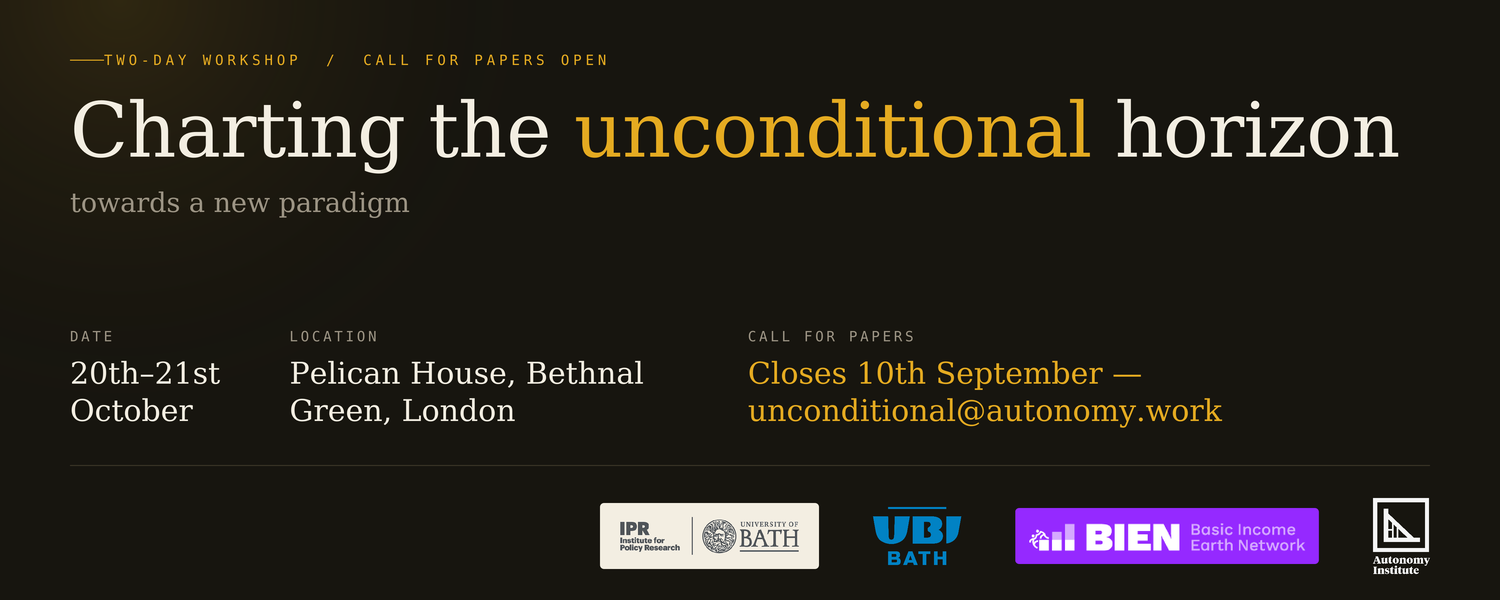
'Charting the unconditional horizon: towards a new paradigm' will be a two-day workshop at Pelican House in London on October 20th and 21st, to discuss the idea of ‘unconditionality’ with progressive stakeholders from across politics, civil society and academia. We know that neoliberalism has caused significant damage to our social, cultural and economic infrastructure and is unraveling now in dangerous ways. We also know that the Left needs a new story, a coherent narrative and a framework within which to generate policy ideas fit for 21st Century transformation.
This gathering aims to begin interrogating whether and how ‘unconditionalism’ might form (part of) that framework. It builds on well established critiques of the failures of conditionality within neoliberal policy making to ask what are the unconditional alternatives? What content does unconditionality have beyond simply being a counterfactual absence of conditionality? What are its practical, political, and philosophical implications? In concrete terms, how could unconditionality be operationalised in/as a social policy regime? Which lines, if any, will need to be drawn, by whom, and how? What are the governmental, institutional, and distributional implications of a political project built around it?
Day 1 (Tuesday) of this gathering will feature presentations from experts situated across the policy spectrum ranging from social security to health and housing. These will share their insights into the core practical questions around ‘unconditionalism’ as a paradigm and answering some of the questions above. To our knowledge, it will be the first ever such gathering to do so and will be professionally facilitated and rapporteured. Call for Papers & submission info/deadline below.
Day 2 (Wednesday), which will also be facilitated and rapporteur, will be more exploratory, with group exercises aimed at fleshing out this paradigm and identifying its strengths, limitations and possible future directions. This will begin with a presentation from Dr. Malcolm Torry on the vision for ‘unconditionalism in the 21st century’. Work on this day will focus in particular on exploring and laying foundations for a future campaign.
Day 1
Time | Session | Focus |
930-10am | Arrival | Arrivals, Sign-Ins, Coffee |
10am | Welcome | Neil Howard: Setting the Scene |
1015-1130am | Session 1: Foundations | Joel Lazarus: What Do We Know? Malcolm Torry: Definitions Tara White: Dignity Neuroscience |
1130-45am | Break | |
1145am-1pm | Session 2: Theory | Almaz Zelleke: Socialist Feminism and the Reciprocity of Care Télémaque Masson: Beyond Punishment Karl Widerquist: The Voluntary Participation Ideal Laudine Grapperon: The Gift of Trust |
1-1.45pm | Lunch | |
1.45-3pm | Session 3: Applications | Scarlett Piasecka-Penfold: Food Security Vibhor Mathur & Neil Howard: Basic Income Gabriel Hayden: The Justice System & Prison Leavers |
3-315pm | Break | |
315-5pm | Session 4: Politics | Andrew White: The Politics of Hope Liz Fouksman: Political Imaginaries & Moral Grammars Mark Drakeford: Unconditionality in Government Deborah Doane: Social Contracts and Guarantees Neal Lawson: A Horizon for the Left? |
5pm | Break | |
515pm | Film, Q&A | Screening of ‘Unconditional’; Q&A with Directors |
6pm | Reception | Pelican House Drinks Reception |
7pm | Dinner |
* All talks are 15 minutes and each session will involve time for questions and debate.
Day 2
Time | Session | Focus |
930-10am | Arrival | Arrivals, Sign-Ins, Coffee |
10am | Welcome and introductions | Introductions by Malcolm Torry and Wolfgang Wopperer |
1030-1130am | Session 1 | Working groups 1: In which economic fields could unconditionalism be applied? In which social fields could unconditionalism be applied? |
1130-45am | Break | |
1145am-1pm | Session 2 | Working groups 2: In each economic or social field, where would we like to see unconditionalism shaping policy? In each case, is it feasible? And what steps would be required to achieve the desired and feasible policy change? |
1-2pm | Lunch | |
2-330pm | Session 3 | Working groups 3: Does this bundle of policy changes constitute a new unconditionalism that might replace neoliberalism? If not, what needs to be added? What strategy is required to bring about a shift from neoliberalism to unconditionalism? What are the questions that need further consideration? |
330-345pm | Break | |
345-5pm | Session 4 | Bringing the results together, and next steps |
5pm | Finish |
Call for Papers: submissions to unconditional@autonomy.work
Charting the unconditional horizon: towards a new paradigm
Research on the failures of and damage wrought by conditionality in social policy is now well-established, coming from disciplines as varied as anthropology, sociology, political science, and economics (e.g. Walker 2015, Dwyer et al. 2022). Evidence concurs that conditionality falls short on at least five grounds. First, it is often ineffective, since targeted support excludes many of those most in need. Second, it can be inefficient, because externally imposed behavioural or categorical requirements tend to be inappropriate to people’s varied circumstances, while policing them involves costly, burdensome bureaucracies. Third, conditionality is frequently inimical to human dignity, since the administrative practices needed to maintain conditions have a tendency towards discrimination and dehumanisation. Fourth, defending conditionality, as conservatives and liberals have done with equal vigour, involves re-instantiating the ideologically pre-conditioned founding assumption of all social policy – that of scarcity, the idea that ‘there isn’t enough to go around’, meaning that we must target to avoid waste. Finally, fifth, embracing conditionality requires us to also embrace ‘deservingness’, the notion that humans can be separated into those who merit support and those who do not. This, it has been shown, plays directly into the hands of far-right populists who rule through division (e.g. De Schutter 2025). Yet for all the shared clarity around what is wrong with conditionality, little-to-no work exists articulating how and why unconditionality could function as an alternative. Indeed, to date, only one single, preliminary volume has been published on unconditionality in social policy (Torry 2024).
This two-day gathering seeks to begin filling this major gap. It asks: what is unconditionality? And how is it understood by critics of the status quo who are convinced that it needs to be central to future social security reforms? What is the concept’s positive content beyond simply being a counterfactual absence of conditionality? What are its practical, political, and philosophical implications? What is its history and what might be its future? In concrete terms, how could unconditionality be operationalised in/as a social policy regime? Which lines, if any, will need to be drawn, by whom, and how? What are the governmental, institutional, and distributional implications of a political project built around it? Philosophically, what links the idea of unconditionality to ‘The Commons’, the putative ‘zone of freedom’ where needs are met outside of disciplinary market or state mechanisms (Standing 2019)? Is unconditionality even popular, and if so, on what grounds (and with which empirical examples) in electoral democracies? These are the kinds of questions that need to be answered by scholars and advocates keen to take us beyond the documented deficiencies of neoliberal (and Keynesian) welfare structures. This conference seeks to begin developing exactly these answers, and it welcomes contributions from scholars, practitioners, and policymakers with an interest in social security and social policy in the UK and beyond.