Oppose the nomination of Michelle Park Steel as U.S. Ambassador to the Republic of Korea
U.S. Congress
SIGNATURE DEADLINE: Sign on to this petition by Friday, May 15 at 5p ET.
--
We oppose the nomination of Michelle Park Steel as U.S. Ambassador to the Republic of Korea, and call for an immediate withdrawal of her nomination.
As Korean peace advocates, we oppose the nomination of former U.S. Representative Michelle Park Steel as U.S. Ambassador to the Republic of Korea, the highest-ranking diplomatic representative of the United States to South Korea.
On undermining the prospects for lasting peace in Korea
The Korean War never ended, but was merely suspended by an armistice agreement. More than 70 years later, the absence of a peace treaty means the Korean Peninsula remains technically at war. This unresolved conflict fuels military tensions, keeps families divided, and sustains the cycle of hostility. A formal peace agreement between the United States and two Koreas would officially end the war, reduce the threat of renewed fighting, and create the foundation for lasting peace and security. A peace agreement would further strengthen global stability, open doors for economic and diplomatic cooperation in the region, and reduce rising international tensions. However, Steel’s nomination would pose a major obstacle to this path to peace.
As Congresswoman, Steel took a staunchly conservative, hardline approach to China and North Korea including by firmly opposing efforts to end the Korean War. The current Lee Jae Myung administration has expressed their intent to pursue inter-Korean dialogue in furtherance of lasting peace on the Korean peninsula. Steel’s nomination not only risks undermining building lasting peace in Korea, but also would pose a friction point for the U.S.-ROK alliance.
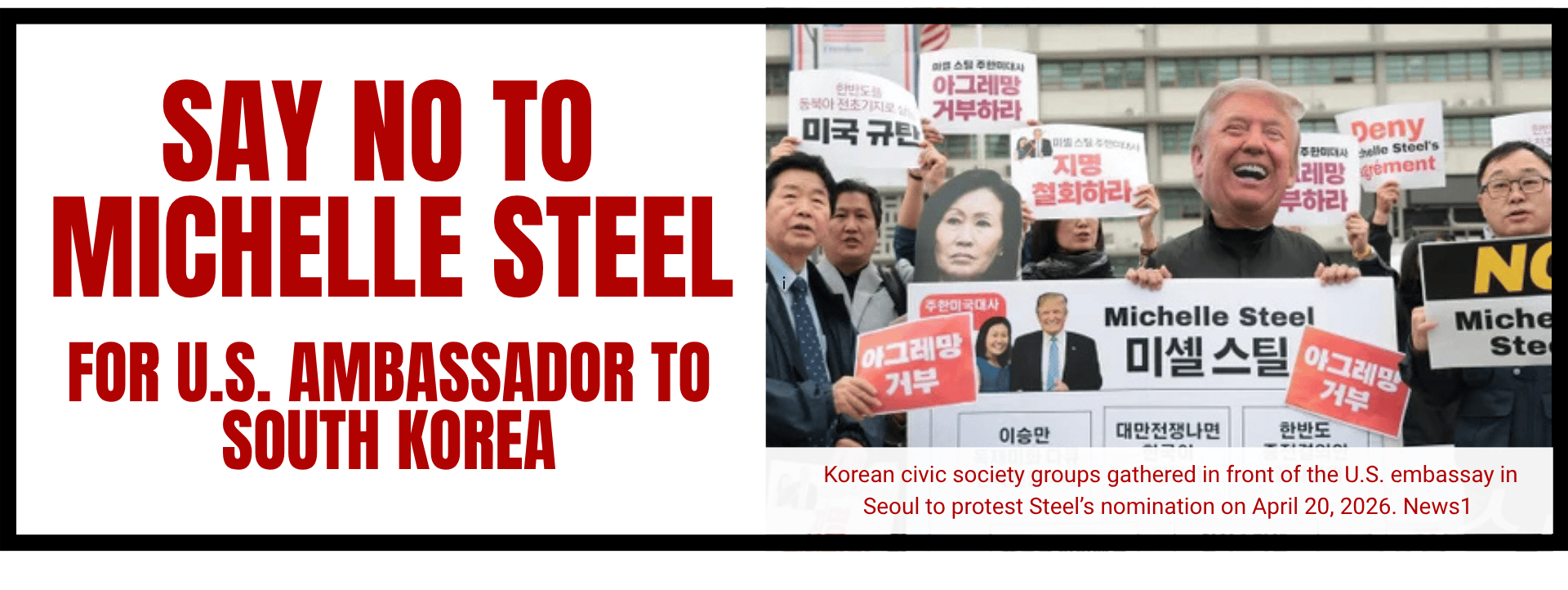
Steel does not represent the interests of the majority of U.S. voters who want peace and dialogue with North Korea. Steel's nomination has also been highly controversial and polarizing in South Korea, resulting in mass protests in front of the U.S. Embassy in Seoul. Several South Korean civic groups have raised concerns about her appointment, while some far‑right fringe groups have been energized by it in part due to her prior support of the now-impeached far right South Korean President Yoon Suk Yeol.
On the expansion of U.S. military spending and “deterrence” funding
With little prior experience or knowledge in international relations, Steel is an advocate for increased military funding and a more aggressive defense posture under the theme of “deterring North Korea” and “countering China.” She also voted for the National Defense Authorization Act (NDAA) in 2023, including advocating for the Pacific Deterrence Initiative (PDI) to deter China. Increasing military spending fuels arms races, deepens mistrust between countries, and further destabilizes international relations, not to mention diverting critical funds away from genuine peace-building initiatives.
Steel’s unquestioning support for exorbitant defense spending is not only detrimental to pursuing sustainable peace efforts, but also effectively contributes to the U.S. forever war economy, which will allow the Pentagon budget to soar to an estimated $1.5 trillion by 2027. Steel’s nomination will contribute to exacerbating tensions between the U.S. and China, thereby worsening the security crisis in East Asia and globally.
On commitment to Women, Peace, and Security
The U.S. has committed by law to advancing women's participation in peace processes, including by the Women, Peace and Security (WPS) Act of 2017. However, Steel has consistently shown that she is not interested in protecting or empowering women’s rights at home and her lackluster record offers little indication that she will ensure the U.S. abides by international law for women, peace, and security measures.
On failing to represent the interests of the Korean American and Asian American communities
If elected, Steel would be the second Korean American ever to serve as the top U.S. envoy in Seoul. Yet Steel’s troubling record of promoting divisive rhetoric and even weaponizing inflammatory “McCarthyist” imagery has directly harmed Asian American and immigrant communities. Korean American leaders – including comfort women survivors, their descendants, peace activists, and divided family members – know that Steel’s hawkish, hardline posture towards the peninsula will worsen inter-Korean and U.S.-Korea relations and foreclose possibilities for genuine diplomatic engagement that serve the interests of the communities affected.
Furthermore, Steel's nomination poses a particular risk to the most vulnerable Korean and Asian Americans – including undocumented immigrants and intercountry adoptees whose immigration status is insecure. While the ambassador does not unilaterally determine immigration enforcement in the U.S., nor directly alter the legal status of undocumented individuals, the ambassador can have real impact in in advocacy, coordination, and the willingness to elevate humanitarian concerns within diplomatic channels. Steel failed Korean American immigrant communities while in elected office and will likely be even less sympathetic when in an appointed, not elected, position.
Please note: This form is meant for U.S. constituents only. If you are based in South Korea or elsewhere, please see the Evergreen Coalition’s form.
Endorsing Organizations:
Academy of Korean Identity Movement
Action One Korea
Baltimore Nonviolence Center
Baltimore Phil Berrigan Memorial Veterans For Peace
Coming Home Collaborative
Church Women United in New York State
Environmentalists Against War
Georgia Peace Forum
In Full Color
Jesus Action
Just Foreign Policy
Justice is Global
KANCC
Korean American Network for Democracy
Korean Americans for Democracy
Korean American Peace Fund
Korea Peace Committee Philadelphia
Korea Peace Now Grassroots Network
Korea Peace Now Hawaii
Korea Policy Institute
Korea Reform Alliance
National Association of Korean Americans
Nodutdol for Korean Community Development
OC Banner Drop 4 Palestine
Orange Indivisible
Peace21
Peace Action New York State
Prutehi Guåhan
Resist US-led War Movement
Seattle Evergreen Coalition
Veterans for Peace - Spokane Chapter #35
World BEYOND War
Signees:
Elliott Adams
Jan-Paul Alon
Harold Appel
Sean Arent
Earl Arnold
johnny atlas
Charles Banfi
Eileen Bardel
Ellen Barfield
Sandra Beerends
Catherine Behrens
Becky Belcore
Steve And Benita Benitez
Dorothy Jean Beyer
Debbie Blane
Amy Blumenshine
Diana Bohn
Patricia Boiko
Dennis Bricker
Elizabeth A Brickowski
Renate Bridenthal
Carly Brook
Steve Brown
Thyais Brown-Newball
Barbara Bryce
Cynthia Burger
Dana Burke
Mike Caggiano
Edward Camerino
Yeonok Camerino
Sarah Carey
Cathy Carpenter
Paula Casner Jackman
Anne Cassebaum
Cathy Carpenter
Linda Castro
Sw Chang
Julie Chang
Haru Chang
AJ cho
Hun Cho
Myung Ji Cho
AJ Cho
Jessica Choe
MuHyeon CHOE
Hannah Choe
Cathi Choi
Jaeseok Choi
Kelly Choi
Yeonjin Choi
Jaewon Chong
David Chu
Jean Chung
Jungrea Chung
Kate Connell
Jayy Covert
Stirling Cousins
Paolo Cruzalegui
Markarya D
Kim Daeman
Jennifer Deibert
William Delzell
Stephanie Dorantes
Maud Easter
steven Edgar
Christine Ediss
Henry Em
Margaret Engel
Tasha Essen
Joseph Essertier
Eliezer Ferrell
Felicity Figueroa
Mary Miho Finley
Monaeka Flores
Maurice Forget
William Forrest
Miok Fowler
Cady Frances
Cynthia Fredrick
Ann Frisch
Derek Fung
John Fussell
Linds G
Michelle Gardner
Jenna Gebner
Nell Geiser
Jae Gianelloni
Yong Gil
Irina Gillett
Greg Giorgio
Rene Marie Gordon/Ono
Micah Grayson
Jean Ha
Mads Ha
Garam Han
Hyunsuk Han
Hyun Sil Han
Cha Hee Ro
Hoon Heo
Hoon Heo
Joanne Holman
Sarah Hong
Nan Hong
Leah Hong
Donald Hong
Duk Jin Hong
Jia Hong
Saskia Hostetler Lippy
Gina Huang
Jackie Huey
Stephanie Hurley
Hyunwoong Hwang
Hasan Isham
Alvin Ja
Karen Jacques
Ju Jaeseok
Alyna Januarius
Anna Jeong
Je Jeong
Ryan Johnson
Nahmi Jones
Sally Jones
Shweta K
Harini Kadambi
Juli Kang
Chaeho Kanzler
Willow Katz
Liz Kaufman
Kathy Kelly
Elizabeth Kelly
Christine Kelsall
Christine Khoury
Patricia Kiefner
Catherine Killough
Brian Kim
Dukho Kim
Henry Kim
Justin Kim
Jonathan Kim
Junghee Kim
Kijeong Kim
Moon Ja Kim
Thomas Kim
C. Harrison Kim
Yujin Kim
Moon Ja Kim
Moses Kim
Chunhee Kim
Sung Kim
Minja Kim
Jiyoun Kim
Jung Kim
Byeong S Kim
Sukkyung Kim
Sehoon Kim
Sang Kim
young kim
Hardy Kim
yi youn kim
Kyongchi Kim
Serena Kim
Jin Yang Kim
Eunha Kim
Junghee Kim
Yong kyu Kim
Su-jin Kim-Holmes
Grant Kobayashi
Youngkwan Kwak
Young-Ku Kwak
Hyukyang Kwon
Odal Kwon
Robin Kwon
Kevin La
Justine Laforge
Benji Lee
junghi lee
Cheol Lee
Cheol Lee
Grace Jiyun Lee
Goo Lee
Julia Lee
Kichang Lee
Miles Lee
Nanhee Lee
ELIZABETH LEE
Yong Lee
Young Lee
Youngwoo Lee
Hyun Lee
Jay Lee
Wook Jong Lee
Zyska Lee
Steve Leeper
Ramsay Liem
Paul Liem
Sunny Lim
Solby Lim
Chong Lim
Uncheon Lim
Lauren Linda
Sharon Longyear
Joellez Lopez
Linda Low
M.Brinton Lykes
Chrisinda Lynch
Jaeshin Lyu
Simon Ma
Soozi MacLeod
Zoreen Mamoon
Eric Mar
Eva Margolis
Stevie Marvin
Mike McGoff
Min Kyoung McMurray
Nancy Mendez
Theodore Mendez
Kathleen Mireault
Linda Moh
Joelene Moore
Dan Moriarty
Mary Morrissey
Zachary Murray
Virginia Myung
S. Nam
Grace Nam
Stacy Nam
Jill Nicholas
Amaru Nicholson
Mary Oberschlake
Max Obuszewski
In Hyeok Oh
Winter Oh
Christine Pae
Jin Paek
Alex Paik
Ellie Pak
Sungu Pak
Andrew Park
Sehyon Park
Joung Park
Julia Park
Ki Park
Samuel Park
Sangkyu Park
Simon Park
Won Park
Daisy Pham
Justin Philipps
Joe Piette
Nancy Pineles
Tim Pluta
Ann Podlipny
Kathy Racine
Peter Rasmussen
Raine Reilly
Summer Reyes
Robert Richard
Michael Ristig
Deborah Robinson
Jodi Rodar
Janice Rothstein
Lynn Rowe
Charles Ryu
Charles Ryu
Sally Sanders
Leo Sandy
Jean Seo Park
Margaret Schier
Sandy Shan
Haengwoo Shin
Sanghyuk Shin
Nadia Sindi
Alice Slater
Gar Smith
Hayden Smith
Mary Smith
Jaszmene Smith
Keith So
Byungsun So
Simon Sohn
Wansun Song
Lee Soyoung
Jane Stoffer
HK Suh
Jessica Sun
Nackil Sung
Mary Swan
David Swanson
Marcy Tanter
Gyver Tc
Jennifer Telfer
Larry Trover
Mark Tseng-Putterman
H Dixon Turner MD
Jae Yoon Um
So Yun Um
Yasmin Vali
Kaia Vereide
Brian Victoria
Jacqueline Villanueva
David Vine
Estelle Voeller
Lauren Warner
Robert Watada
Harold Watson
Donald Winters
Jung Mi Yang
Milan Yim
Susan Yohn
Gerry Yokota
Claire Yoo
Sootae Yoon
Jin You
Erin Young
Kim Young
Kyronn Young
Mark Zimmerman
Sponsored by
.png)
To:
U.S. Congress
From:
[Your Name]
We oppose the nomination of Michelle Park Steel as U.S. Ambassador to the Republic of Korea, and call for an immediate withdrawal of her nomination.
As Korea peace advocates, we oppose the nomination of former U.S. Representative Michelle Park Steel as U.S. Ambassador to the Republic of Korea, the highest ranking diplomatic representative of the United States to South Korea.
On undermining the prospects for lasting peace in Korea
The Korean War (1950–53) never ended but was merely suspended by an armistice agreement. More than 70 years later, the absence of a peace treaty means the Korean Peninsula remains technically at war. This unresolved conflict fuels military tensions, keeps families divided, and sustains the cycle of hostility. A formal peace agreement between the United States and two Koreas would officially end the war, reduce the threat of renewed fighting, and create the foundation for lasting peace and security. A peace agreement would further strengthen global stability, open doors for economic and diplomatic cooperation in the region, and support U.S. credibility as a leading peacemaker. However, Steel’s nomination would pose a major obstacle to this path to peace.
As a Congresswoman, Steel took a staunchly conservative, hardline approach to China and North Korea including by firmly opposing efforts to end the Korean War. The current Lee Jae Myung administration has expressed their intent to pursue inter-Korean dialogue in furtherance of lasting peace on the Korean peninsula. Steel’s nomination not only risks undermining building lasting peace in Korea, but also would pose a friction point for the U.S.-ROK alliance.
Steel does not represent the interests of the majority of U.S. voters who want peace and dialogue with North Korea. Steel's nomination has also been highly controversial polarizing in South Korea. Several civic groups have already raised concerns about her appointment, while some far‑right fringe groups have been energized by it in part due to her prior support of the now-impeached far right South Korean President Yoon Suk Yeol.
On the expansion of the U.S. military spending and “deterrence” funding
With little prior experience or knowledge in international relations, Steel is an advocate for increased military funding, and a more aggressive defense posture under the theme of “deterring North Korea” and “countering China.” She also voted for the National Defense Authorization Act (NDAA) in 2023, including advocating for the Pacific Deterrence Initiative (PDI) to deter China. Increasing military spending fuels arms races, deepens mistrust between countries, and further destabilizes international relations, not to mention diverting critical funds away from genuine peace-building initiatives.
Steel’s unquestioning support for exorbitant defense spending is not only detrimental to pursuing sustainable peace efforts, but also effectively contributes to the U.S. forever war economy, which will allow the Pentagon budget to soar to an estimated $1.5 trillion by 2027. Steel’s nomination will contribute to exacerbating tensions between the U.S. and China, thereby worsening the security crisis in East Asia and globally.
On commitment to Women, Peace, and Security
The U.S. has committed by law to advancing women's participation in peace processes, including by the Women, Peace and Security (WPS) Act of 2017. However, Steel has consistently shown that she is not interested in protecting or empowering women’s rights at home and her lackluster record offers little indication that she will ensure the U.S. abides by international law for women, peace, and security measures.
On failing to represent the interests of the Korean American and Asian American communities
If elected, Steel would be the second Korean American ever to serve as the top U.S. envoy in Seoul. Yet Steel’s troubling record of promoting divisive rhetoric and even weaponizing inflammatory “McCarthyist” imagery has directly harmed Asian American and immigrant communities. Korean American leaders – including comfort women survivors, their descendants, peace activists, and divided family members – know that Steel’s hawkish, hardline posture towards the peninsula will worsen inter-Korean and U.S.-Korea relations and foreclose possibilities for genuine diplomatic engagement that serve the interests of the communities affected.
Further, Steel's nomination poses a particular risk to the most vulnerable Korean and Asian Americans – including undocumented immigrants and intercountry adoptees whose immigration status is insecure. While the ambassador does not unilaterally determine immigration enforcement in the U.S., nor directly alter the legal status of undocumented individuals, the ambassador can have real impact in in advocacy, coordination, and the willingness to elevate humanitarian concerns within diplomatic channels. Steel failed Korean American immigrant communities while in elected office and will likely be even less sympathetic when in an appointed, not elected, position.